










Pantaloons closes 16 stores as OWND reaches 90 outlets
Key highlights
- Pantaloons closed 16 stores and opened four in Q2 FY27, leaving 387 stores in September 2026.
- Pantaloons reported Rs 1,140 crore of segment revenue in Q2 FY27.
- Pantaloons' OWND proposition grew 58% year on year and reached 90 stores.
- Pantaloons' e-commerce sales grew 19% year on year and represented about 4% of mix.
powered by IRIS
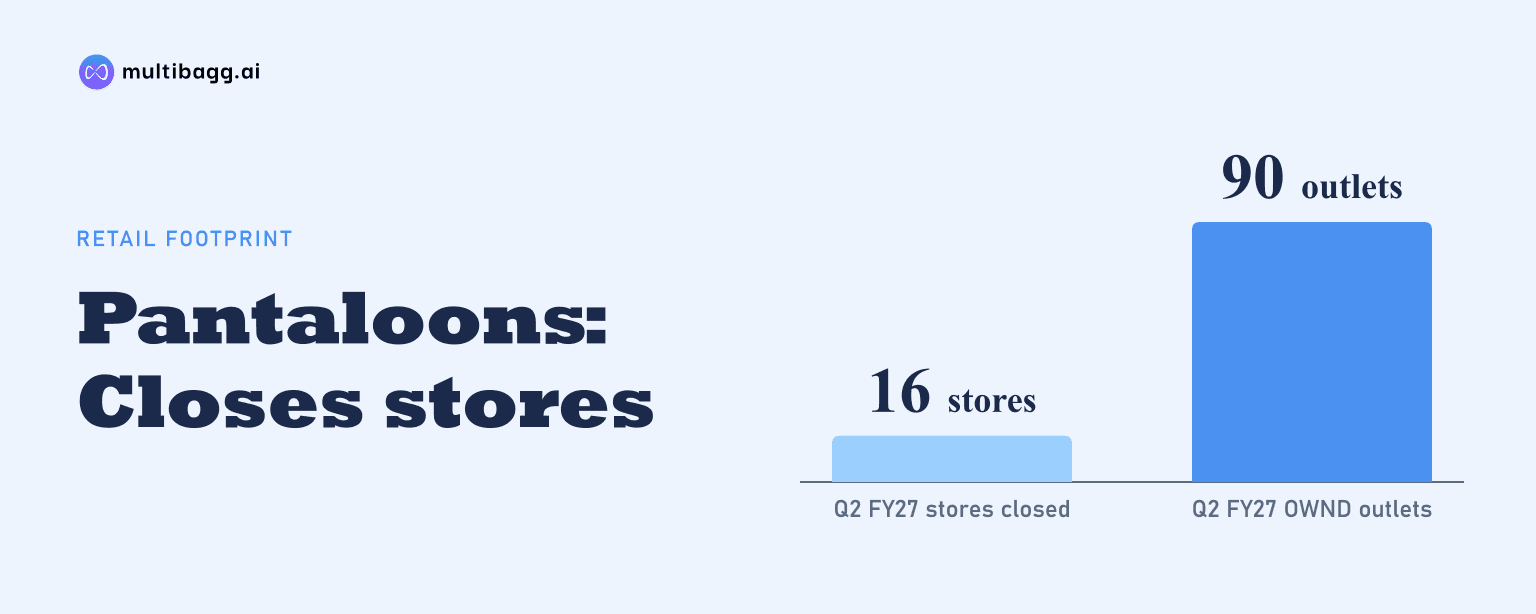
Pantaloons closed 16 stores and opened four in Q2 FY27, while its OWND proposition grew 58% year on year and reached 90 stores. The network action came during a quarter when segment revenue was Rs 1,140 crore and format like-for-like sales declined 7%, primarily after Pujo shifted into Q3 from Q2.
Know Aditya Birla Fashion & Retail inside out
Results, valuation, peers and who's buying, in one view.
Why did Pantaloons close 16 stores in Q2 FY27?
Pantaloons closed 16 stores and added four in Q2 FY27 as it sharpened distribution for what management described as quality growth. The presentation does not disclose the locations, sizes or formats of the 16 closures, but the quarter produced a net reduction of 12 stores despite the four additions.
Pantaloons had 387 stores at September 2026, down from 403 at September 2025, a year-on-year reduction of 16 stores. Retail area decreased to 5,677 thousand square feet from 5,745 thousand square feet, a reduction of 68 thousand square feet. The smaller percentage decline in area than in store count indicates that the reported network change did not involve stores of uniform size.
The 387-store network at September 2026 was lower than the prior-year count even though Pantaloons continued opening stores during Q2 FY27. Management characterised the approach as sharpening distribution, rather than disclosing a store-count target, a geographic exit plan or a schedule for further openings and closures.
What caused Pantaloons' Q2 FY27 sales pressure?
Pantaloons reported like-for-like, or LTL, sales growth of negative 7% in Q2 FY27 because Pujo shifted into Q3 and primarily affected the East region. LTL compares sales from comparable stores and therefore excludes the direct contribution of newly opened locations from the growth comparison.
The regional result differed from the overall format result: non-East markets delivered 2% LTL growth while the total format recorded a 7% decline. This creates a nine-percentage-point difference between non-East and total LTL performance, consistent with management's statement that the Pujo timing affected the East and the overall quarter.
Management said growth would have been about 6% year on year after adjusting for the festive shift and store closures. Pantaloons did not disclose the calculation behind that adjustment, East-region revenue, or the individual contribution of closures. Segment revenue for Q2 FY27 was Rs 1,140 crore.
Pantaloons used 360-degree go-to-market activations for regional festivities, naming Onam and Pujo, and management said these had generated green shoots. The presentation does not provide revenue, LTL growth or customer metrics for either festival, so their effect on the Rs 1,140 crore quarterly segment revenue cannot be quantified from the disclosure.
Got a follow-up? Ask IRIS
How is Pantaloons changing its fashion and category positioning?
Pantaloons is repositioning itself as younger and more fashion-forward, with women's western wear rising to 23% of category mix in Q2 FY27 from 20% in Q2 FY26. The company said it is raising its social-media presence through trend-led editorial storytelling as part of that fashion positioning.
Men's category share fell to 34% in Q2 FY27 from 36% a year earlier, while women's ethnic wear and kids each declined by one percentage point to 16%. Non-apparel, reported as Non-Apps, rose to 11% from 10%. Women's western wear recorded the largest disclosed change, gaining three percentage points.
The mix shifts occurred in the same Q2 FY27 in which Pantaloons reported negative 7% total-format LTL growth. The presentation links the younger positioning to social-media storytelling, but it does not report customer age data, conversion rates, product-level sales or a target mix for women's western wear.
How large is Pantaloons' OWND proposition?
Pantaloons' OWND proposition grew 58% versus last year in Q2 FY27 and was available in 90 stores by the reported period. Management said OWND continued to elevate product and consumer experience, but did not disclose its revenue, profit, average selling price or prior-year store availability.
The 90-store OWND footprint was a subset of Pantaloons' 387-store network at September 2026. That establishes its distribution reach but not its sales contribution. The presentation does not state what proportion of OWND's 58% growth came from store expansion, existing-store sales or changes in assortment.
Pantaloons reported own brands at 62% of ownership mix in both Q2 FY26 and Q2 FY27. ABFRL plus ABLL Brands declined to 11% from 12%, while Others increased to 27% from 26%. The presentation does not state whether OWND is included in the 62% own-brands category, so its growth should not be treated as the growth rate of all own brands.
What role does e-commerce play in Pantaloons' strategy?
Pantaloons' e-commerce sales grew 19% year on year in Q2 FY27 and represented about 4% of mix. The disclosed growth rate was above management's approximately 6% adjusted overall growth figure, although the two measures are not directly comparable because the latter adjusts for the festive shift and store closures.
Management paired the 19% e-commerce growth with trend-led social-media storytelling in its younger, fashion-forward positioning. The presentation does not disclose e-commerce revenue in rupees, order volumes, customer-acquisition costs or profitability, limiting assessment of the 4% digital mix within the Rs 1,140 crore segment revenue base.
Conclusion
Pantaloons' Q2 FY27 update shows a format balancing network rationalisation with investment in product distribution and fashion positioning. The chain closed 16 stores while opening four, and the September 2026 network of 387 stores was below 403 a year earlier. Against the 7% total LTL decline, non-East markets grew 2% and OWND expanded 58% to 90 stores.
The next disclosed event to watch is Q3 FY27, when Pujo, which management said shifted out of Q2, will fall into the reporting period. Management also plans festive activations around Onam and Pujo while sharpening distribution for quality growth. The presentation leaves unresolved whether the Q3 festive timing, 19% e-commerce growth and OWND's 90-store availability will translate into reported format growth.