










Paramount Communications Q2 Revenue Rises 31% to ₹560 Cr
Key highlights
- Paramount Communications reported Q2 FY27 revenue from operations of ₹560.4 crore, up 31.1% year-on-year.
- Q2 FY27 EBITDA, including other income, rose 74.2% year-on-year to ₹44.7 crore.
- Paramount Communications reported Q2 FY27 profit after tax of ₹24.2 crore and an operating margin of 7.3%.
- The company had a ₹731 crore order book as of September 30, 2026, including ₹632 crore of domestic orders.
powered by IRIS
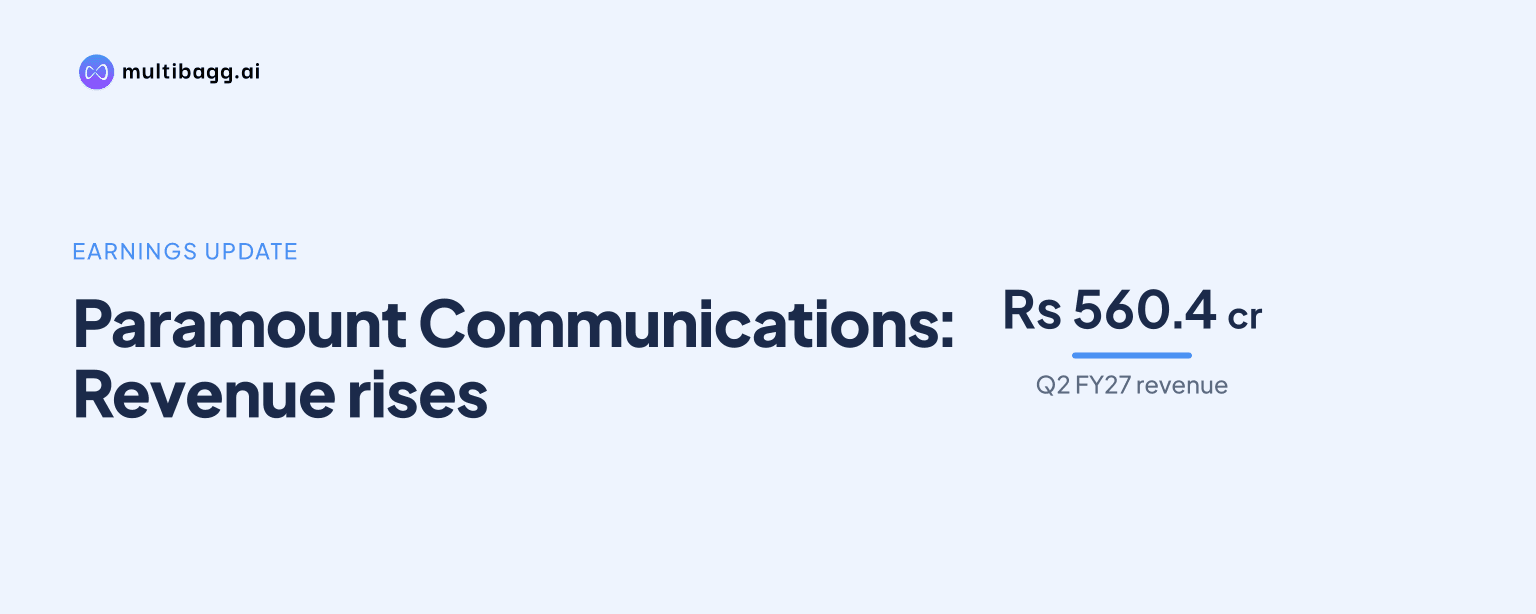
Paramount Communications Ltd reported Q2 FY27 revenue from operations of ₹560.4 crore, up 31.1% year-on-year, alongside profit after tax of ₹24.2 crore and an operating margin of 7.3%. The September-quarter performance is relevant because it combined higher sales with a substantial improvement in operating profitability and a ₹731 crore order book.
Know Paramount Communications inside out
Results, valuation, peers and who's buying, in one view.
What did Paramount Communications report for Q2 FY27?
Paramount reported revenue from operations of ₹560.4 crore for the quarter ended September 30, 2026, compared with ₹427.6 crore in Q2 FY26. Total income rose 26.1% year-on-year to ₹564.2 crore from ₹447.5 crore, according to the company's Q2 FY27 investor presentation.
The company reported EBITDA, including other income, of ₹44.7 crore, an increase of 74.2% from ₹25.6 crore a year earlier. Operating profit was ₹40.9 crore, while the operating margin stood at 7.3%. Profit after tax was ₹24.2 crore. The results were approved by the board on October 26, 2026 and cover the July-September 2026 period.
What drove Paramount Communications' revenue growth?
Paramount's reported growth came alongside a larger domestic business and continued demand across its cable and conductor operations. Domestic revenue was ₹402.3 crore in Q2 FY27, representing 71.8% of quarterly revenue. Power cables accounted for 55.9% of revenue, underlining the importance of this segment in the company's quarterly sales mix.
India B2C revenue was ₹54 crore, up 23% year-on-year from ₹44 crore. The investor presentation also identified high-temperature low-sag conductors, or HTLS, data centres, exports and higher-value products as areas of focus. The company reported a pipeline of more than ₹200 crore in HTLS conductors, though a pipeline does not represent confirmed revenue.
The available information attributes the numbers to the Q2 FY27 investor presentation. Paramount later disclosed the audio recording of its investor conference call under Regulation 30 of the SEBI Listing Obligations and Disclosure Requirements Regulations. No management guidance should be inferred from the reported financial figures alone.
What does the ₹731 crore order book indicate?
Paramount had an order book of ₹731 crore as of September 30, 2026, comprising ₹632 crore of domestic orders and ₹99 crore of export orders. Domestic orders therefore represented about 86% of the reported order book, while power cables and specialised conductors accounted for ₹575 crore.
An order book provides visibility on contracted work to be executed, but the timing of revenue recognition depends on project execution, supplies and customer schedules. The mix also shows that the company remains primarily exposed to the domestic market, even as it seeks to rebuild its export business.
Got a follow-up? Ask IRIS
What are Paramount Communications' expansion plans?
Paramount is developing a greenfield project at Narmadapuram. The company has said partial commissioning is planned for Q1 FY28. The facility is intended to add capabilities in extra-high-voltage cables, specialised conductors and electron-beam technology.
The project is part of the company's effort to increase its value-added product mix. Such capacity additions are relevant for cable manufacturers because product capability, customer approvals and execution capacity can influence participation in infrastructure, transmission and industrial projects.
The company has outlined a five-year revenue objective of ₹5,000 crore. Its stated roadmap includes strengthening domestic leadership, rebuilding exports, advancing the Narmadapuram project and improving the proportion of value-added products. This is a stated company target rather than a financial forecast established by the quarterly results.
How do the results affect investors and the cable industry?
For investors, the quarter shows that revenue growth was accompanied by improved operating profitability. EBITDA grew faster than revenue on the reported figures, while the 7.3% operating margin marked a stronger earnings profile than the prior-year comparison implied by the company's presentation. The reported debt-to-equity ratio was 0.14 times and net worth stood at ₹920 crore in H1 FY27.
For industry participants, the results point to activity in power cables, specialised conductors and domestic distribution channels. The order book's domestic concentration reflects the significance of Indian transmission, power and industrial demand to the company. Its export order book of ₹99 crore and stated effort to rebuild exports indicate that overseas business remains a smaller part of the confirmed order position.
The key operating matters disclosed by Paramount are the execution of the existing order book, progress toward partial commissioning at Narmadapuram in Q1 FY28 and the conversion of its HTLS opportunity pipeline into orders. The company has not provided a quarter-specific earnings forecast in the information available.
Conclusion
Paramount Communications delivered Q2 FY27 revenue from operations of ₹560.4 crore, 31.1% above the prior-year quarter, and reported profit after tax of ₹24.2 crore. Higher EBITDA of ₹44.7 crore, a 7.3% operating margin and a ₹731 crore order book provide the central factual markers of the quarter.
Investors will next watch execution of domestic and export orders, movement in the more than ₹200 crore HTLS pipeline and the Narmadapuram project's planned partial commissioning in Q1 FY28. Progress against the company's stated five-year ₹5,000 crore revenue objective will depend on these operating developments and the growth of its value-added portfolio.