










Park Hospitals lifts super-speciality mix 730 basis points
Key highlights
- Park Hospitals reported super-speciality mix of 63.7% in Q2 FY'27, versus 56.3% in Q2 FY'26.
- Oncology mix rose to 8.9% in Q2 FY'27 from 5.7%, while cardiology reached 12.8% from 10.2%.
- Q2 FY'27 revenue was Rs 511 crore, compared with Rs 410.2 crore in Q2 FY'26.
- Outpatient revenue mix increased to 6.7% in Q2 FY'27 from 4.3% a year earlier.
powered by IRIS
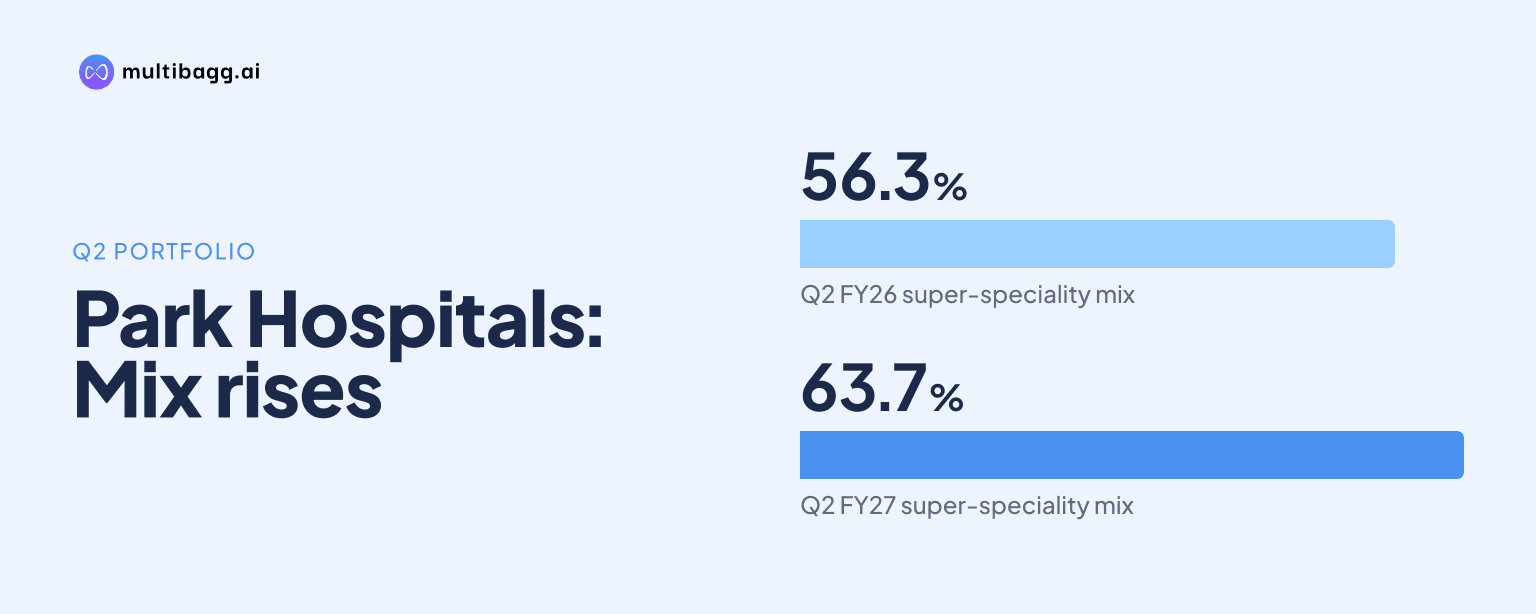
Park Medi World Limited, operating as Park Hospitals, reported that its super-speciality revenue mix increased by 730 basis points year on year to 63.7% in Q2 FY'27 from 56.3% in Q2 FY'26. Oncology, orthopaedics and cardiology recorded the largest share gains, while outpatient revenue mix increased to 6.7% from 4.3%.
Know Park Medi World inside out
Results, valuation, peers and who's buying, in one view.
Why did Park Hospitals’ super-speciality mix rise in Q2 FY'27?
Park Hospitals’ super-speciality mix rose to 63.7% in Q2 FY'27, compared with 56.3% in Q2 FY'26, which the presentation reported as a 730-basis-point year-on-year increase. The corresponding H1 FY'27 mix was 62.7%, versus 56.4% in H1 FY'26, a reported increase of 640 basis points. A basis point is one-hundredth of a percentage point.
The shift coincided with lower revenue shares for internal medicine, general surgery and other services. Internal medicine represented 25.7% of Q2 FY'27 revenue, down from 29.6% a year earlier, while general surgery declined to 4.2% from 5.9% and others fell to 6.5% from 8.1%. Park Hospitals defines internal medicine as infectious and communicable diseases, rheumatology, endocrinology, intensive care and general medicine.
Which clinical services contributed most to the mix change?
Oncology, orthopaedics and cardiology recorded the largest gains in Park Hospitals’ Q2 FY'27 speciality mix. Oncology increased to 8.9% from 5.7% in Q2 FY'26, orthopaedics increased to 7.8% from 5.9%, and cardiology increased to 12.8% from 10.2%. These services include cancer treatment, joint replacement and trauma care, and cardiac procedures such as angioplasty, bypass surgery and valve replacement.
The H1 comparison shows a similar direction of change across the three services. Oncology reached 9.0% in H1 FY'27 from 5.7% in H1 FY'26, orthopaedics reached 8.5% from 5.9%, and cardiology rose to 12.2% from 10.3%. Gastroenterology moved in the opposite direction, declining to 7.5% from 8.6%, while urology was unchanged at 10.9% and neurology declined to 14.6% from 15.0%.
Park Hospitals’ disclosed infrastructure supports several of these service lines. Its network has 18 catheterisation laboratories, or cath labs, for cardiac procedures; linear accelerators for radiation oncology; 125 dialysis units; and more than 90 operation theatres. The company also lists robotic surgical equipment, including iMARS systems at three hospitals, alongside Da Vinci, SSI Mantra, Meril and Robo Lens equipment in its technology inventory.
Got a follow-up? Ask IRIS
How did inpatient and outpatient revenue change in Q2 FY'27?
Park Hospitals remained inpatient-led in Q2 FY'27, but outpatient revenue gained share. Inpatient revenue represented 93.3% of revenue in Q2 FY'27, down from 95.7% in Q2 FY'26, while outpatient revenue increased to 6.7% from 4.3%. The presentation describes inpatient services as its primary revenue driver, covering surgeries, critical care, intensive care unit treatment and complex procedures across more than 30 specialties.
Revenue increased to Rs 511 crore in Q2 FY'27 from Rs 410.2 crore in Q2 FY'26, while the outpatient mix increased by 243 basis points. For H1, revenue rose to Rs 986.7 crore in H1 FY'27 from Rs 809 crore in H1 FY'26. Outpatient share increased to 6.2% from 4.3% in that six-month comparison, a gain of 186 basis points, while inpatient share decreased to 93.8% from 95.7%.
Outpatient services include consultations, diagnostics and minor procedures, according to Park Hospitals. Pharmacy and ancillary operations cover in-house pharmacy, diagnostics, radiology and laboratory revenue, while the company lists Employees’ State Insurance Corporation, Central Government Health Scheme, Ex-Servicemen Contributory Health Scheme and Ayushman Bharat Pradhan Mantri Jan Arogya Yojana among its payer channels.
What capacity and clinical infrastructure support this care mix?
Park Hospitals had 17 operational hospitals and 4,290 beds across 15 cities in six North Indian states as of the presentation date. The network included 1,166 intensive care unit beds, and intensive care beds made up 34% of census beds, compared with 37% general beds and 28% private or semi-private beds. The company also stated that all 17 hospitals were accredited by the National Accreditation Board for Hospitals and Healthcare Providers.
The company’s 4,290-bed capacity was split between 1,450 greenfield beds and 2,840 beds added through acquisitions. It identified six greenfield hospitals and 11 acquired hospitals among its 17 operating facilities. The 2026 additions listed in the presentation were a 350-bed greenfield hospital in Panchkula and acquisitions in Agra with 360 beds and Rudrapur with 330 beds.
Park Hospitals lists five hospitals approved for kidney transplant programmes and says nine hospitals have laboratories accredited by the National Accreditation Board for Testing and Calibration Laboratories. It also states that laboratories in four additional hospitals are planned for that accreditation. These disclosed services and equipment are relevant to the company’s oncology, cardiology, urology and critical-care offerings, though the presentation does not quantify revenue by individual hospital.
Conclusion
Park Hospitals’ Q2 FY'27 data shows a measurable change in its service and patient-setting mix: super-speciality revenue mix reached 63.7%, while outpatient revenue mix reached 6.7% of Rs 511 crore quarterly revenue. The largest speciality-share increases were in oncology, orthopaedics and cardiology, while internal medicine, general surgery and other services accounted for smaller shares than in Q2 FY'26.
The next disclosed item to watch is capacity expansion. Park Hospitals states a roadmap to reach 6,590 beds and says capacity is planned to increase by 40% in FY'27 and by about 83% by December 2028; it also plans National Accreditation Board for Testing and Calibration Laboratories accreditation for laboratories in four additional hospitals.