










Patanjali Foods sets record Rs 8,532 crore edible-oil revenue
Key highlights
- Patanjali Foods reported record Q2FY27 edible-oils revenue of Rs 8,532.25 crore, up 22.39% year on year.
- Patanjali Foods had 127,265 hectares of oil-palm area under cultivation as of September 30, 2026.
- Nearly 34% of Patanjali Foods' cultivated oil-palm area was in the 7-to-25-year prime-yielding phase.
- Patanjali Foods reported H1FY27 revenue from operations of Rs 22,660.03 crore, up 22.06% year on year.
powered by IRIS
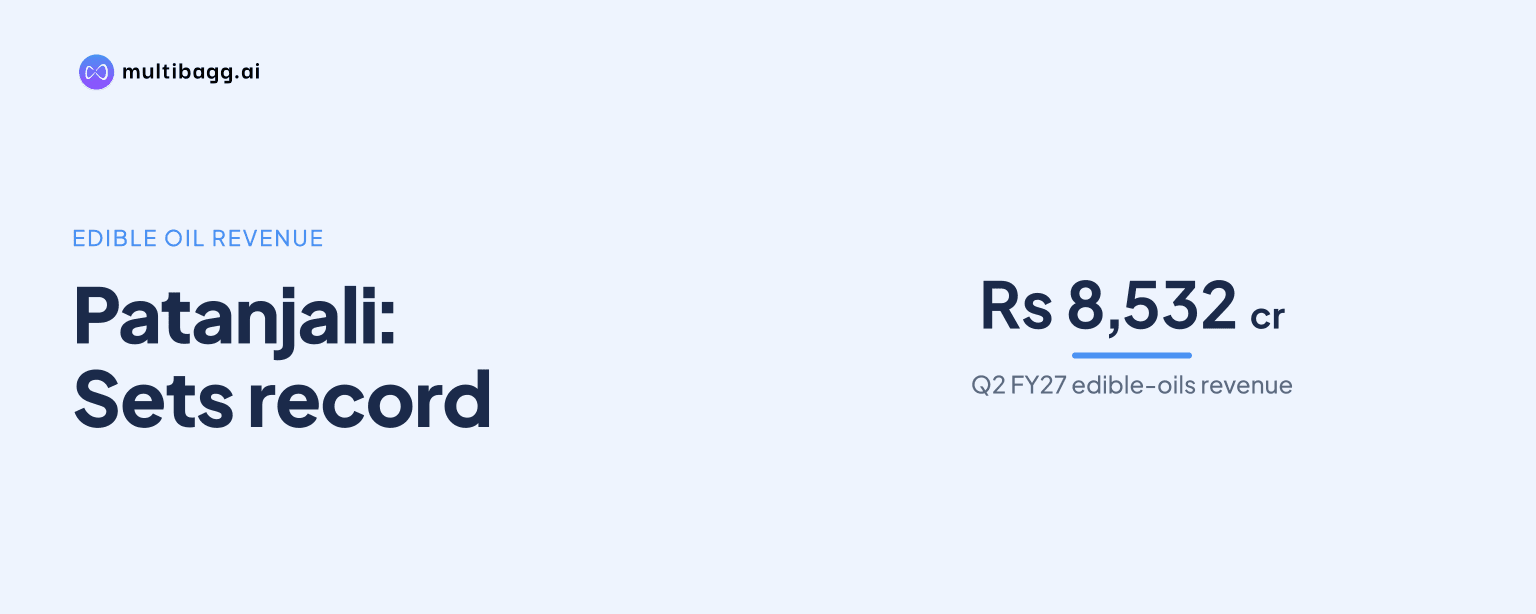
Patanjali Foods Limited recorded its highest-ever edible-oils revenue of Rs 8,532.25 crore in Q2FY27, up 22.39% year on year, while its oil-palm cultivation area reached 127,265 hectares as of September 30, 2026. Nearly 34% of this cultivated area was in the 7-to-25-year prime-yielding phase.
Know Patanjali Foods inside out
Results, valuation, peers and who's buying, in one view.
How large was Patanjali Foods' edible-oils business in Q2FY27?
Patanjali Foods' edible-oils segment generated record quarterly revenue of Rs 8,532.25 crore in Q2FY27 and recorded 22.39% year-on-year growth. The segment produced earnings before interest, tax, depreciation and amortisation, or EBITDA, of Rs 256.22 crore, equivalent to a 3.00% EBITDA margin. Its oil-palm plantation business accounted for Rs 742.29 crore of the segment's quarterly revenue.
The edible-oils business was substantially larger than the fast-moving consumer goods, or FMCG, segment in revenue terms during Q2FY27. FMCG revenue was Rs 2,923.48 crore, compared with Rs 8,532.25 crore for edible oils, although FMCG EBITDA was Rs 221.33 crore on a 7.57% margin, above the edible-oils margin. This comparison shows that edible oils supplied most segment revenue while FMCG generated a higher margin on sales.
What does Patanjali Foods' oil-palm acreage disclose?
Patanjali Foods had 127,265 hectares under oil-palm cultivation as of September 30, 2026, and nearly 34% of the area was in the prime-yielding 7-to-25-year age bracket. The company also said its total allocated plantation area was 6.63 lakh hectares, meaning the cultivated footprint represented only part of the disclosed land allocation.
The plantation operation generated Rs 742.29 crore in Q2FY27 revenue within the edible-oils segment. Patanjali Foods said it was conducting farmer-awareness seminars and dedicated outreach programmes across India to expand plantation areas. The filing does not provide a prior-period cultivation-area figure, fresh-fruit-bunch volumes, yield per hectare or a timetable for converting the remaining allocated area into cultivated plantations.
How did Patanjali Foods' revenue and profitability change in H1FY27?
Patanjali Foods reported its highest-ever half-year revenue from operations of Rs 22,660.03 crore in H1FY27, up 22.06% year on year. Operating EBITDA excluding exceptional items was Rs 969.03 crore, with a 4.28% margin, while profit before tax was Rs 862.36 crore and the associated margin was 3.79%.
In Q2FY27, revenue from operations rose 15.55% year on year to Rs 11,322.58 crore from Rs 9,798.84 crore in Q2FY26. Gross profit was Rs 1,439.14 crore, producing a 12.62% gross-profit margin, and operating EBITDA excluding exceptional items was Rs 425.63 crore at a 3.76% margin. Quarterly profit before tax reached Rs 409.02 crore, or 3.59% of revenue.
Got a follow-up? Ask IRIS
What factors affected Patanjali Foods' edible-oils market?
Patanjali Foods said global vegetable-oil markets remained firm in Q2FY27 as dry weather affected Indonesian palm-oil production and Indonesia's B50 biodiesel mandate supported domestic palm-oil demand. It also cited United States demand for soybean oil for biofuel, alongside higher soybean crushing and increased rapeseed and sunflower-seed production, as factors shaping international supply and demand.
India reduced effective import duty on crude palm oil and crude soybean oil to 11.0% from 16.5% on September 24, 2026, while the duty on crude sunflower oil was cut to 5.5% from 16.5%. Patanjali Foods also pointed to standardised edible-oil pack sizes introduced in September 2026 as a structural change that management considered supportive of transparency and organised national brands. The company did not quantify the effect of either policy measure on its Q2FY27 revenue or margin.
How important was FMCG alongside Patanjali Foods' edible oils?
Patanjali Foods' FMCG segment supplied 25.50% of revenue from operations excluding inter-segment revenue in Q2FY27, but 45.04% of EBITDA excluding unallocable income. For H1FY27, the segment's revenue contribution was 25.57% and its EBITDA contribution was 36.28%, with FMCG revenue of Rs 5,861.23 crore and EBITDA of Rs 410.85 crore.
Within FMCG, the biscuits division reported its highest-ever quarterly revenue of Rs 638.31 crore, up 27.69% year on year, with an 11.91% EBITDA margin versus 9.79% in Q2FY26. Home and personal care delivered Rs 713.88 crore of Q2FY27 revenue, up 11.06%, while consumer staples generated Rs 838.84 crore. These categories sat alongside edible oils as management pursued premiumisation, portfolio expansion and operational efficiency.
Conclusion
Patanjali Foods' Q2FY27 filing links a record Rs 8,532.25 crore edible-oils revenue result with an upstream plantation platform of 127,265 cultivated hectares. The segment's 22.39% year-on-year revenue growth helped lift total quarterly revenue to Rs 11,322.58 crore, while FMCG's 7.57% EBITDA margin remained above the 3.00% margin reported for edible oils.
The next disclosures to watch are whether Patanjali Foods expands cultivation from its 127,265 hectares toward the 6.63 lakh hectares allocated, and how the 34% of acreage already in the 7-to-25-year prime-yielding range develops. Management also said it expects growth momentum to continue through the recent festive period and upcoming wedding season while it scales edible oils, FMCG and oil-palm plantations.