










PGIL Bangladesh plant adds 7 million pieces of capacity
Key highlights
- PGIL inaugurated a Bangladesh plant that will add about 7 million pieces of annual capacity at optimum utilisation.
- PGIL plans to invest about Rs 675-725 crore between FY27 and FY30.
- PGIL's H1FY27 consolidated revenue rose 31.1% year on year to Rs 3,330 crore.
- PGIL shipped 43.6 million pieces in H1FY27, compared with 37.1 million pieces in H1FY26.
powered by IRIS
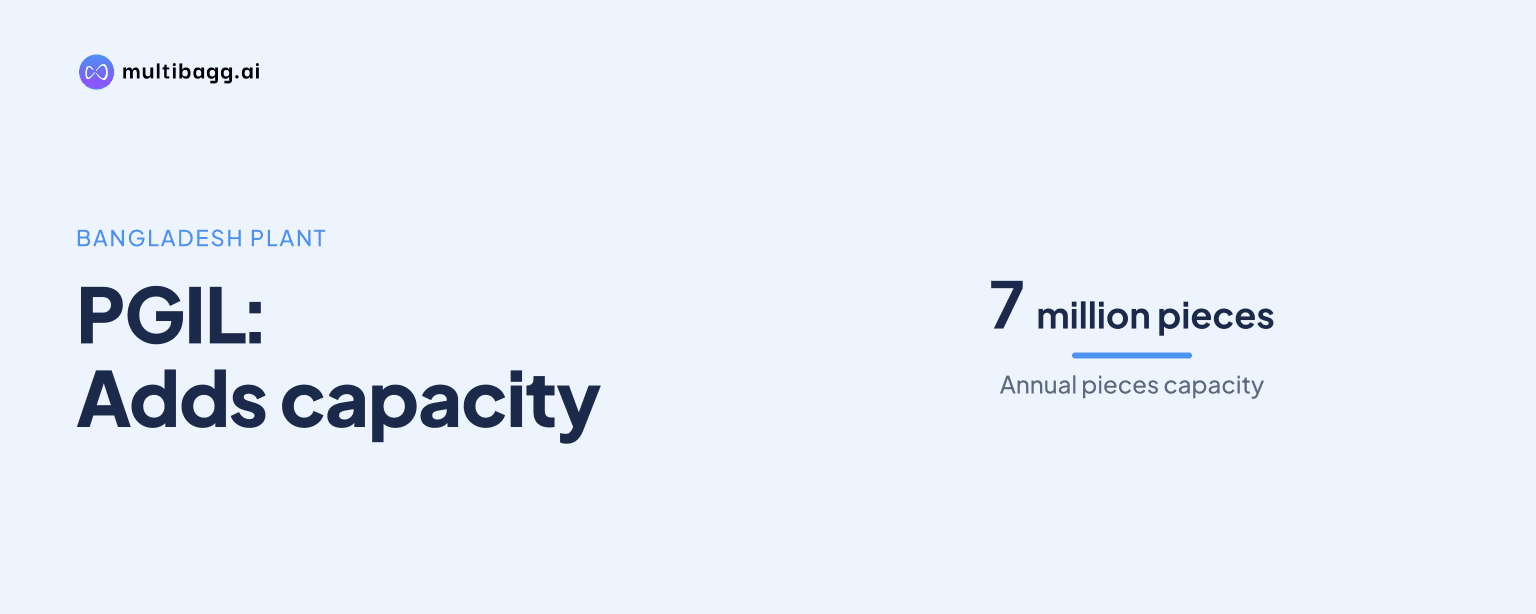
Pearl Global Industries Limited (PGIL) inaugurated a Bangladesh manufacturing plant in H1FY27 that will add about 7 million pieces of annual capacity at optimum utilisation, alongside a planned Rs 675-725 crore investment programme for FY27 to FY30. Management said the programme supports its aspirational FY30 revenue target of Rs 9,000-10,000 crore.
Know Pearl Global Industries inside out
Results, valuation, peers and who's buying, in one view.
What capacity does PGIL's Bangladesh plant add?
PGIL said the newly inaugurated Bangladesh facility will add about 7 million pieces of annual capacity at optimum utilisation. The announcement identified the inauguration as an H1FY27 development, when PGIL shipped 43.6 million pieces, compared with 37.1 million pieces in H1FY26, an increase of 6.5 million pieces.
The new facility is part of PGIL's existing cross-border manufacturing platform. PGIL reported 26 manufacturing units across India, Bangladesh, Vietnam, Indonesia and Guatemala, with total annual capacity of about 108 million pieces at optimum utilisation, including owned and outsourced facilities.
The company did not disclose the new plant's commissioning date, investment cost, product mix or expected output in FY27. PGIL makes knits, woven garments, denim, outerwear, activewear and athleisure, but the release does not identify which of these product categories will be made at the Bangladesh unit.
Management said the additional Bangladesh capacity is intended to strengthen PGIL's sourcing platform and provide customers with greater flexibility, scalability and supply-chain resilience. The 7 million-piece measure represents potential annual capacity at optimum utilisation, rather than a disclosed forecast of plant production, shipments or revenue.
How much does PGIL plan to invest through FY30?
PGIL plans to invest about Rs 675-725 crore between FY27 and FY30, according to Vice-Chairman and Non-Executive Director Pulkit Seth. Management said the programme is expected to strengthen supply-chain integration, improve operational efficiencies and support sustainable margin expansion.
The Rs 9,000-10,000 crore FY30 figure is management's aspirational revenue target, not reported revenue or a confirmed sales forecast. PGIL did not provide a year-by-year capital expenditure schedule, project allocation by country, funding mix or expected financial return from the Rs 675-725 crore plan.
PGIL reported cash and bank balances of Rs 534 crore at September 30, 2026, excluding cash earmarked for letter-of-credit payments, plus Rs 104 crore invested in mutual funds. This resulted in total reported cash and mutual-fund investments of Rs 638 crore, while net worth was Rs 1,634 crore, compared with Rs 1,438 crore at March 31, 2026.
The release does not state that the reported Rs 638 crore balance will fund the FY27-FY30 investment programme. It does state that PGIL's holding company received about Rs 22.5 crore of dividends in H1FY27 from NorpKnit Industries Limited, its Bangladesh subsidiary, and Pearl Global (HK) Limited, its Hong Kong subsidiary.
Got a follow-up? Ask IRIS
What were PGIL's results when the plant opened?
PGIL reported consolidated revenue of Rs 3,330 crore for H1FY27, up 31.1% year on year, as the Bangladesh facility was inaugurated. Adjusted earnings before interest, tax, depreciation and amortisation (EBITDA), excluding employee stock-option-plan expense, increased 47.7% to Rs 348 crore, while profit after tax (PAT) rose 63.6% to Rs 225 crore.
The H1FY27 adjusted EBITDA margin was 10.5%, which PGIL said was its highest for a first-half period and about 120 basis points higher year on year. A basis point is one-hundredth of a percentage point. The higher first-half revenue coincided with shipment growth to 43.6 million pieces from 37.1 million pieces a year earlier.
For Q2FY27, PGIL reported revenue of Rs 1,802 crore, up 37.2% year on year, adjusted EBITDA of Rs 184 crore, up 51.1%, and PAT of Rs 126 crore, up 74.7%. The quarterly adjusted EBITDA margin was 10.2%, about 90 basis points above Q2FY26 and 30 basis points below the 10.5% H1FY27 margin.
PGIL also declared an interim dividend of 5 rupees per equity share for H1FY27. The company said this was 100% of face value and represented a payout ratio of about 20.6% relative to group PAT.
How does PGIL link the expansion to its sourcing network?
PGIL said the Bangladesh plant reinforces a manufacturing network across five countries: India, Bangladesh, Vietnam, Indonesia and Guatemala. The group reported about 108 million pieces of annual capacity across its 26 units, including own and outsourced facilities, at optimum utilisation.
The company described its revenue structure as primarily export based, serving customers in the United States, European Union, United Kingdom, Japan, Australia and Canada. Its product offering spans knits, woven garments, denim, outerwear, activewear and athleisure, with the release describing PGIL as a supplier of total supply-chain solutions.
Managing Director Pallab Banerjee said recently acquired customer programmes continued to scale during Q2FY27, when revenue reached Rs 1,802 crore. He also said PGIL had seen customer interest after the conclusion of the India-UK Free Trade Agreement, while describing the proposed India-EU Free Trade Agreement as having potential to improve Indian apparel manufacturers' competitiveness.
These comments are management's assessment of commercial conditions rather than disclosed order commitments. PGIL said it entered the second half of FY27 with a robust order pipeline and expanded manufacturing footprint, but did not quantify the pipeline or specify revenue expected from newly acquired customer programmes.
Conclusion
PGIL's Bangladesh plant adds about 7 million pieces of annual capacity to a network already reported at about 108 million pieces a year across 26 units. The expansion was disclosed alongside H1FY27 revenue of Rs 3,330 crore, 31.1% higher year on year, and shipments of 43.6 million pieces, up from 37.1 million pieces.
The next disclosed measure is execution of the Rs 675-725 crore investment plan between FY27 and FY30 and progress towards management's Rs 9,000-10,000 crore FY30 revenue ambition. Future disclosures could clarify the Bangladesh plant's utilisation, investment allocation and contribution to output, while PGIL's stated order pipeline and customer programmes remain relevant through the second half of FY27.