










Piccadily Agro Industries Ltd. alcobev share hit 44.2% FY26
Key highlights
- Branded alcobev revenue increased from Rs 10 crore in FY22 to Rs 502 crore in FY26.
- Branded alcobev’s revenue share rose from 1.7% in FY22 to 44.2% in FY26.
- Distillery EBITDA margin increased from 19.3% in FY23 to 31.5% in FY26.
- Sugar’s revenue share declined from 52.3% in FY22 to 20.5% in FY26.
powered by IRIS
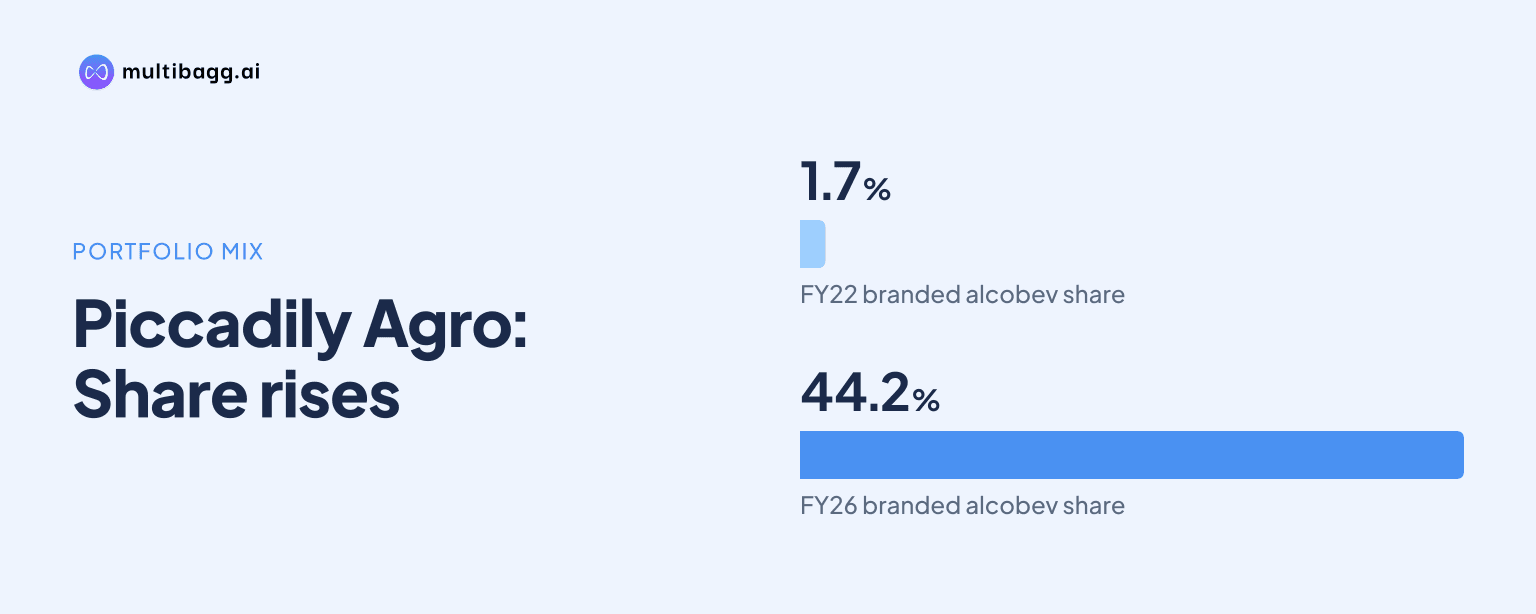
Piccadily Agro Industries Ltd.'s branded alcobev products accounted for 44.2% of revenue in FY26, up from 1.7% in FY22, after segment revenue rose from Rs 10 crore to Rs 502 crore. Over FY23 to FY26, its distillery EBITDA margin increased from 19.3% to 31.5%.
Know Piccadily Agro Industries inside out
Results, valuation, peers and who's buying, in one view.
What changed in Piccadily Agro’s revenue mix?
Piccadily Agro’s revenue mix shifted from sugar- and other-distillery-led sales in FY22 to branded alcobev as its largest reported segment in FY26. Branded alcobev represented 44.2% of FY26 revenue, ahead of other distillery at 35.2% and sugar at 20.5%.
Sugar was the largest segment in FY22, contributing Rs 301 crore and 52.3% of revenue, while branded alcobev supplied Rs 10 crore and 1.7%. By FY26, sugar revenue was Rs 233 crore and its share had fallen by 31.8 percentage points, while branded alcobev’s share had risen by 42.5 percentage points.
Other distillery, which comprises ethanol, extra neutral alcohol (ENA), IML, business-to-business malt and other products, remained a substantial revenue source. Its revenue increased from Rs 264 crore in FY22 to Rs 400 crore in FY26, although its share declined by 10.7 percentage points as branded alcobev revenue expanded faster.
How quickly did Piccadily Agro’s branded alcobev revenue grow?
Piccadily Agro’s branded alcobev revenue rose by Rs 492 crore between FY22 and FY26, reaching Rs 502 crore after four consecutive annual increases. The reported sequence was Rs 10 crore in FY22, Rs 77 crore in FY23, Rs 272 crore in FY24, Rs 380 crore in FY25 and Rs 502 crore in FY26.
Annual growth was highest in the earlier years, with branded revenue rising 670.0% year on year in FY23 and 253.2% in FY24. Growth then moderated to 39.8% in FY25 and 32.1% in FY26 as the revenue base increased from Rs 272 crore to Rs 502 crore.
The presentation labels the Rs 502 crore FY26 figure as revenue from premium spirits and reports a 166% compound annual growth rate from FY22 to FY26. It also identifies Indri, Camikara, Cashmir and Whistler as branded products, whose sales volumes grew 38% year on year in Q2 FY2026-27.
Piccadily Agro reported net sales realisation of Rs 9,274 per case for its branded alcobev business in H1 FY2026-27 and Rs 8,797 per case in Q2 FY2026-27. The presentation provides these revenue-per-case measures but does not disclose comparable branded case volumes for the FY22-FY26 segment-revenue series.
Got a follow-up? Ask IRIS
How did Piccadily Agro’s margins change as the mix shifted?
Piccadily Agro’s distillery EBITDA margin increased to 31.5% in FY26 from 19.3% in FY23, a rise of 12.2 percentage points. EBITDA, or earnings before interest, tax, depreciation and amortisation, margin for the company increased from 10.0% to 23.4% over the same period.
The distillery margin rose in each year shown, from 19.3% in FY23 to 26.9% in FY24, 30.2% in FY25 and 31.5% in FY26. In contrast, sugar reported a negative 4.6% EBITDA margin in FY26, compared with a positive 1.5% in FY24.
Management states that distillery margin will depend on branded alcobev’s share of sales and, within that category, the proportion of premium and luxury products. The presentation therefore identifies sales mix as the mechanism affecting future distillery margins, but gives no numerical margin target beyond the FY26 result of 31.5%.
What supports Piccadily Agro’s next branded-alcobev phase?
Piccadily Agro completed expansions at its Indri and Chhattisgarh facilities by Q2 FY2026-27, according to the presentation. The Indri site has stated capacity of 30 kilolitres per day for malt and 420 kilolitres per day for ENA and ethanol, while excise approval to use full Indri capacity remains in progress.
The company reported 96,000 barrels, with additional procurement under way and new maturation halls built to hold more barrels. Since April 2026, it has launched Indri ilka and Indri Diwali Collector’s Edition 2026, the latter using near-field communication bottle authentication.
Distribution covered 29 states and union territories, including CSD, and more than 25,700 retail outlets including on-trade outlets in Q2 FY2026-27. The presentation also cited 33 countries, 23 Indian duty-free locations and 20 international duty-free locations for its branded products.
At Chhattisgarh, sales of IMIL had commenced, and management said volumes would scale over the following six months. Ethanol production and sales had also started, while branded alcobev launches from the site were described as forthcoming and part of the company’s national-expansion strategy.
Conclusion
Piccadily Agro’s FY22-FY26 segment data show that branded alcobev moved from Rs 10 crore, or 1.7% of revenue, to Rs 502 crore, or 44.2%. During the FY23-FY26 period, distillery EBITDA margin rose from 19.3% to 31.5%, while sugar’s revenue share declined from 52.3% to 20.5%.
The next disclosed markers are utilisation of the expanded Indri and Chhattisgarh facilities, the planned six-month scaling of Chhattisgarh IMIL volumes and branded-product launches from that facility. Management also expects the sugar demerger to be finalised over the coming months, after which losses attributable to the sugar division would no longer be reflected in the company’s financials.