










Piccadily Q2 PBT fell 13% despite 19% total income growth
Key highlights
- Piccadily’s Q2 FY27 total income rose 19.0% year on year to Rs 278.9 crore.
- Q2 FY27 distillery revenue increased 30.5% to Rs 271.3 crore, while sugar revenue declined 73.4% to Rs 6.6 crore.
- Piccadily’s Q2 FY27 finance costs rose 78.5% to Rs 11.6 crore and depreciation increased 67.7% to Rs 10.4 crore.
- H1 FY27 profit before tax declined 2.1% to Rs 59.7 crore despite a 19.1% increase in total income to Rs 552.5 crore.
powered by IRIS
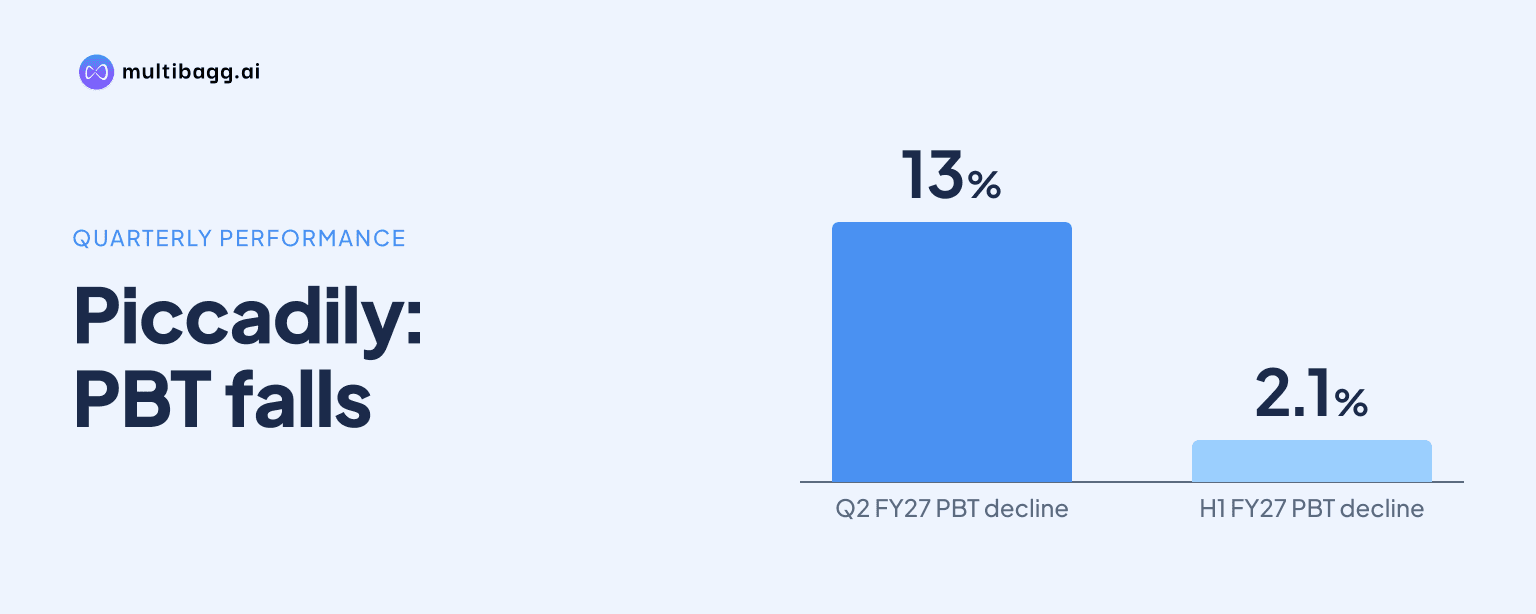
In Q2 FY27, Piccadily’s total income rose 19.0% year on year to Rs 278.9 crore, while profit before tax fell 12.9% to Rs 31.0 crore. Finance costs increased 78.5%, depreciation and amortisation rose 67.7%, and distillery revenue grew 30.5%, according to its earnings presentation.
Know Piccadily Agro Industries inside out
Results, valuation, peers and who's buying, in one view.
What drove Piccadily’s Q2 FY27 revenue growth?
Piccadily’s Q2 FY27 revenue growth was led by a 30.5% increase in distillery revenue to Rs 271.3 crore, which offset a 73.4% decline in sugar revenue to Rs 6.6 crore. Revenue from operations rose 19.4% to Rs 277.9 crore from Rs 232.7 crore in Q2 FY26. Other income fell to Rs 1.0 crore from Rs 1.6 crore, taking total income to Rs 278.9 crore.
The operating mix shifted towards distillery activity in Q2 FY27. Distillery revenue was Rs 271.3 crore, compared with Rs 207.9 crore a year earlier, while sugar revenue fell from Rs 24.8 crore to Rs 6.6 crore. Piccadily reported net sales realisation, or NSR, of Rs 8,797 per case for its branded alcoholic beverages business and said revenue from Chhattisgarh had started to grow.
Why did Piccadily’s profit before tax decline in Q2 FY27?
Piccadily’s profit before tax declined because finance costs and depreciation rose faster than earnings before interest, tax, depreciation and amortisation, or EBITDA. EBITDA increased by Rs 4.6 crore to Rs 53.0 crore, while finance costs increased by Rs 5.1 crore to Rs 11.6 crore and depreciation and amortisation increased by Rs 4.2 crore to Rs 10.4 crore. The combined increase in those two charges was Rs 9.3 crore.
Total expenses rose 21.6% to Rs 226.0 crore, exceeding the 19.0% increase in total income. Material costs rose 65.4% to Rs 176.3 crore, excise duty increased 66.8% to Rs 34.2 crore, and power and fuel costs rose 39.9% to Rs 22.1 crore. Changes in inventories were negative Rs 64.6 crore, compared with negative Rs 1.8 crore in Q2 FY26.
EBITDA margin, measured against net revenue from operations, declined 110 basis points to 21.7% from 22.8%. Profit-before-tax margin fell 410 basis points to 11.1% from 15.2%, while profit after tax declined 9.0% to Rs 24.2 crore. Earnings per share fell 12.1% to Rs 2.46 from Rs 2.80.
How did Piccadily’s first-half earnings compare with last year?
Piccadily’s H1 FY27 total income rose 19.1% to Rs 552.5 crore, but profit before tax declined 2.1% to Rs 59.7 crore from Rs 61.0 crore in H1 FY26. Revenue from operations increased 18.8% to Rs 548.7 crore and EBITDA rose 14.5% to Rs 100.3 crore. EBITDA growth therefore did not translate into higher pre-tax profit for the six-month period.
Finance costs increased 34.4% to Rs 20.3 crore in H1 FY27, while depreciation and amortisation rose 78.1% to Rs 20.3 crore. Total expenses increased 20.2% to Rs 452.2 crore, compared with 19.1% growth in total income. H1 EBITDA margin was 20.2%, down 30 basis points, and profit-before-tax margin was 10.8%, down 230 basis points.
Profit after tax increased 1.2% to Rs 46.0 crore because tax expense increased 1.3% to Rs 15.7 crore, despite the decline in pre-tax profit. The H1 profit-after-tax margin fell 150 basis points to 8.3%, and earnings per share declined 2.5% to Rs 4.67. Employee benefit expense included an employee stock option plan charge of Rs 3.28 crore in H1 and Rs 0.81 crore in Q2.
Got a follow-up? Ask IRIS
What expansion costs and plans does Piccadily identify?
Piccadily attributed the Q2 increase in depreciation to the commissioning of expansions at its Indri distillery and Chhattisgarh distillery. Depreciation and amortisation was Rs 10.4 crore in Q2 FY27, up from Rs 6.2 crore in Q2 FY26. The company said post-commissioning expenditure in Chhattisgarh related to production and that these initial costs affected Q2 profitability.
Management said revenue realisation from the relevant Chhattisgarh production is expected to commence in Q3 and contribute through Q4 and beyond. Sales of Indian-made Indian liquor, or IMIL, have commenced, and management expects volume to scale over the next six months. Ethanol production and sales have also commenced, while branded alcoholic beverage launches are planned.
Piccadily reported 30 kilo litres per day of malt capacity and 420 kilo litres per day of ethanol and extra neutral alcohol capacity across Haryana and Chhattisgarh. It had 96,000 barrels under maturation, with additional procurement ongoing. The company said capacity utilisation at Indri and Chhattisgarh was being increased in line with requirements.
How is Piccadily’s product mix changing?
Piccadily reported 38% year-on-year volume growth in Q2 FY27 for branded products including Indri, Camikara, Cashmir and Whistler. Its branded alcoholic beverages NSR was Rs 9,274 per case in H1 FY27, compared with Rs 8,797 per case in Q2 FY27. Distribution covered 29 Indian states and union territories, more than 25,700 retail and on-trade outlets, 33 countries and 43 duty-free outlets.
The revenue composition disclosed for FY22 to FY26 shows a larger contribution from branded alcoholic beverages. Branded alcoholic beverages revenue rose from Rs 10 crore, or 1.7% of revenue, in FY22 to Rs 502 crore, or 44.2%, in FY26. Sugar revenue declined from Rs 301 crore, or 52.3%, to Rs 233 crore, or 20.5%, while other distillery revenue rose from Rs 264 crore to Rs 400 crore.
Conclusion
Piccadily’s Q2 FY27 result combined Rs 45.2 crore of additional revenue from operations with a 12.9% fall in profit before tax. Distillery revenue rose by Rs 63.4 crore, but the Rs 9.3 crore combined increase in finance costs and depreciation and amortisation exceeded the Rs 4.6 crore increase in EBITDA. H1 profit before tax also declined 2.1% despite 19.1% total-income growth.
The next disclosed milestones are expected Chhattisgarh revenue realisation from Q3, contribution through Q4 and beyond, and management’s plan to scale IMIL volume over six months. Piccadily also expects the sugar division demerger to be finalised over the coming months; management said sugar-related losses would no longer be reflected in its financials after completion.