










P N Gadgil Jewellers Limited says franchises can lift EBITDA margin
Key highlights
- PNG said a 50-basis-point quarter-on-quarter gross-margin decline was linked to higher franchise mix.
- PNG said franchise rentals and store operating costs sit in the franchisee's profit and loss account.
- A PNG showroom typically requires Rs 50 crore to Rs 55 crore of inventory, or about 30 kilograms to 32 kilograms.
- Management said PNG employs hardly any capital in franchise outlets and expects ROCE to improve as the channel becomes meaningful.
powered by IRIS
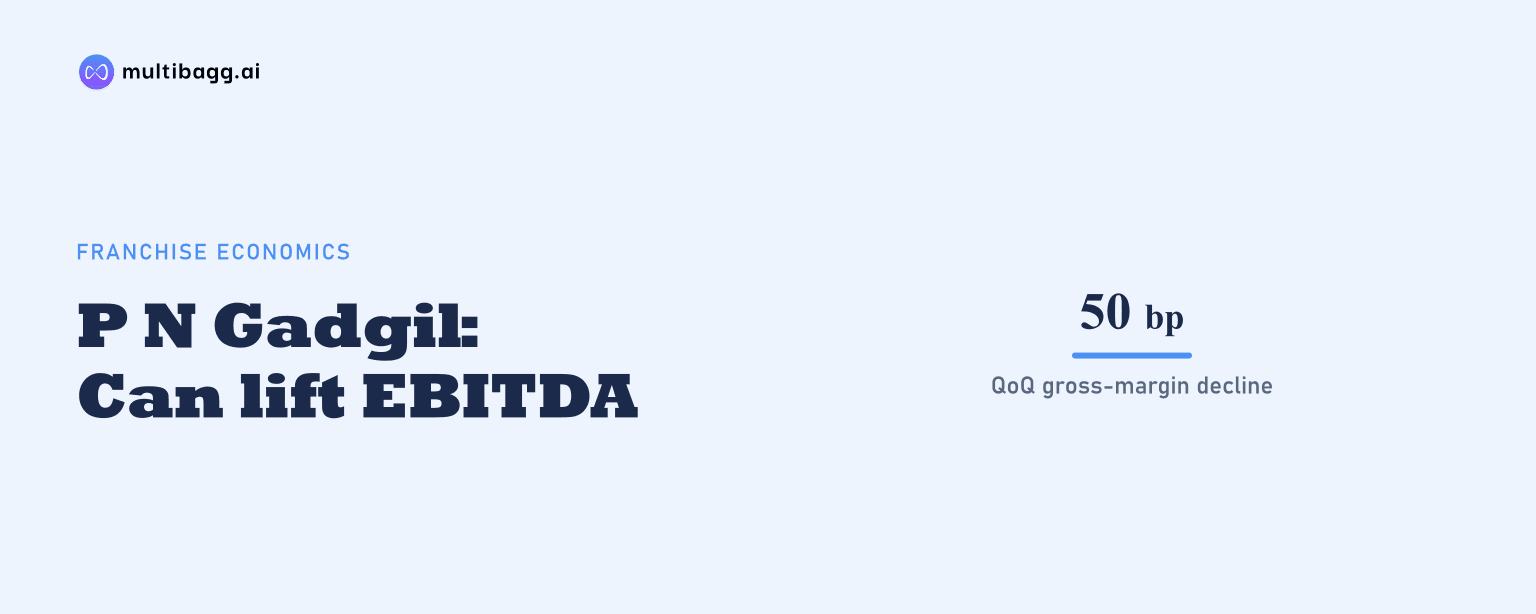
P N Gadgil Jewellers Limited (PNG) said a 50-basis-point quarter-on-quarter gross-margin decline linked to higher franchise mix can still improve earnings before interest, tax, depreciation and amortisation (EBITDA) margin because franchisees carry store operating costs and PNG employs hardly any capital in those outlets. Management said a showroom typically needs Rs 50 crore to Rs 55 crore of inventory.
Know P N Gadgil Jewellers inside out
Results, valuation, peers and who's buying, in one view.
Why does PNG's franchise mix dilute gross margin?
PNG said a higher franchise mix dilutes gross margin, and an analyst on the call cited a 50-basis-point quarter-on-quarter decline as franchise sales increased. Management did not disclose a separate gross-margin percentage for franchise outlets or a gross-margin target for FY '27 or FY '28.
The franchise arrangement starts with an inventory sale when a store opens. PNG said it makes one sale on day 0, followed by replenishment sales as the franchise store trades, while describing this approach as an industry practice. Management put the inventory requirement for an average showroom at about Rs 50 crore to Rs 55 crore.
That initial inventory requirement is also substantial in physical terms. Management estimated a typical showroom needs about 30 kilograms to 32 kilograms of jewellery inventory, although the quantity depends on the mix of 14-karat, 18-karat and 22-karat products. PNG did not quantify the margin earned on either the opening sale or subsequent replenishment.
How can franchise expansion improve PNG's EBITDA margin?
PNG said franchise expansion can improve EBITDA margin despite gross-margin dilution because rentals, other expenses and the cost of operating franchise stores do not enter PNG's profit and loss account. Those costs instead sit in the franchisee's profit and loss account, according to management.
The different treatment of revenue and costs explains the stated trade-off. Management said gross margin had shifted on a quarter-on-quarter basis, while other expenses had come down because PNG did not incur the cost of operating those franchise outlets. It added that this relationship was included in the forecast calculations discussed during the call.
PNG separately reported a controlled operating-expense run rate in its own business. Other expenses were Rs 85 crore in the preceding quarter and Rs 86 crore in the reported quarter, with promotion discounts and advertising included in that category. Management said it had recalibrated these expenses and expected similar moderation in the second half.
The second-half expense expectation is distinct from the franchise model. Management linked the expected moderation to rationalised advertising and campaign discounts, whereas the franchise benefit arises because rental and store-operation costs are incurred by the franchisee. Neither point was accompanied by a standalone EBITDA-margin target for the franchise channel.
Got a follow-up? Ask IRIS
Why does PNG expect a ROCE benefit from franchises?
PNG expects return on capital employed (ROCE) to improve yearly once the franchise business becomes meaningful because it employs hardly any capital in franchise outlets. Management did not disclose a current ROCE figure, a target ROCE percentage or the franchise share required for the channel to become meaningful.
The inventory transaction is central to management's explanation. PNG sells inventory when a franchise store opens, then supplies replenishment, instead of carrying the full Rs 50 crore to Rs 55 crore showroom inventory requirement for that outlet. Management said there is hardly any capital employed by PNG in the franchise format.
By comparison, a company-operated outlet would leave its store operating costs in PNG's profit and loss account, while franchise rentals and other store expenses are borne by the franchisee. Management's expected ROCE improvement is therefore a forward-looking view based on lower capital employed, rather than a reported result for the 30-kilogram to 32-kilogram inventory model.
What forecasts and store assumptions has PNG disclosed?
PNG said its franchise economics were considered in the forecast numbers discussed on the call, but it did not disclose franchise revenue, store count, EBITDA margin or gross-margin guidance for FY '27 or FY '28. Management's company-level current guidance was revenue above Rs 13,000 crore and a profit-after-tax margin of 4% to 4.2%.
For its longer-term planning, management described a three-year plan as aspirational and initially said revenue should be above Rs 17,000 crore, with a compound annual growth rate of about 25% from FY '27 to FY '29. Later in the same exchange, management said its detailed estimates indicated revenue of around Rs 21,000 crore by FY '29, based on planned store openings, legacy stores and the YOOU format.
Management's store assumptions distinguish mature outlets from newer ones. It estimated same-store sales growth of 7% to 8% for mature stores without a gold-price increase, while a new store completing one stock turn in year 1 is expected to reach 1.8 to 2 turns in year 2 and 2.5 turns in year 3. These are management planning assumptions, not reported same-store sales results.
Conclusion
PNG's franchise model changes the location of costs and capital rather than removing the operating requirements of a jewellery store. The 50-basis-point quarter-on-quarter gross-margin decline cited on the call is the near-term trade-off, while management expects lower rentals, lower other expenses and limited capital employed to support EBITDA margin and ROCE.
The next item to watch is whether franchise operations become meaningful enough to produce the yearly ROCE improvement management expects, without a disclosed timetable or current franchise share. Execution against revenue guidance above Rs 13,000 crore, the 4% to 4.2% profit-after-tax margin range, and the FY '29 estimate of around Rs 21,000 crore will provide further evidence of how the model is developing.