










PNG plans internal funding for FY28 company-owned stores
Key highlights
- PNG plans a 50:50 company-owned and franchisee store mix from FY28.
- PNG expects to add around 30 to 35 stores annually from FY28.
- PNG targets a 20% to 25% reduction in borrowings by FY30.
- PNG reported a Rs 167 crore reduction in net borrowings in Q2 FY27, including QIP funds.
powered by IRIS
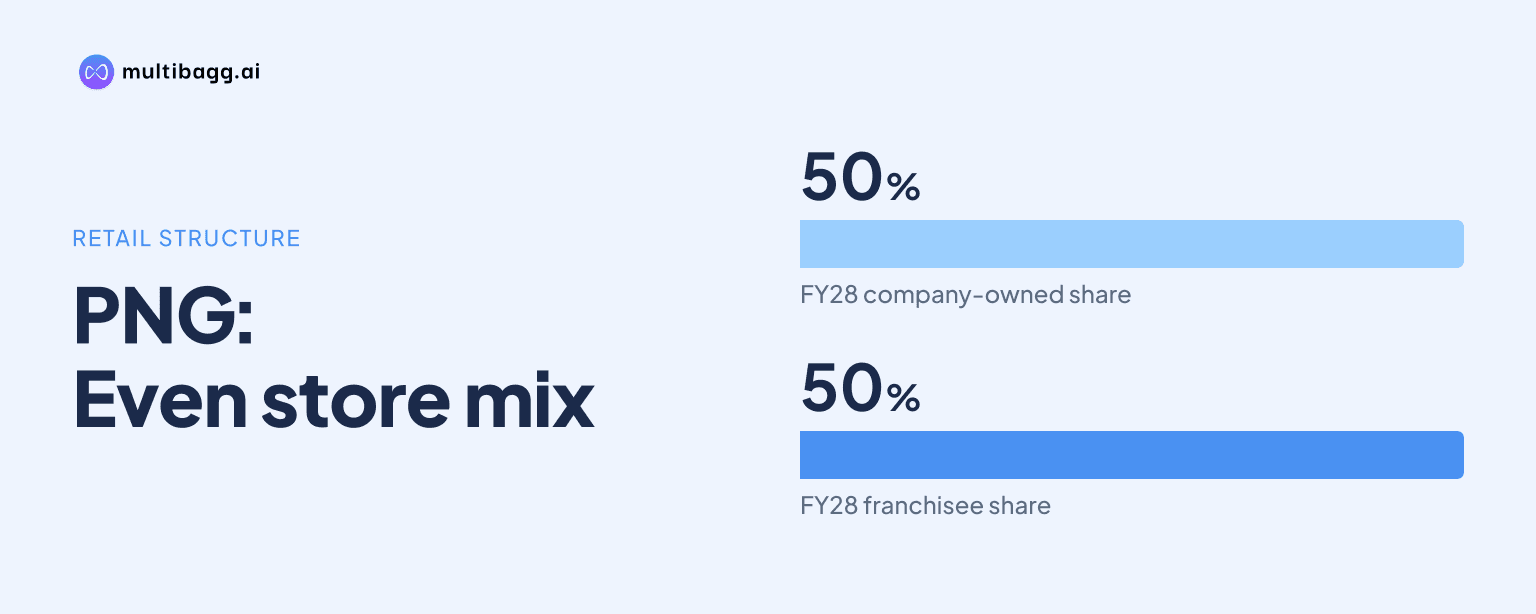
P N Gadgil Jewellers plans to fund the company-owned share of FY28 store expansion through internal accruals rather than further debt, after a more franchisee-led FY27. Management said it envisages 30 to 35 annual additions from FY28 in an even company-owned and franchisee mix, while targeting a 20% to 25% reduction in borrowings by FY30.
Know P N Gadgil Jewellers inside out
Results, valuation, peers and who's buying, in one view.
How will PNG fund company-owned stores from FY28?
PNG said internal accruals should be sufficient to fund company-owned store expansion from FY28, and management does not expect further debt to be needed for that purpose. The statement was made during the earnings call for the quarter ended September 30, 2026.
The funding plan follows a Rs 700 crore qualified institutional placement, or QIP, completed in Q2 FY27. Management said some QIP proceeds were deployed into working capital for festive inventory demand, while the company had net worth of Rs 2,865 crore as of September 30, 2026.
Management also said its earlier target of about 170 stores by FY29 is to be funded entirely from profit-generated accruals. That is a management plan rather than a forecast of achieved funding, and it follows the reported network of 80 stores at the end of Q2 FY27.
What store mix does PNG plan from FY28?
PNG plans an even 50:50 split between company-owned and franchisee stores from FY28 across both its legacy format and YOOU by PNG. Management referred to the two formats as COCO and FOCO during the call.
For annual additions of around 30 to 35 stores, management said 17 to 18 stores would be in the legacy format and about half of the balance would be YOOU by PNG. It said the company-owned and franchisee allocation would be evenly divided within both formats, although the transcript gives no precise annual store count for YOOU by PNG.
FY27 has a different emphasis. PNG said it was on track to open around 23 stores during FY27, taking the network to approximately 103 by year-end, with eight to 10 openings planned in Q3 FY27 and the balance in Q4 FY27. The Ayodhya store was already operating, while the Prayagraj store was scheduled to open on November 4, 2026.
Why is PNG shifting toward franchisee-led expansion?
PNG said it first used company-owned stores to establish the brand in newer northern and central markets before extending through the franchisee route. In Q3 and Q4 of the prior year, it opened four Uttar Pradesh stores in Lucknow, Kanpur, Gorakhpur and Banaras, as well as company-owned stores in Patna and Indore.
At the end of Q2 FY27, PNG had seven company-owned stores across Uttar Pradesh, Madhya Pradesh, Bihar and Haryana, within 80 total stores, including 79 in India and one in the United States. Management said the newer-market stores were 11 to 12 months old on average and had been opened to build local brand confidence.
Management reported that these stores were generating about Rs 60 crore of revenue at roughly 1.1 stock turns, compared with its initial projection of Rs 50 crore to Rs 55 crore and one stock turn. Their stud ratio was above 17%, versus the 15% management had projected for the new markets.
PNG’s longer-term target for these stores is 2.5 to three stock turns, increasing to 3.5 to four turns after year four. Management said that level could translate into roughly Rs 200 crore of revenue per fully mature store and a 22% to 25% stud ratio; these are internal targets, not reported outcomes.
Got a follow-up? Ask IRIS
What does the current balance sheet show about PNG’s funding plan?
PNG said its QIP and internal accruals support expansion, inventory, Silvostyle integration, digital investments and higher hedging coverage. The QIP of Rs 700 crore in Q2 FY27 was oversubscribed 1.5 times, according to management.
Bank fixed deposits were about Rs 1,191 crore at the end of Q2 FY27, up Rs 637 crore from Rs 554 crore in the prior quarter. Management also said around Rs 600 crore was parked in bank fixed deposits at the time of the call, without reconciling that figure with the Q2-end deposit balance.
Gross borrowings rose Rs 385 crore since March, which management attributed mainly to higher gold metal loans, or GML loans, used alongside its hedging strategy. Fixed deposits and bank collateral increased by Rs 552 crore over the same comparison, resulting in a stated Rs 167 crore reduction in net borrowings, including QIP funds.
How does PNG’s operating performance support internal accruals?
PNG’s operating performance expanded in Q2 FY27, providing the earnings base management cited for internally funded growth. Consolidated revenue from operations increased 22% year on year to Rs 2,660 crore, while retail revenue rose 31% to Rs 2,061 crore.
Retail accounted for 77% of total revenue in Q2 FY27, compared with 72% a year earlier, while franchisee revenue grew 35% year on year. However, management said the franchisee share rose to 17% from 12% in the preceding quarter, contributing to a 50-basis-point sequential decline in gross margin.
Gross margin was 12.7%, up 89 basis points year on year, while earnings before interest, tax, depreciation and amortisation, or EBITDA, rose 57% to Rs 224.6 crore. Excluding a Rs 5 crore unhedged inventory gain, adjusted EBITDA increased 60% to Rs 209.6 crore and the adjusted margin improved to 8.2% from 6.3% a year earlier.
Newer geographies remain a small part of current retail sales, with northern and central India contributing 2.7% in Q2 FY27 versus 0.7% in Q2 FY26. Management’s internal projection is for newer geographies to account for 30% to 35% of sales by FY30, compared with Maharashtra’s current contribution of about 91% of total sales.
What borrowing reduction does PNG target by FY30?
PNG targets a 20% to 25% reduction in borrowings by FY30, with management also referring to FY29 or FY30 as the intended period. This target sits alongside the plan not to raise additional debt for company-owned expansion from FY28.
The company increased hedge coverage to about 80% in FY27, while higher GML loans contributed to the Rs 385 crore increase in gross borrowings since March. Management’s debt-reduction objective therefore depends on internal accruals, expansion execution and the ongoing level of working-capital and hedge-related funding needs.
Conclusion
PNG’s capital-allocation plan changes the store funding model after FY27: franchisees are expected to lead near-term openings, while FY28 is intended to use an even company-owned and franchisee mix. Management links the company-owned portion to internal accruals, supported by Q2 FY27 adjusted EBITDA of Rs 209.6 crore and a stated Rs 167 crore decline in net borrowings.
The next disclosed milestones are eight to 10 planned Q3 FY27 store openings, the remaining FY27 openings in Q4, and progress toward about 170 stores by FY29. Investors can also track whether PNG’s borrowings move toward management’s FY30 reduction target of 20% to 25%, particularly as GML loans, fixed deposits and working-capital funding change.