










Poonawalla Fincorp Allots ₹1,318 Crore NCDs on BSE
Key highlights
- Poonawalla Fincorp allotted ₹1,318 crore of NCDs on October 29, 2026.
- The ZCB G1 series accounted for ₹913 crore through 91,300 NCDs.
- The G2 series accounted for ₹405 crore through 40,500 NCDs.
- The two-series private-placement programme has a maximum approved size of ₹2,000 crore.
powered by IRIS
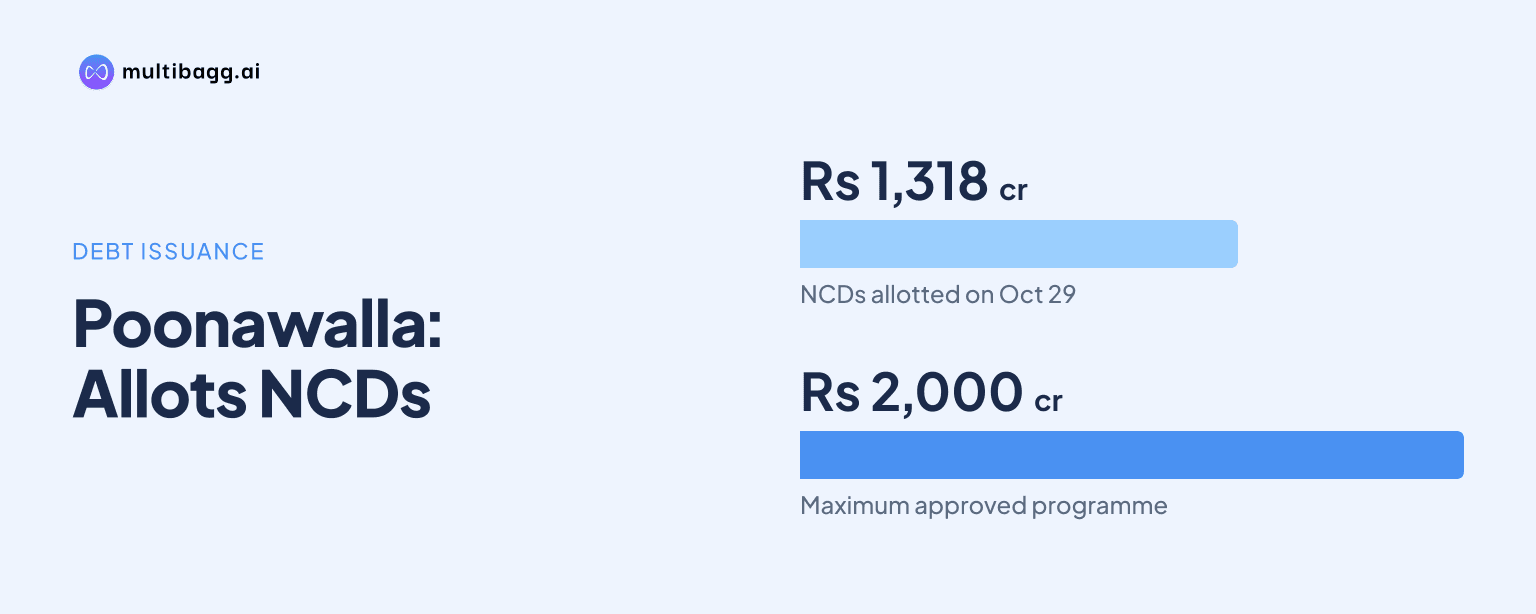
Poonawalla Fincorp Limited allotted ₹1,318 crore of secured, redeemable, rated and listed non-convertible debentures on October 29, 2026, using two NCD series approved under a private-placement programme of up to ₹2,000 crore. The allotment matters because it represents debt funding raised through instruments proposed for listing on BSE Limited's Debt Market Segment.
Know Poonawalla Fincorp inside out
Results, valuation, peers and who's buying, in one view.
What did Poonawalla Fincorp allot on October 29, 2026?
Poonawalla Fincorp allotted 131,800 non-convertible debentures, or NCDs, with a combined face-value amount of ₹1,318 crore. The finance committee approved the allotment through a resolution dated October 29, 2026, under authority granted by the company's board of directors.
The instruments are described as secured, redeemable, rated and listed NCDs. They carry a face value of ₹1 lakh each and were issued in dematerialised form under two series for the financial year 2026-27. The disclosure identifies the securities as PFL NCD Series ZCB G1 FY 2026-27 and PFL NCD Series G2 FY 2026-27.
The company said the NCDs are to be listed on the Debt Market Segment of BSE Limited. Its disclosure was made under Regulations 30 and 51 of the SEBI Listing Regulations, read with the relevant provisions of Schedule III.
How is the ₹1,318 crore NCD allotment divided between the two series?
Poonawalla Fincorp allotted ₹913 crore through the ZCB G1 series and ₹405 crore through the G2 series. The ZCB G1 allotment comprised 91,300 NCDs, while the G2 allotment comprised 40,500 NCDs, with each debenture having a face value of ₹1 lakh.
The two series were part of an issue structure with different approved limits. ZCB G1 had an issue size of up to ₹1,250 crore, comprising a ₹750 crore base issue and a green shoe option of up to ₹500 crore. G2 had an issue size of up to ₹750 crore, comprising a ₹250 crore base issue and a green shoe option of up to ₹500 crore.
The allotment amount was ₹568 crore above the combined base issue of ₹1,000 crore for the two series. It remained within the aggregate maximum issue size of ₹2,000 crore, leaving ₹682 crore of capacity under the stated limits.
What was the original NCD issuance approval?
Poonawalla Fincorp's finance committee had approved the issuance of secured, redeemable, rated and listed NCDs worth up to ₹2,000 crore through private placement to eligible investors. The approval covered 200,000 NCDs with a face value of ₹1 lakh each across the ZCB G1 and G2 series.
Private placement means the securities are issued to eligible investors rather than offered through a broad public issue. The company did not disclose interest rates, tenure, redemption dates or the names of allottees in the information provided. The available disclosure therefore establishes the amount and structure of the allotment, but not the detailed cost or maturity profile of the borrowings.
The two-series design allowed the company to set separate base issue amounts and retain oversubscription through green shoe options. In this case, the allotment exceeded both the ₹750 crore base issue for ZCB G1 and the ₹250 crore base issue for G2, while staying below each series' respective maximum limit.
Got a follow-up? Ask IRIS
How does the NCD allotment affect investors and the company’s funding structure?
For Poonawalla Fincorp, the allotment adds ₹1,318 crore of secured debt instruments to the funding raised under the approved programme. As listed NCDs, the securities are intended to be listed on BSE's debt market segment, providing a formal market listing for the instruments.
For investors in the NCDs, the disclosed features are that they are secured, redeemable and rated. The source material does not identify the credit rating agency, coupon, yield, maturity or security cover. Those items would be necessary to assess the specific return and credit terms of either series.
The transaction also follows earlier NCD activity disclosed by Poonawalla Fincorp. On July 3, 2026, its finance committee approved an allotment of ₹500.019 crore, including ₹500 crore of NCD face value and a premium of ₹0.019 crore, through private placement. Separately, the company had disclosed a ₹808 crore private-placement allotment on June 25, 2025, across two NCD series.
Why does the BSE listing matter for these NCDs?
Listing on BSE's Debt Market Segment places the NCDs within a recognised exchange framework. The company has described both the current instruments as listed NCDs and stated that they are to be listed on BSE Limited's debt market segment.
The listing does not change the stated face value of ₹1 lakh per NCD, but it distinguishes these instruments from unlisted debt. The information supplied does not provide trading data, market prices or investor participation for the two series. It also does not report any equity-share price reaction to the allotment.
The main disclosed market-relevant facts are therefore the ₹1,318 crore allotment, the ₹2,000 crore maximum approval, the two-series structure and the planned BSE debt-market listing. Any assessment of the company's overall borrowing levels or financial performance would require additional financial statements or disclosures not included in the source material.
Conclusion
Poonawalla Fincorp completed an allotment of ₹1,318 crore across the ZCB G1 and G2 NCD series, using part of its approved ₹2,000 crore private-placement programme. The larger ₹913 crore allocation was made through ZCB G1, while G2 accounted for ₹405 crore. Both series consist of secured, redeemable, rated and listed instruments with a ₹1 lakh face value.
The next disclosed point to watch is whether Poonawalla Fincorp uses the remaining ₹682 crore capacity under the two-series issue limits. Investors would also need future disclosures on coupon rates, maturity dates, ratings and any further allotments to evaluate the detailed terms and funding implications of these NCDs.