










Power Mech H1 investing outflow rose to Rs 422.13 crore
Key highlights
- Power Mech reported a Rs 422.13 crore net investing cash outflow in Sep-26, versus Rs 73.46 crore in Sep-25.
- Power Mech’s net operating cash flow was negative Rs 2.85 crore in Sep-26 after Rs 90.37 crore of direct taxes paid.
- Power Mech’s CWIP rose by Rs 394.32 crore to Rs 575.98 crore at Sep-26.
- Power Mech’s financing cash inflow increased to Rs 419.67 crore in Sep-26 from Rs 167.36 crore in Sep-25.
powered by IRIS
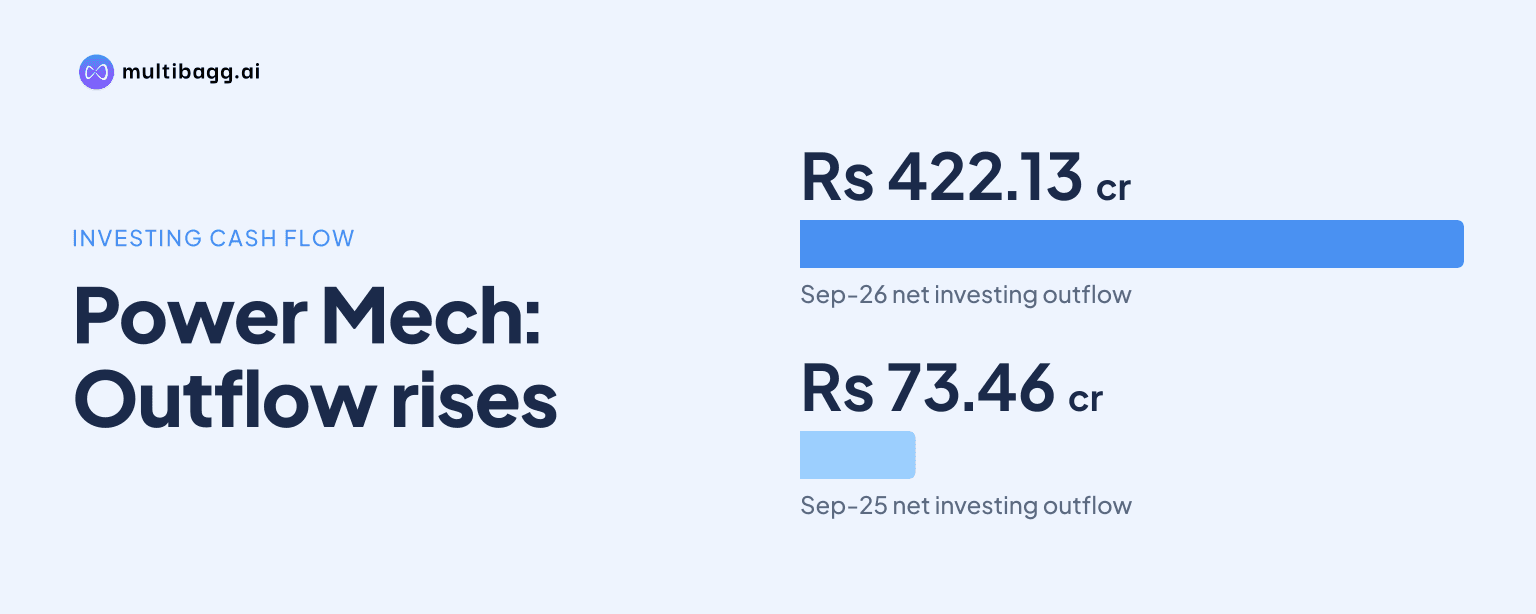
Power Mech Projects Limited reported a Rs 422.13 crore net investing cash outflow for the period ended Sep-26, while net operating cash flow remained negative at Rs 2.85 crore after tax payments. The higher investment outflow coincided with capital work in progress rising to Rs 575.98 crore at Sep-26 from Rs 181.66 crore at Mar-26.
Know Power Mech Projects inside out
Results, valuation, peers and who's buying, in one view.
Why was Power Mech’s operating cash flow negative in Sep-26?
Power Mech reported net cash used in operating activities of Rs 2.85 crore in Sep-26 because direct taxes paid, net of refunds, were Rs 90.37 crore, exceeding Rs 87.52 crore of cash generated from operations. This was an improvement from net operating cash outflow of Rs 62.59 crore in Sep-25, when cash generated from operations was Rs 15.22 crore and direct taxes paid were Rs 77.81 crore.
Operating profit before working-capital changes increased to Rs 344.35 crore in Sep-26 from Rs 320.20 crore in Sep-25. Changes in working capital used Rs 256.83 crore, compared with an outflow of Rs 304.98 crore a year earlier, leaving more cash generated from operations before tax despite the continued working-capital use.
How much cash did Power Mech use for investing activities?
Power Mech used Rs 422.13 crore in net investing cash flow in Sep-26, compared with Rs 73.46 crore in Sep-25. The Rs 348.67 crore increase made investing activities the largest cash outflow in the Sep-26 consolidated cash-flow statement.
The presentation does not provide a line-by-line composition of the Rs 422.13 crore investing outflow. It reports non-current assets of Rs 1,891.20 crore at Sep-26, up from Rs 1,480.87 crore at Mar-26, including capital work in progress, or CWIP, of Rs 575.98 crore versus Rs 181.66 crore.
CWIP increased by Rs 394.32 crore during the six-month period, while property, plant and equipment increased by Rs 56.23 crore to Rs 461.47 crore. The presentation does not identify the projects within CWIP, provide their commissioning dates, or reconcile the balance-sheet additions directly with investing cash flow.
How did Power Mech finance its Sep-26 cash requirements?
Power Mech reported Rs 419.67 crore of net cash from financing activities in Sep-26, compared with Rs 167.36 crore in Sep-25. This financing inflow was close to the Rs 422.13 crore investing cash outflow and, together with the Rs 2.85 crore operating cash outflow, resulted in a Rs 5.31 crore decline in cash and cash equivalents.
Cash and cash equivalents stood at Rs 101.40 crore at Sep-26, down from Rs 106.71 crore at the beginning of the period. In Sep-25, cash and cash equivalents increased by Rs 31.31 crore to Rs 123.30 crore from Rs 91.99 crore, reflecting a smaller Rs 73.46 crore investing outflow despite lower financing cash inflow.
The balance sheet shows non-current borrowings rising to Rs 108.25 crore at Sep-26 from Rs 63.21 crore at Mar-26, while current borrowings declined to Rs 543.05 crore from Rs 660.03 crore. Trade payables rose to Rs 1,174.48 crore from Rs 929.98 crore, but the presentation does not specify how individual liability movements contributed to the Rs 419.67 crore financing inflow.
Got a follow-up? Ask IRIS
Did Power Mech’s H1FY27 profit growth convert into operating cash?
Power Mech’s H1FY27 revenue from operations rose 28% year on year to Rs 3,233.01 crore and profit after tax increased 12% to Rs 177.06 crore. However, the Sep-26 cash-flow statement recorded a Rs 2.85 crore operating cash outflow after tax, because Rs 256.83 crore was used in working capital and Rs 90.37 crore was paid as direct taxes.
Profit after non-controlling interest rose 28% to Rs 163.60 crore in H1FY27 from Rs 127.43 crore in H1FY26. Earnings before interest, tax, depreciation and amortisation, or EBITDA, increased 7% to Rs 362.84 crore, although the EBITDA margin declined to 11.17% from 13.33%.
Finance cost increased to Rs 60.12 crore in H1FY27 from Rs 57.84 crore in H1FY26, while depreciation increased to Rs 47.93 crore from Rs 33.85 crore. Profit before tax rose 2% to Rs 252.35 crore, compared with a 28% increase in revenue, and the profit before tax margin declined to 7.81% from 9.76%.
What balance-sheet changes accompanied Power Mech’s investment outflow?
Power Mech’s total assets increased by Rs 653.36 crore to Rs 6,242.72 crore at Sep-26 from Rs 5,589.36 crore at Mar-26. Non-current assets rose by Rs 410.33 crore, principally alongside the Rs 394.32 crore rise in CWIP, while current assets increased by Rs 243.03 crore.
Inventories increased to Rs 549.86 crore at Sep-26 from Rs 264.27 crore at Mar-26, a rise of Rs 285.59 crore. Trade receivables moved in the opposite direction, declining by Rs 163.68 crore to Rs 1,383.11 crore, while other current assets increased to Rs 722.71 crore from Rs 629.35 crore.
Total equity increased to Rs 2,589.05 crore at Sep-26 from Rs 2,182.63 crore at Mar-26, including reserves and surplus of Rs 2,486.77 crore. Non-current liabilities rose to Rs 601.43 crore from Rs 365.83 crore, and current liabilities increased to Rs 2,398.88 crore from Rs 2,065.95 crore.
Conclusion
Power Mech’s Sep-26 disclosure shows that H1FY27 revenue and reported profit rose while operating cash remained marginally negative after taxes. The Rs 422.13 crore investing cash outflow was accompanied by a Rs 394.32 crore increase in CWIP and was largely matched by Rs 419.67 crore of financing cash inflow.
The next reporting periods will show whether the Rs 575.98 crore CWIP balance moves into property, plant and equipment and how this affects depreciation, cash generation and financing requirements. The presentation discloses neither a capex target nor project-level CWIP completion timing, leaving the composition and expected conversion of that balance unresolved.