










Power Mech Projects Reports Q2 Growth After 26% Revenue Rise
Key highlights
- Power Mech Projects reported year-on-year revenue and profit growth in Q2 FY27, while H1 operating cash flow remained negative.
- Q1 FY27 revenue from operations increased 26% year-on-year to ₹1,623.68 crore.
- Q1 FY27 total revenue rose 25% year-on-year to ₹1,632.36 crore.
- The September 2026 presentation reported a ₹17,317 crore order book excluding MDO activity and ₹2,032 crore of H1 FY27 O&M wins.
powered by IRIS
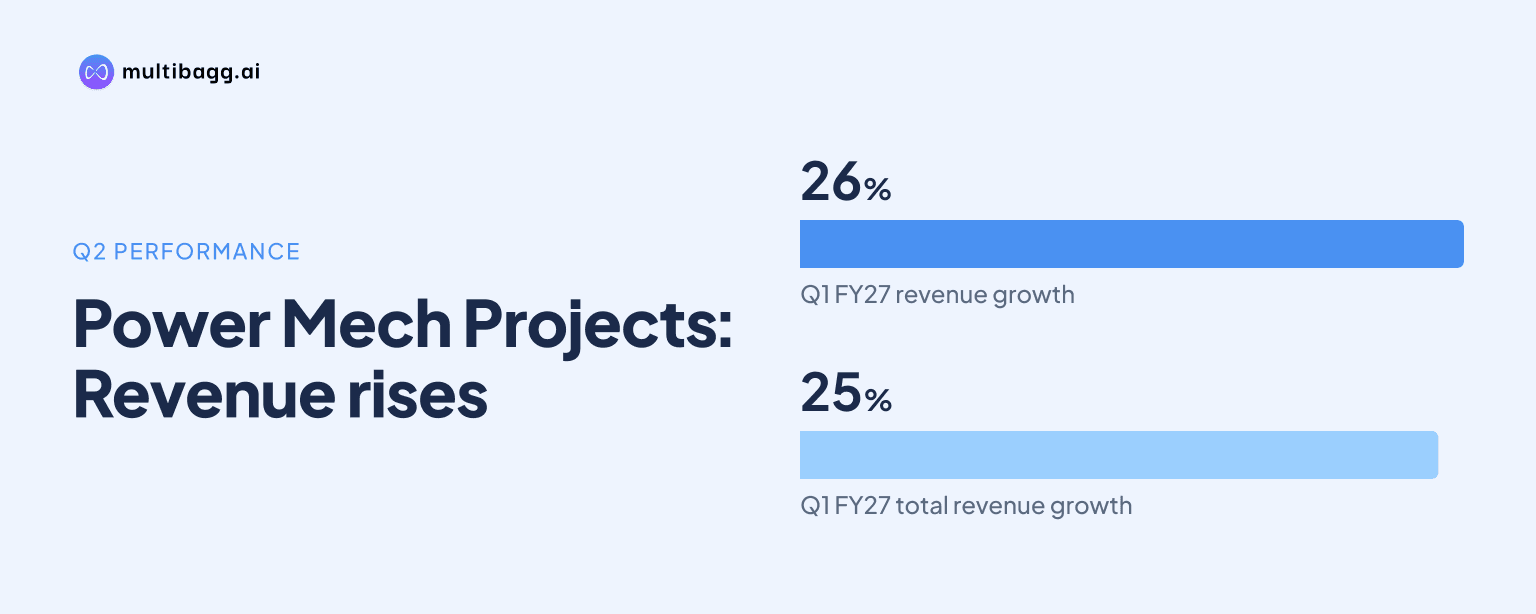
Power Mech Projects Limited reported year-on-year growth in revenue and profit for Q2 FY27, following a 26% increase in Q1 FY27 revenue from operations to ₹1,623.68 crore, but its H1 operating cash flow remained negative. The contrast makes cash generation a key item alongside execution and profitability.
Know Power Mech Projects inside out
Results, valuation, peers and who's buying, in one view.
What did Power Mech Projects report for Q2 FY27?
Power Mech Projects reported that both revenue and profit after tax increased year-on-year in Q2 FY27. The company’s Q2 update, released after its board meeting on November 11, 2026, also indicated that operating cash flow for the first half of FY27 remained negative.
The supplied Q2 material does not provide a reliable set of usable absolute consolidated revenue and profit figures, as some numbers are presented in a corrupted format. Therefore, the disclosed year-on-year direction of revenue and profit, rather than those inconsistent values, is the relevant reported outcome. The negative H1 operating cash flow is an important counterpoint because accounting profit and cash conversion can move differently during project execution.
How did the Q2 FY27 process unfold?
The Board of Directors approved the unaudited financial results for the quarter ended September 2026 on November 11, 2026. The board also approved material related-party transactions, subject to shareholder approval through a postal ballot.
Power Mech Projects had separately announced a conference call for November 13, 2026 at 11:00 a.m. IST to discuss Q2 FY27 performance. The announced participants were Director S. K. Ramaiah and Chief Financial Officer N. Nani Aravind. Such calls generally give investors an opportunity to seek management comments on execution, working capital and the order pipeline, although the supplied material does not include the call transcript or management guidance.
The related-party transaction proposal remains subject to the shareholder process disclosed by the company. The available information does not specify the transaction value, counterparties or the timetable for the postal ballot, so those details should not be inferred from the Q2 announcement.
What was Power Mech Projects' financial position before Q2?
Power Mech Projects entered Q2 after reporting revenue from operations of ₹1,623.68 crore in Q1 FY27, compared with ₹1,293.41 crore in Q1 FY26. Total revenue for Q1 FY27 was ₹1,632.36 crore, up 25% year-on-year from ₹1,304.79 crore.
The company’s September 2026 investor presentation described a diversified industrial and infrastructure services business spanning power, rail, metro, roads, water and mining. It said the company manages more than 42 GW of power plant operations and maintenance globally, including about one-fifth of India’s thermal power base.
Over the five years through FY26, the presentation said revenue grew 3.2 times, representing a compound annual growth rate above 17%. It also reported EBITDA margin expansion to 12.29% in FY26 from 11.62% in FY25. These historical figures provide context for the reported Q2 profit growth, although they do not resolve the cash-flow position in H1 FY27.
Got a follow-up? Ask IRIS
What does negative H1 operating cash flow mean for investors?
Negative H1 operating cash flow means Power Mech Projects reported an outflow from operating activities during the first half despite year-on-year growth in Q2 revenue and profit. The company’s supplied update does not state the value of the operating cash-flow deficit or identify its specific cause.
For an engineering, procurement, construction and operations-and-maintenance business, cash flow is affected by billing schedules, collection timing, mobilising advances, retention amounts and working-capital movements. The disclosure does not establish which of these factors applied to Power Mech Projects in H1 FY27. Investors therefore have a reported cash-flow signal, but not sufficient detail in the provided material to assign a cause.
The issue matters because the company is executing projects across several sectors and has cited a substantial order book. Revenue recognition and profit can reflect work completed, while cash receipts may occur at a different point under customer contracts. Future financial disclosures will be relevant for assessing whether operating cash generation aligns more closely with reported earnings.
Which figures frame Power Mech Projects' operating scale?
The available disclosures point to a business with growing reported revenue, a multi-sector order pipeline and significant operations-and-maintenance activity. The following figures are stated in the company’s Q1 FY27 financial table and September 2026 presentation.
The presentation said the ₹17,317 crore order book, excluding mine developer and operator activity, represented more than 2.5 years of revenue coverage. It also cited ₹2,032 crore of H1 FY27 operations-and-maintenance wins, including an Athena order of ₹970 crore. These disclosures indicate the scale of contracted activity cited by the company, while the Q2 update keeps attention on operating cash flow.
Conclusion
Power Mech Projects reported positive year-on-year Q2 FY27 revenue and profit trends after a 26% rise in Q1 revenue from operations. However, negative H1 operating cash flow means the financial picture cannot be assessed through profit growth alone. The disclosed Q1 revenue base, FY26 margin improvement and September order-book data show the scale of the company’s operating platform.
The next disclosed event was the November 13, 2026 conference call on Q2 FY27 performance. Investors will watch for management’s explanation of the negative operating cash flow, comments on working-capital movements, progress in converting the order book into revenue, and any update on the shareholder approval process for material related-party transactions.