










POWERGRID targets 13,000 SiC modules by 2030-31
Key highlights
- POWERGRID targets development and deployment of about 13,000 indigenous SiC power modules by 2030-31.
- The SiC programme covers 3.3 kV, 4.5 kV and 6.5 kV module classes for VSC-HVDC systems.
- POWERGRID has identified a 1,000 MW Pusauli Back-to-Back upgradation as the pilot.
- POWERGRID reported H1 FY27 capital expenditure of Rs 16,864 crore, compared with Rs 15,385 crore in H1 FY26.
powered by IRIS
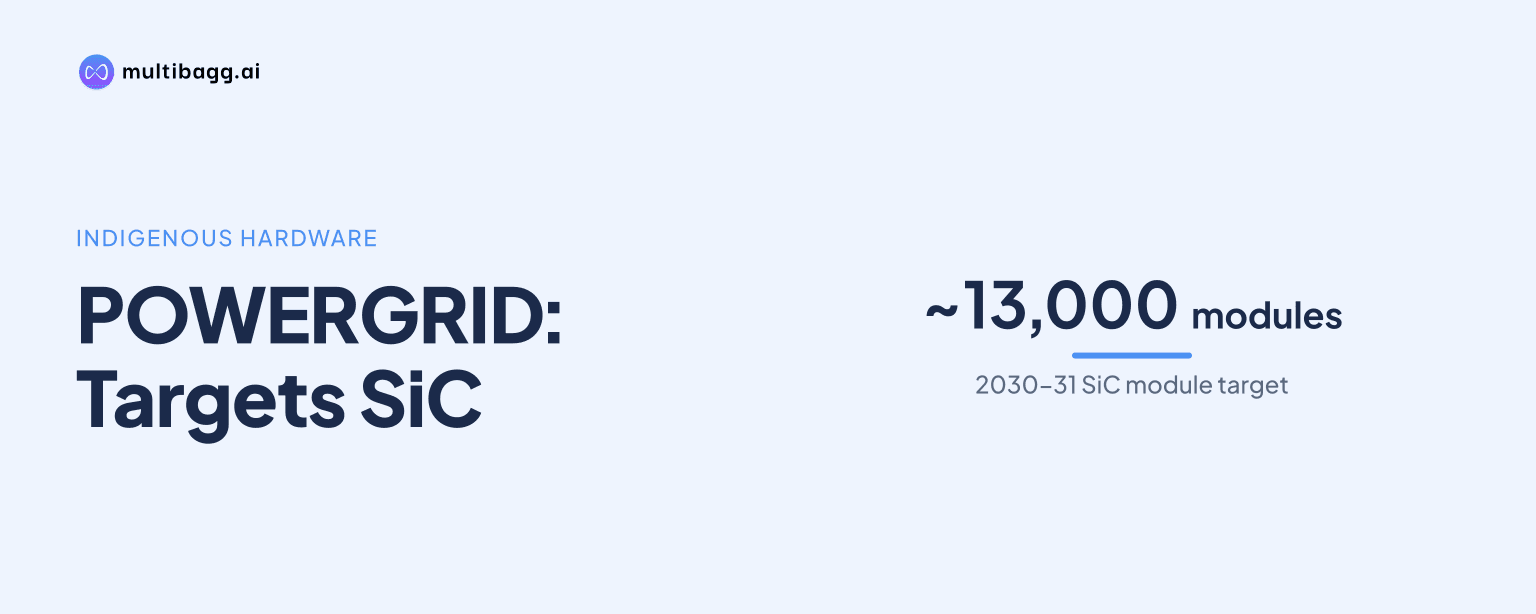
POWERGRID plans to develop and deploy about 13,000 indigenous silicon carbide (SiC) power modules for voltage source converter high-voltage direct current (VSC-HVDC) systems by 2030-31, with its 1,000 megawatt (MW) Pusauli Back-to-Back upgradation identified as the pilot. The programme covers 3.3 kilovolt (kV), 4.5 kV and 6.5 kV module classes.
Know Power Grid Corporation of India inside out
Results, valuation, peers and who's buying, in one view.
What is POWERGRID planning for SiC power modules?
POWERGRID is planning indigenous design, development and deployment of about 13,000 SiC metal-oxide-semiconductor field-effect transistor (MOSFET)-based power modules for VSC-HVDC systems by 2030-31. The stated collaboration includes the Ministry of Electronics and Information Technology, the Ministry of Power and POWERGRID.
The disclosed target combines development with deployment rather than reporting modules already installed. POWERGRID places the programme within its technology and supply-chain capability work, and specifies three voltage classes, 3.3 kV, 4.5 kV and 6.5 kV, for the planned modules.
The presentation does not disclose a project cost, manufacturing site, supplier, annual production plan or module deployment schedule before 2030-31. It also does not give a split of the approximately 13,000 modules among the three stated voltage classes, leaving the eventual voltage mix unspecified.
Which pilot will use POWERGRID's SiC modules?
POWERGRID identifies the 1,000 MW Pusauli Back-to-Back upgradation to VSC-HVDC as the pilot for the SiC module programme. The presentation describes Pusauli as an upgradation and does not name another VSC-HVDC pilot for the 2030-31 target.
POWERGRID does not state the pilot's commissioning date, capital cost, module count or share of the approximately 13,000-module programme. It also provides no expected efficiency, availability, reliability or cost comparison for the Pusauli VSC-HVDC installation.
The Pusauli disclosure gives the localisation programme a named 1,000 MW application, unlike a general localisation statement. However, the source does not say how many modules will be deployed at Pusauli or whether further named installations will follow before the 2030-31 endpoint.
How did POWERGRID's execution metrics change in H1 FY27?
POWERGRID reported consolidated capital expenditure of Rs 16,864 crore in H1 FY27, compared with Rs 15,385 crore in H1 FY26, an increase of Rs 1,479 crore. Capitalisation rose to Rs 9,300 crore from Rs 3,888 crore, an increase of Rs 5,412 crore across the two first-half periods.
In Q2 FY27, consolidated capital expenditure was Rs 9,099 crore against Rs 8,404 crore in Q2 FY26. Q2 FY27 capitalisation was Rs 4,023 crore, compared with Rs 2,205 crore a year earlier; the source says capitalisation includes finance-lease assets and excludes foreign-exchange rate variation.
Management's FY27 guidance is Rs 37,000 crore to Rs 40,000 crore for consolidated capital expenditure and Rs 25,000 crore to Rs 30,000 crore for capitalisation. POWERGRID does not allocate any part of those FY27 ranges to the Pusauli pilot or to SiC module development.
Got a follow-up? Ask IRIS
How did POWERGRID's transmission operations compare with last year?
POWERGRID reported transmission-system availability of 99.81% in H1 FY27, compared with 99.83% in H1 FY26. The H1 FY27 result was 0.06 percentage points above the 99.75% availability level that the presentation states earns full incentive, despite a 0.02-percentage-point year-on-year decline.
Tripping per line was 0.17 in H1 FY27, unchanged from H1 FY26. POWERGRID also reported completion of the National Transmission Asset Management Centre upgrade and operationalisation of the Integrated Indigenous Information Security Operation Centre during the reported period.
These operating figures are separate from the future SiC deployment target. The presentation provides no operating data for installed SiC modules, so the 99.81% availability and 0.17 tripping-per-line measures do not establish performance for the Pusauli VSC-HVDC pilot.
POWERGRID commissioned 981 circuit kilometres of transmission lines and 14,600 megavolt-amperes of transformation capacity in Q2 FY27. Its H1 FY27 totals were 2,616 circuit kilometres and 25,100 megavolt-amperes, respectively, providing the broader execution setting for the 2030-31 technology programme.
What other technology capability did POWERGRID disclose?
POWERGRID reported charging an indigenous 220 kV mobile gas-insulated switchgear bay for rapid emergency deployment. The stated purpose is to support grid resilience and uptime, although the source provides no quantity, location, cost or measured operating outcome for the 220 kV asset.
POWERGRID also reported deploying an insulated aerial work platform that enables maintenance without system outages. The source places this equipment alongside technology and supply-chain initiatives, but does not state that it is part of the Ministry of Electronics and Information Technology and Ministry of Power SiC collaboration.
A heavy-lift programmable drone with a 100 kilogram payload capacity has been developed and deployed, according to POWERGRID. The drone can transport tower parts, cement bags and insulator strings to difficult-to-access locations, making it a disclosed deployment rather than a future target such as the 13,000 SiC modules.
POWERGRID further reported restoring the Srinagar-Drass line on 29 October 2026 at 11,800 feet and minus 10 degrees Celsius. This restoration event is distinct from the 1,000 MW Pusauli project, but it forms part of the operational capability disclosures presented alongside the SiC programme.
Conclusion
POWERGRID has disclosed a defined indigenous VSC-HVDC component programme, targeting about 13,000 SiC MOSFET-based modules across 3.3 kV, 4.5 kV and 6.5 kV classes by 2030-31. The 1,000 MW Pusauli Back-to-Back upgradation provides the named pilot, while H1 FY27 capital expenditure of Rs 16,864 crore and capitalisation of Rs 9,300 crore show a larger execution programme progressing separately.
The next items to watch are disclosures on the 1,000 MW Pusauli pilot's schedule, module allocation, commissioning and performance, none of which are provided in the presentation. Management's FY27 guidance of Rs 37,000 crore to Rs 40,000 crore in capital expenditure and Rs 25,000 crore to Rs 30,000 crore in capitalisation remains the nearer-term execution benchmark, although no SiC-specific allocation has been disclosed.