










Powerica lists 150 MW wind pipeline including GUVNL project
Key highlights
- Powerica lists two wind pipeline projects aggregating 150 MW.
- The 50 MW project has a 25-year PPA at Rs 3.81 per kilowatt-hour.
- Powerica operates 12 wind projects with total capacity of 330.85 MW.
- Powerica reports BoP EPC work across 12 projects totalling 450.40 MW.
powered by IRIS
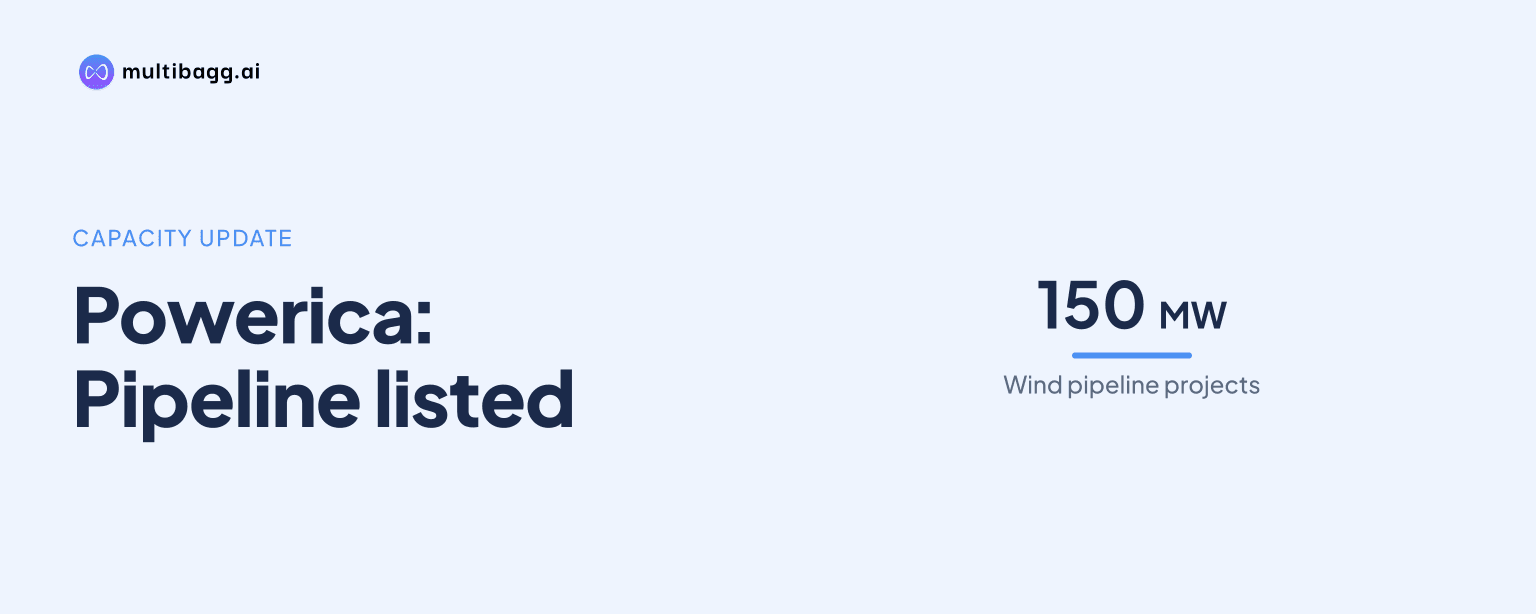
Powerica lists a 150 MW wind-project pipeline comprising a 50 MW project with a 25-year power-purchase agreement at Rs 3.81 per kilowatt-hour and a 100 MW GUVNL project, alongside 330.85 MW across 12 operational projects. The supplied filing does not describe the 50 MW project as a GUVNL letter of intent.
Know Powerica inside out
Results, valuation, peers and who's buying, in one view.
What wind projects does Powerica list in its pipeline?
Powerica lists two pipeline projects aggregating 150 MW: a 50 MW project under construction and a 100 MW GUVNL project. Its wind-business presentation places both items under its pipeline-project disclosure, while describing the 50 MW project as having a 25-year power-purchase agreement, or PPA, at Rs 3.81 per kilowatt-hour.
The supplied material does not state that Powerica has received a 50 MW GUVNL letter of intent. It identifies the 100 MW item as a GUVNL project and separately refers to one 50 MW project under construction; therefore, the filing supports a 150 MW aggregate pipeline but does not establish a letter-of-intent characterisation or link the 50 MW project to GUVNL.
Powerica also describes its operating portfolio as having 300 MW of construction and pipeline runway. That stated runway is twice the specifically enumerated 150 MW pipeline, but the presentation does not reconcile the two descriptions or identify the additional construction or pipeline capacity within the 300 MW figure.
How does Powerica's pipeline compare with its operating portfolio?
Powerica's identified 150 MW pipeline equals about 45% of its 330.85 MW operating portfolio, which consists of 12 operational wind projects. The operating base is supported by 10 GUVNL PPAs covering 228.25 MW and two Solar Energy Corporation of India, or SECI, PPAs covering 102.60 MW, together matching the reported 330.85 MW total.
GUVNL represents the larger portion of Powerica's operating portfolio, with 228.25 MW compared with 102.60 MW for SECI. The presentation identifies GUVNL as rated “AA” by CARE and SECI as rated “AAA” by ICRA, while the 10 GUVNL and two SECI PPAs account for all 12 operating projects.
Powerica further says it commissioned 153.9 MW in 2023 and 51.3 MW in 2026. The stated 2026 commissioning figure is 102.6 MW below the 2023 figure, although the presentation does not provide a fuller annual commissioning series or specify whether these references use calendar or financial years.
What tariff and contract terms does Powerica disclose for wind assets?
Powerica discloses a tariff range of Rs 2.4 to Rs 4.19 per kilowatt-hour across its current 330.85 MW portfolio, while the 50 MW project under construction is stated at Rs 3.81 per kilowatt-hour. The construction-project tariff falls within the published range for the operating portfolio.
All operating PPAs are stated to run for 25 years except one 4.80 MW project, which has a 20-year PPA. For the construction pipeline, Powerica specifically says the 50 MW project has a 25-year PPA; it does not provide a tariff or PPA term for the separately listed 100 MW GUVNL project.
The differing contract disclosure limits comparison across the full 150 MW pipeline. Powerica provides a price and tenure for only 50 MW, while the remaining 100 MW is identified by customer category rather than price or contract duration, so the filing does not permit a blended tariff calculation for the full pipeline.
Got a follow-up? Ask IRIS
How will Powerica build and operate wind projects?
Powerica says its in-house engineering capability develops, executes, operates and monitors wind assets for both its independent power producer, or IPP, portfolio and third-party IPPs. Development work includes resource assessment, civil and electrical works, transmission lines and substations, covering functions relevant to its 150 MW pipeline.
For operations, Powerica lists balance-of-plant, or BoP, infrastructure operation and maintenance, availability work, forecasting and scheduling. It also uses in-house supervisory control and data acquisition, or SCADA, systems for real-time supervision, predictive maintenance and performance analytics, with substation monitoring stated as operating 24 hours a day, seven days a week.
Powerica reports engineering, procurement and construction, or EPC, for BoP across 12 projects with 450.40 MW of capacity. It also reports BoP operation and maintenance across 10 projects with 296.50 MW, and says six projects have been developed for its own IPP portfolio; project income from third-party work is tracked separately from owned-asset economics.
What other wind EPC and grid work is under way?
Powerica says two projects for other IPPs totalling 435.60 MW, including BoP EPC scope, are under construction. It also reports a letter of award for an additional 150 MW BoP project, which is a separate EPC-related development from the 150 MW wind-project pipeline disclosed for its IPP business.
Powerica is developing grid infrastructure that includes a 7.2-kilometre, 400-kilovolt transmission line and a 220/400-kilovolt substation. These disclosed works extend its scope beyond owned wind generation into transmission and substation infrastructure associated with renewable projects.
Outside wind, Powerica reports land-acquisition services for a 150 MW solar project and land aggregation for a 50 MW solar project at Khambalia, Gujarat. Those solar assignments are not included in the stated 150 MW wind pipeline, but they are disclosed alongside the EPC and asset-management activities.
Conclusion
Powerica's presentation identifies a 150 MW wind pipeline made up of a 50 MW project with a disclosed Rs 3.81-per-kilowatt-hour, 25-year PPA and a 100 MW GUVNL project. Against its 330.85 MW operational base, the pipeline represents about 45% of current capacity, while 450.40 MW of BoP EPC work shows a separate third-party service activity.
The next disclosed items to watch are construction progress on the 50 MW project and the 100 MW GUVNL project, as well as execution of the additional 150 MW BoP letter of award. Delivery of the 7.2-kilometre, 400-kilovolt line and the 220/400-kilovolt substation also remains relevant because Powerica identifies both as infrastructure under development.