










Premier Roadlines H1 revenue rises 18.3% as EBITDA margin falls
Key highlights
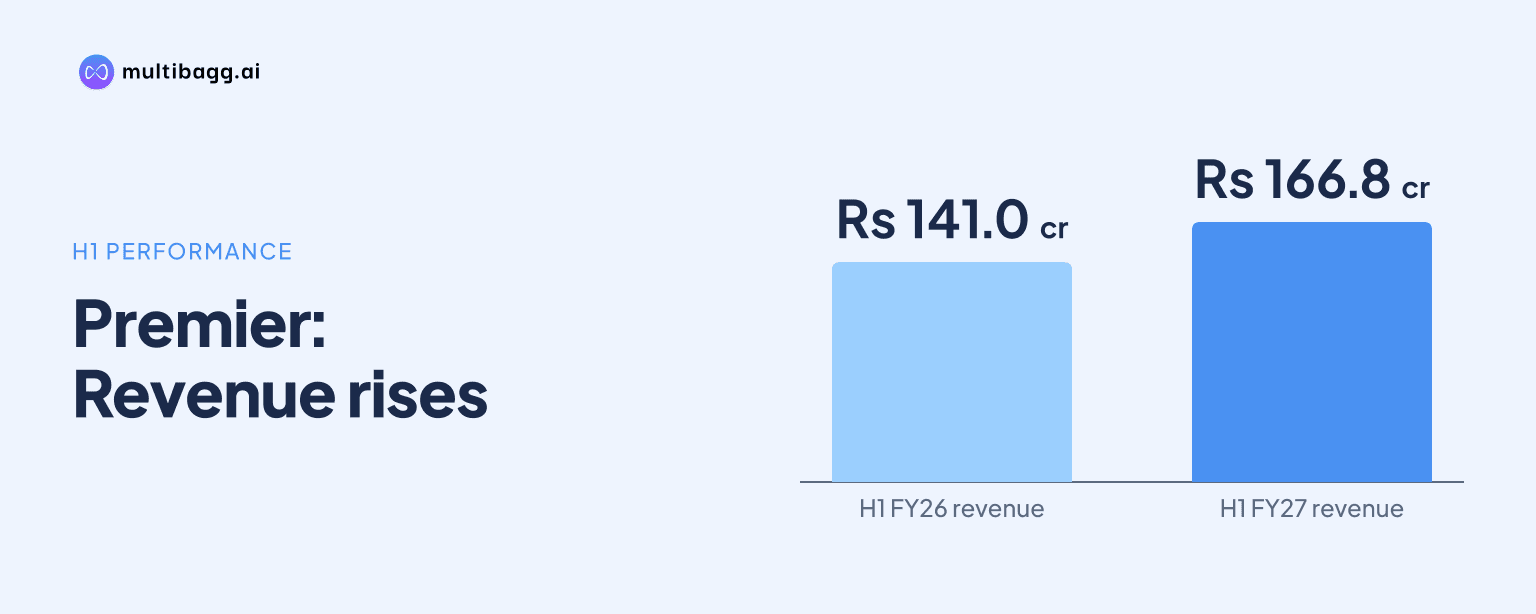
- Premier Roadlines reported H1FY27 revenue of Rs 166.8 crore, up 18.3% from Rs 141.0 crore.
- Premier Roadlines EBITDA rose to Rs 14.3 crore, while EBITDA margin declined 70 basis points to 8.6%.
- Project Logistics and ODC contributed 52% of Premier Roadlines H1FY27 revenue, compared with 50% in H1FY26.
- Premier Roadlines borrowings declined by Rs 14.0 crore to Rs 41.9 crore at September 2026.
powered by IRIS
Premier Roadlines Limited reported revenue from operations of Rs 166.8 crore in H1FY27, the first half of financial year 2027, up 18.3% year on year, while earnings before interest, tax, depreciation and amortisation (EBITDA) margin fell 70 basis points to 8.6% as contract-logistics costs were not fully recovered.
Know Premier Roadlines inside out
Results, valuation, peers and who's buying, in one view.
How did Premier Roadlines perform in H1FY27?
Premier Roadlines increased revenue from operations to Rs 166.8 crore in H1FY27 from Rs 141.0 crore in H1FY26, adding Rs 25.8 crore. Management attributed the 18.3% increase to demand from power, transformer and renewable-energy customers, execution in Project Logistics and Over Dimensional Cargo (ODC), and higher average revenue per order.
EBITDA increased 9.4% to Rs 14.3 crore from Rs 13.1 crore, which was slower than revenue growth. Profit after tax (PAT) rose 2.8% to Rs 7.8 crore from Rs 7.6 crore, as higher operating costs, depreciation and finance costs reduced the conversion of revenue growth into profit.
Premier Roadlines’ chairman said profitability improved sequentially from H2FY26, although the presentation did not disclose H2FY26 revenue, EBITDA or PAT. The disclosed year-on-year comparison shows revenue rising faster than EBITDA, while PAT margin declined by 71 basis points to 4.7% in H1FY27.
Why did Premier Roadlines EBITDA margin decline?
Premier Roadlines’ EBITDA margin declined to 8.6% in H1FY27 from 9.3% a year earlier because freight and operating expenses rose to Rs 140.2 crore from Rs 117.0 crore. Employee-benefit expenses increased to Rs 8.0 crore from Rs 6.9 crore, while other expenses rose to Rs 4.3 crore from Rs 3.9 crore.
Management said geopolitical developments, rising operating costs and tighter credit availability for smaller fleet operators reduced vehicle availability and increased vehicle-hiring costs. It identified Contract Integrated Logistics as the segment most affected because diesel-price escalations are largely passed through, but existing contracts provided limited recovery of non-fuel cost increases.
Costs below EBITDA also increased during H1FY27. Depreciation and amortisation rose to Rs 2.0 crore from Rs 1.6 crore, and finance cost increased to Rs 2.0 crore from Rs 1.2 crore; consequently, earnings before interest and tax increased 7.8% to Rs 12.4 crore, while profit before tax was Rs 10.4 crore against Rs 10.3 crore a year earlier.
Got a follow-up? Ask IRIS
Which operations supported Premier Roadlines revenue growth?
Premier Roadlines derived 52% of H1FY27 revenue from Project Logistics and ODC, compared with 50% in H1FY26. ODC represented 32% of H1FY27 revenue and Project Logistics 20%, while Contract Integrated Logistics accounted for 30% and General Logistics for 18%.
Management said execution and high-capacity utilisation in Project Logistics and ODC helped mitigate pressure from Contract Integrated Logistics. General Logistics also had flexible spot-market pricing, which management said enabled better cost recovery than fixed pricing under certain existing contracts.
The operating data showed a more concentrated customer base with higher order activity. Customers served declined to 415 in H1FY27 from 467 in H1FY26, but orders rose to 17,487 from 17,010 and average revenue per order increased to Rs 95,367 from Rs 82,870.
Premier Roadlines linked the Rs 12,497 increase in revenue per order to specialised Project Logistics and ODC demand, particularly in power and transformer work. Vehicle handling increased 5.2% year on year to 13,216 vehicles, despite the fleet-availability constraints cited by management.
What is Premier Roadlines doing to recover costs and expand capacity?
Premier Roadlines said contracts approaching renewal in Q3FY27 and Q4FY27 will be subject to a more disciplined pricing approach intended to reflect prevailing operating costs and improve non-fuel cost recovery. This is a management plan, rather than a reported improvement in H1FY27 pricing or margins.
The company added one heavy-duty puller and 16 hydraulic axle lines during H1FY27 to support complex cargo movements. Its stated fleet objective is 12 heavy-duty pullers and 160 hydraulic axle lines, funded through initial public offering proceeds, internal accruals and bank finance.
Premier Roadlines generated operating cash flow of Rs 22.4 crore in H1FY27 and reported total borrowings of Rs 41.9 crore at September 2026, compared with Rs 55.9 crore at March 2026. The presentation did not disclose a debt target, debt-to-equity ratio or interest-coverage measure.
Management’s strategy also includes selectively acquiring niche assets that have limited third-party availability and expanding into Defence, Transformers, Hydro Projects and Oil & Gas. Through wholly owned subsidiary Premier Worldwide Logistics, Premier Roadlines plans to offer ocean freight, air freight, ODC road movement, warehousing and distribution.
Conclusion
Premier Roadlines combined 18.3% H1FY27 revenue growth with higher absolute EBITDA and PAT, supported by specialised logistics demand and improved order realisation. However, EBITDA margin fell to 8.6% because Contract Integrated Logistics had limited recovery of non-fuel cost increases, while higher vehicle-hiring, depreciation and finance costs also narrowed profitability.
The next disclosed event to watch is the renewal of contracts in Q3FY27 and Q4FY27, when management plans revised pricing to improve cost recovery. Investors can also track whether Project Logistics and ODC increase beyond their 52% H1FY27 revenue contribution and whether the fleet moves toward the stated target of 12 pullers and 160 hydraulic axle lines.