










Prime Focus net debt reaches Rs 5,001 crore, reduction planned
Key highlights
- Prime Focus's net debt rose by Rs 625 crore to Rs 5,001 crore between June and September 2026.
- Prime Focus said a Rs 408 crore Reliance Alpha NCLT settlement payout was a primary driver of higher net debt.
- Prime Focus targets a $150 million-$200 million debt reduction over the next 12 months.
- Prime Focus reported H1 FY27 revenue of Rs 2,696 crore, up 29.4% year on year.
powered by IRIS
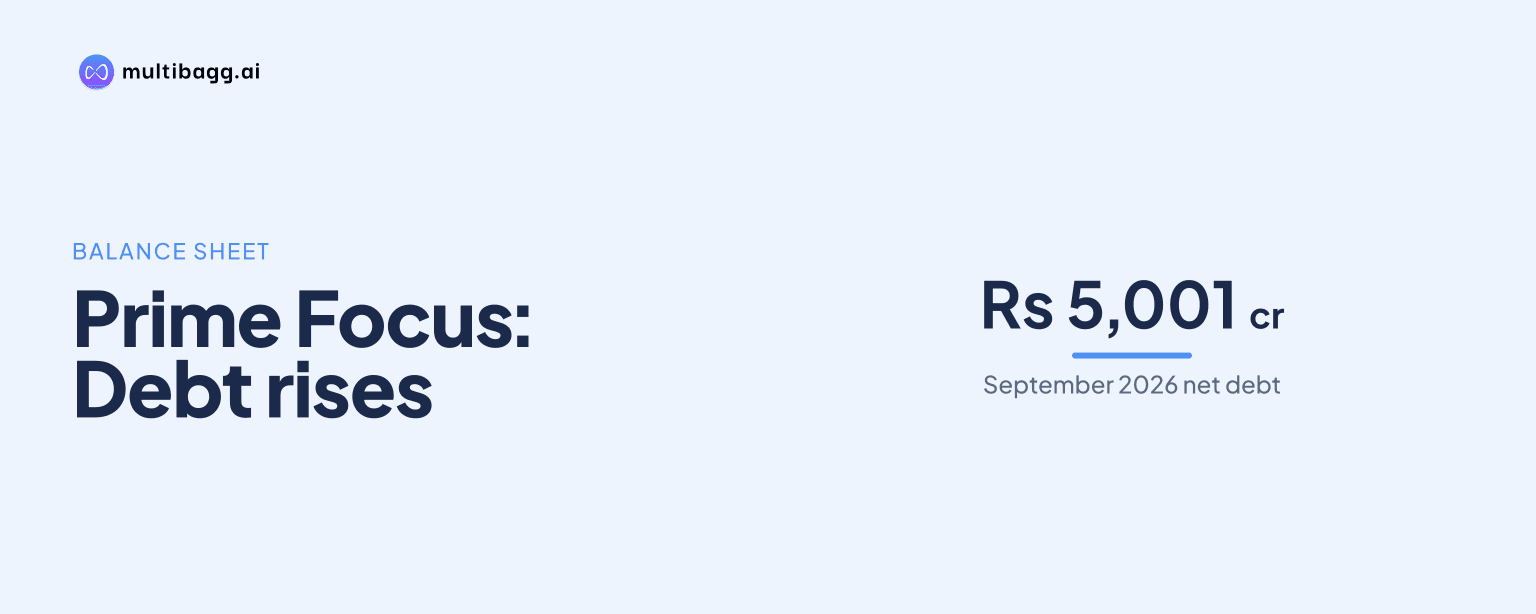
Prime Focus reported net debt of Rs 5,001 crore in September 2026, up Rs 625 crore from June 2026, after a Rs 408 crore Reliance Alpha settlement payout and capacity-related capital expenditure and research and development spending. Management said it intends to reduce debt by $150 million-$200 million over the next 12 months.
Know Prime Focus inside out
Results, valuation, peers and who's buying, in one view.
What caused Prime Focus's net debt to rise in September 2026?
Prime Focus's net debt rose because cash and liquid investments fell more sharply than gross debt changed during the quarter. Gross debt increased by Rs 18 crore, from Rs 5,155 crore in June 2026 to Rs 5,173 crore in September 2026, while cash and cash equivalents plus liquid investments declined by Rs 606 crore, from Rs 778 crore to Rs 172 crore. The resulting net-debt increase was Rs 625 crore, taking the balance from Rs 4,376 crore to Rs 5,001 crore.
Prime Focus attributed the increase primarily to a Rs 408 crore payout for the settlement of the Reliance Alpha National Company Law Tribunal, or NCLT, case. It also cited capital expenditure and research and development spending for capacity build-out. The presentation does not assign separate amounts to the capacity and research spending, so the disclosed Rs 408 crore settlement payout is the only quantified driver of the quarterly net-debt movement.
What changed on Prime Focus's balance sheet from March to September 2026?
Prime Focus's gross debt increased by Rs 232 crore between March 2026 and September 2026, reaching Rs 5,173 crore from Rs 4,941 crore. Cash and cash equivalents shown in the balance sheet fell by Rs 530 crore, from Rs 688 crore to Rs 158 crore. This balance-sheet cash figure differs from the Rs 172 crore used in the September net-debt calculation because the debt overview also includes bank balances other than cash and cash equivalents and current financial investments.
Prime Focus's total assets increased by Rs 67 crore to Rs 10,716 crore in September 2026. Current assets declined by Rs 308 crore to Rs 4,757 crore, although other financial assets rose by Rs 383 crore to Rs 3,709 crore. The company says those financial assets include unbilled revenue, export incentive receivables and amounts recoverable toward line production; it describes unbilled revenue as work completed before invoicing milestones are reached.
Non-current assets rose by Rs 374 crore to Rs 5,959 crore in the same March-to-September period. Property, plant and equipment increased from Rs 652 crore to Rs 701 crore, intangible assets rose from Rs 801 crore to Rs 822 crore, and other long-term assets increased by Rs 303 crore to Rs 4,436 crore. Prime Focus said the latter category largely included Rs 2,436 crore of goodwill, Rs 555 crore of content investments and Rs 694 crore of right-of-use assets at September 2026.
Got a follow-up? Ask IRIS
How does Prime Focus plan to reduce debt within 12 months?
Prime Focus said it will endeavour to reduce debt by $150 million-$200 million over the next 12 months. Its plan has three stated pillars: monetisation of investment content assets, operational working-capital improvement and a capital-markets fundraise. Management attached an expected $100 million-$150 million range to monetisation of investment content assets, making it the only quantified component of the three-part plan.
The proposed monetisation relates to content investments carried on Prime Focus's balance sheet, which stood at Rs 555 crore within other long-term assets at September 2026. The company explains that advances toward content investments represent equity participation in certain content productions and are recovered when the content is released. The presentation does not identify specific assets for sale, expected release dates or a timetable for a capital-markets fundraise.
Working-capital improvement is the second stated route to lower indebtedness, alongside asset monetisation and fundraising. Prime Focus reported Rs 467 crore of net trade and other receivables in September 2026, compared with Rs 462 crore in March 2026, while other financial assets were Rs 3,709 crore. The company’s explanation of unbilled revenue indicates that billing depends on predetermined milestones, which provides the disclosed operating mechanism behind part of the working-capital plan.
What operating results accompanied Prime Focus's higher debt?
Prime Focus reported revenue of Rs 2,696 crore in the first half of financial year 2027, up 29.4% from Rs 2,084 crore a year earlier, while earnings before interest, tax, depreciation and amortisation, or EBITDA, increased 26.3% to Rs 683 crore. The EBITDA margin declined by 0.6 percentage points to 25.3% from 25.9%, as personnel cost rose 32.3% to Rs 1,761 crore, faster than revenue.
The first-half profit outcome did not move in line with revenue and EBITDA growth. Net profit was Rs 12 crore in the first half of financial year 2027, versus Rs 115 crore in the comparable prior-year period. Prime Focus reported Rs 67 crore of exceptional items, comprising a Rs 71 crore NCLT-proceedings-related settlement charge offset by a Rs 6 crore net gain related to a joint venture or subsidiary, while depreciation and amortisation rose to Rs 368 crore from Rs 273 crore.
In the second quarter of financial year 2027, revenue rose 34.7% year on year and 12.8% quarter on quarter to Rs 1,429 crore. EBITDA increased 28.7% year on year to Rs 381 crore, and the margin was 26.7%, compared with 27.9% a year earlier and 23.8% in the preceding quarter. Prime Focus attributed the revenue expansion to ramp-up in key tentpole projects and said short-term headcount, outsourcing and freelancers supported delivery of projects including Ramayana and DUNE 3.
Conclusion
Prime Focus's September 2026 net debt of Rs 5,001 crore reflects a Rs 606 crore reduction in cash and liquid investments from June, alongside a Rs 18 crore increase in gross debt. The company continued to report higher first-half revenue of Rs 2,696 crore and EBITDA of Rs 683 crore, but the debt position increased after the Rs 408 crore Reliance Alpha settlement payout and capacity-related spending.
The next measure of progress is management's stated 12-month effort to cut debt by $150 million-$200 million. Investors will need to watch whether Prime Focus monetises the indicated $100 million-$150 million of investment content assets, improves working capital tied partly to milestone-based unbilled revenue, and executes the disclosed capital-markets fundraising pillar.