










Prime Focus H1 FY27 profit falls to Rs 12 crore despite growth
Key highlights
- Prime Focus reported H1 FY27 revenue of Rs 2,696 crore, up 29.4% year on year.
- Prime Focus's H1 FY27 EBITDA rose 26.3% to Rs 683 crore, while margin declined to 25.3% from 25.9%.
- Prime Focus reported H1 FY27 net profit of Rs 12 crore, compared with Rs 115 crore a year earlier.
- Prime Focus reported net debt of Rs 5,001 crore at September 2026, up from Rs 4,376 crore in June 2026.
powered by IRIS
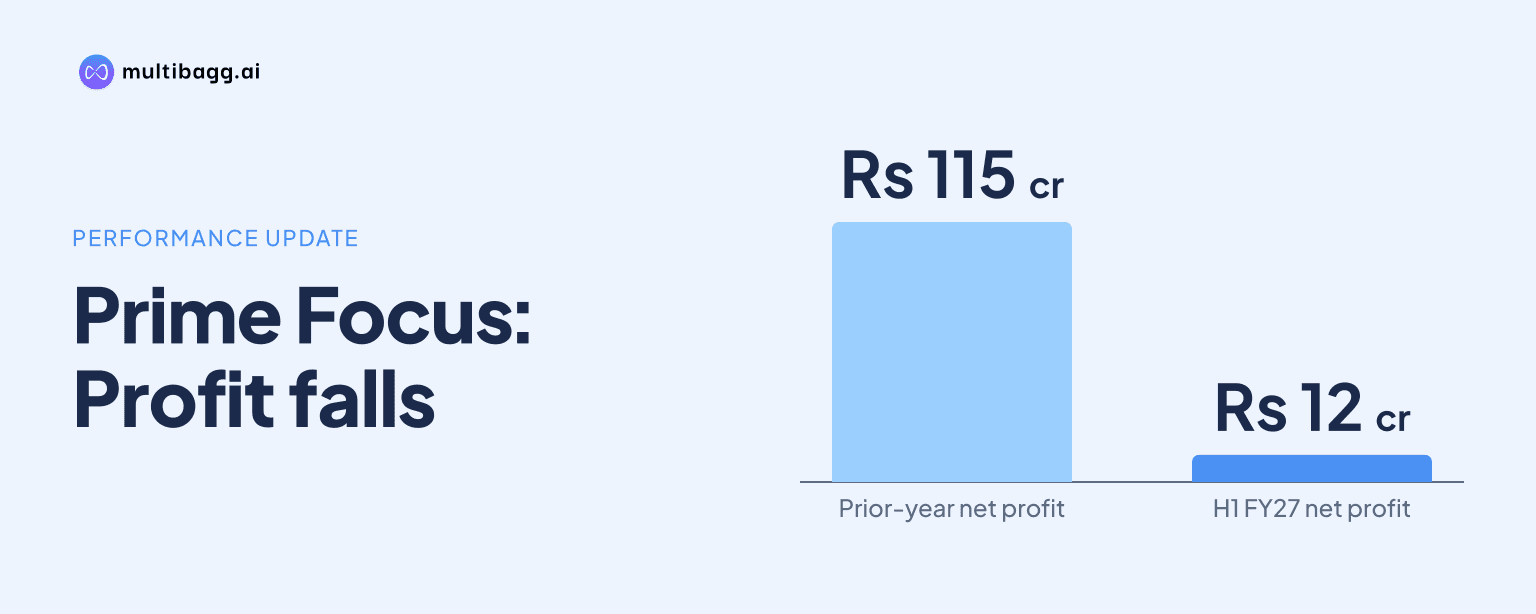
In H1 FY27, Prime Focus reported net profit of Rs 12 crore, down from Rs 115 crore despite 29.4% revenue growth to Rs 2,696 crore. EBITDA rose 26.3% to Rs 683 crore, but exceptional items of Rs 67 crore, lower foreign-exchange gains and higher depreciation and interest reduced reported earnings.
Know Prime Focus inside out
Results, valuation, peers and who's buying, in one view.
How did Prime Focus's H1 FY27 revenue and EBITDA change?
Prime Focus increased H1 FY27 revenue by 29.4% to Rs 2,696 crore and EBITDA, or earnings before interest, tax, depreciation and amortisation, by 26.3% to Rs 683 crore. In H1 FY26, revenue was Rs 2,084 crore and EBITDA was Rs 540 crore, meaning revenue increased by Rs 612 crore and EBITDA increased by Rs 143 crore.
Prime Focus's personnel cost rose faster than revenue, increasing 32.3% to Rs 1,761 crore in H1 FY27 from Rs 1,331 crore. Employee cost was Rs 1,533 crore and other direct cost was Rs 228 crore; the latter includes technician fees and technical service cost. Indirect cost also increased by Rs 35 crore to Rs 248 crore.
Prime Focus's EBITDA margin declined to 25.3% from 25.9%, even though EBITDA rose by Rs 143 crore. The comparison shows that the higher H1 FY27 revenue base generated more operating profit, while personnel and indirect costs rose at rates that limited margin expansion.
Why did Prime Focus's net profit fall despite higher EBITDA?
Prime Focus's net profit fell to Rs 12 crore because the H1 FY27 result included Rs 67 crore of exceptional items and a Rs 35 crore foreign-exchange, or FX, gain, compared with no exceptional item and a Rs 117 crore FX gain in H1 FY26. Profit before tax declined to Rs 58 crore from Rs 170 crore, and tax fell to Rs 46 crore from Rs 55 crore.
Profit before tax before exceptional items and FX increased 66.8% to Rs 89 crore from Rs 53 crore. However, the Rs 67 crore exceptional item comprised Rs 71 crore towards a National Company Law Tribunal, or NCLT, proceedings-related settlement, partly offset by a Rs 6 crore net gain relating to a joint venture or subsidiary.
Depreciation and amortisation rose to Rs 368 crore in H1 FY27 from Rs 273 crore, while interest increased to Rs 246 crore from Rs 234 crore. The H1 FY27 FX gain was Rs 82 crore lower year on year, at Rs 35 crore versus Rs 117 crore, reducing the benefit to profit before tax despite the increase in EBITDA.
The joint-venture share of profit was Rs 2 crore in H1 FY27, compared with nil in H1 FY26. Prime Focus identifies the joint-venture item as relating to Anima Kitchen, while the tax charge declined by Rs 9 crore year on year but did not offset the Rs 103 crore fall in net profit.
Got a follow-up? Ask IRIS
What did Prime Focus's Q2 FY27 result show?
Prime Focus reported Q2 FY27 revenue of Rs 1,429 crore, EBITDA of Rs 381 crore and net profit of Rs 58 crore. Revenue was 34.7% above Rs 1,061 crore in Q2 FY26 and 12.8% above Rs 1,267 crore in Q1 FY27; EBITDA was 28.7% above Rs 296 crore a year earlier.
Prime Focus's Q2 profit before tax was Rs 91 crore, compared with a Rs 33 crore loss in Q1 FY27. Exceptional items were Rs 2 crore in Q2 versus Rs 65 crore in Q1, while the FX gain was Rs 10 crore in Q2 and Rs 25 crore in Q1, showing that the timing of the settlement-related charge affected the first-half split between quarters.
Management attributed quarterly revenue growth to a ramp-up in key tentpole projects. It said personnel cost rose about 35% year on year because of short-term headcount expansion, outsourcing and freelancers for projects including Ramayana and DUNE 3; it attributed higher indirect cost to data-centre and selling, general and administrative costs.
How does Prime Focus plan to reduce debt?
Prime Focus reported net debt of Rs 5,001 crore at September 2026, up from Rs 4,376 crore at June 2026. It attributed the increase primarily to a Rs 408 crore payout towards settlement of the Reliance Alpha NCLT case and capital expenditure and research-and-development spending for capacity build-out.
Gross debt was Rs 5,173 crore at September 2026, compared with Rs 5,155 crore at June 2026. Cash, cash equivalents and liquid investments declined to Rs 172 crore from Rs 778 crore over the same period, accounting for most of the Rs 625 crore increase in net debt.
Management said it intends to reduce debt over the next 12 months through monetisation of investment content assets, operational working-capital improvement and a capital-markets fundraise. The balance sheet showed other financial assets of Rs 3,709 crore at September 2026, including unbilled revenue and advances towards content investments, while cash and cash equivalents separately stood at Rs 158 crore.
Prime Focus also disclosed an order book and visible pipeline of about $1 billion for FY27 and beyond, comprising 70% contracted and confirmed revenue and 30% highly visible pipeline. The presentation said 89% of FY26 revenue came from the top 10 studios, compared with 90% in FY25, describing the customer base alongside the debt-reduction plan rather than forecasting profit or cash generation.
Conclusion
Prime Focus's H1 FY27 results show that operating expansion did not translate into comparable reported earnings growth. Revenue rose by Rs 612 crore and EBITDA by Rs 143 crore, while net profit declined by Rs 103 crore as exceptional items, a lower FX gain, and higher depreciation, amortisation and interest affected the path from operating profit to net profit.
The next disclosed issue is execution of management's debt-reduction plan over the following 12 months, including content-asset monetisation, working-capital improvement and a potential capital-markets fundraise. Readers can also watch whether the contracted 70% share of the disclosed FY27-and-beyond order book and visible pipeline converts into revenue while personnel, data-centre and financing costs develop.