










Prime Fresh Q2 EBITDA climbs 71.2% as margin reaches 8.70%
Key highlights
- PFL reported Q2 FY27 revenue from operations of Rs 80.39 crore, up 21.1% year on year.
- PFL's Q2 FY27 EBITDA rose 71.2% to Rs 6.99 crore, while EBITDA margin reached 8.70%.
- PFL's H1 FY27 PAT increased 52.79% to Rs 9.18 crore.
- Standalone F&V sales tonnage rose 14.2% year on year to 30,780 MT in H1 FY27.
powered by IRIS
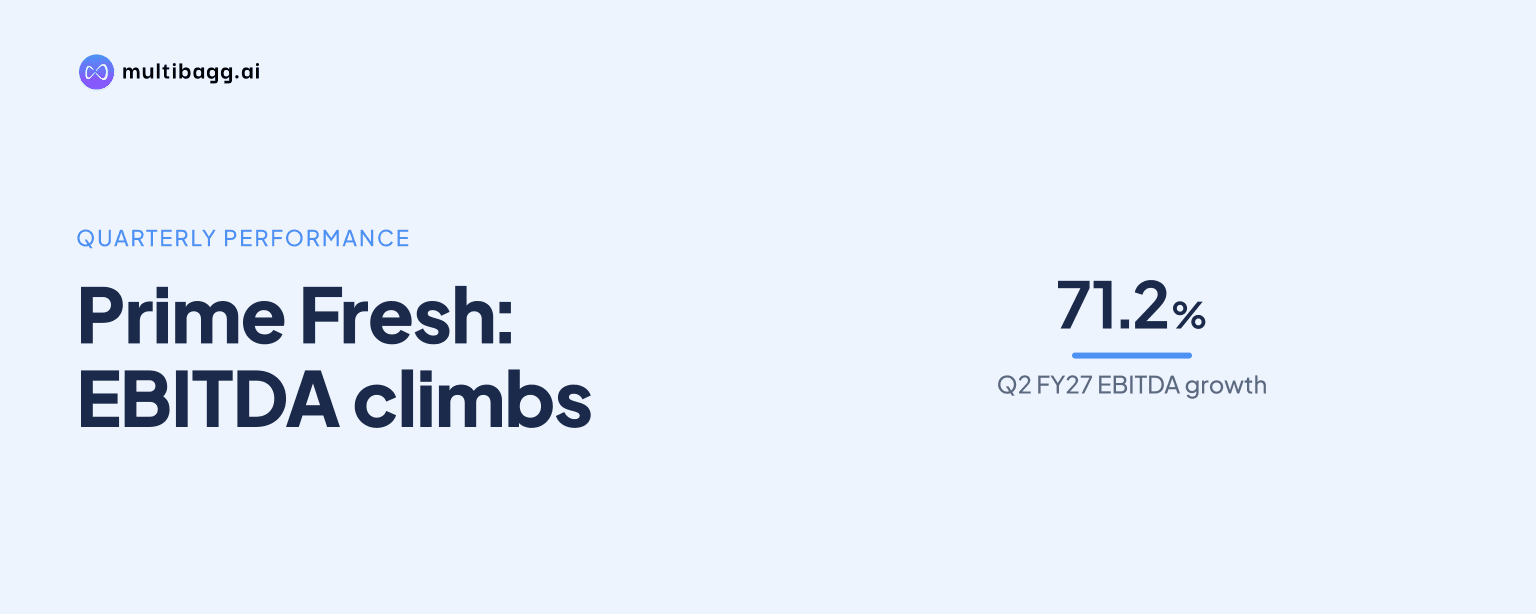
For Q2 FY27 ended September 30, 2026, Prime Fresh Limited reported earnings before interest, tax, depreciation and amortisation (EBITDA) of Rs 6.99 crore, up 71.2% year on year, and an EBITDA margin of 8.70%. Revenue from operations rose 21.1% to Rs 80.39 crore, while profit after tax (PAT) increased 54.7% to Rs 4.83 crore.
Know Prime Fresh inside out
Results, valuation, peers and who's buying, in one view.
How did PFL perform in Q2 FY27?
PFL reported consolidated Q2 FY27 revenue from operations of Rs 80.39 crore, EBITDA of Rs 6.99 crore and PAT of Rs 4.83 crore, compared with Rs 66.40 crore, Rs 4.08 crore and Rs 3.12 crore respectively in Q2 FY26. Revenue grew 21.1% year on year, while EBITDA rose 71.2% and PAT increased 54.7%, meaning both profit measures grew faster than sales in the quarter ended September 30, 2026.
PFL's EBITDA margin increased by 255 basis points, or bps, to 8.70% in Q2 FY27 from 6.15% in Q2 FY26. PAT margin rose by 130 bps to 6.00% from 4.70%, based on the company's consolidated results for the quarter.
Why did PFL's Q2 FY27 margins increase?
PFL attributed its Q2 FY27 profitability improvement to cost rationalisation, favourable onion pricing, inventory gains, higher product realisations and an improving product mix. Management cited these mechanisms alongside EBITDA growth to Rs 6.99 crore from Rs 4.08 crore and the 255-bps year-on-year expansion in EBITDA margin to 8.70%.
On a quarter-on-quarter basis, PFL's revenue increased 30.3% from Rs 61.71 crore in Q1 FY27 to Rs 80.39 crore in Q2 FY27, while EBITDA increased 13.4% from Rs 6.15 crore to Rs 6.99 crore. However, the Q2 EBITDA margin of 8.70% was 126 bps below Q1 FY27's 9.96%, while the PAT margin of 6.00% was 105 bps below 7.05% in the preceding quarter.
Management said higher onion prices and inventory-related gains contributed during the period, while better procurement economics and operational discipline also supported profitability. It said its longer-term focus is on value addition, product mix and cost efficiencies, even as agricultural markets remain subject to seasonal and pricing fluctuations.
What were PFL's H1 FY27 financial results?
PFL reported H1 FY27 revenue from operations of Rs 142.09 crore, up 18.66% from Rs 119.75 crore in H1 FY26, while EBITDA rose 62.25% to Rs 13.14 crore from Rs 8.10 crore. PAT increased 52.79% to Rs 9.18 crore from Rs 6.01 crore, continuing the pattern of earnings growth exceeding revenue growth in the six months ended September 30, 2026.
PFL's H1 FY27 EBITDA margin expanded by 249 bps to 9.25% from 6.76% in H1 FY26. Its PAT margin increased by 144 bps to 6.46% from 5.02%, with management linking the half-year outcome to operational discipline, procurement economics and commodity-market conditions.
Got a follow-up? Ask IRIS
Which operating trends affected PFL's results?
PFL said onion continued to anchor business volumes in Q2 FY27, while pomegranate strengthened its contribution. The company also reported a higher average sales realisation per metric tonne, or MT, which it said reflected improved realised pricing and product mix during the quarter in which revenue reached Rs 80.39 crore.
Standalone fruits and vegetables, or F&V, sales tonnage increased 14.2% year on year to 30,780 MT in H1 FY27. PFL said this reflected higher cumulative throughput despite lower volumes in Q2 FY27, distinguishing the half-year standalone volume measure from the consolidated revenue and earnings figures.
PFL operates across sourcing, aggregation, sorting, grading, packing, storage, logistics and distribution of fruits and vegetables. Its disclosed footprint includes procurement links with more than 1,30,000 farmers, 16 collection centres and sourcing capacity of more than 1,80,000 tonnes a year across 85 districts in more than six states.
What expansion plans has PFL disclosed for FY27?
PFL signed a grant agreement for the Nashik Cluster Development Programme, or CDP, under the National Horticulture Board, or NHB, and secured selection at the expression-of-interest stage for a proposed Pune CDP. Management said the Nashik project is intended to deepen farmer and Farmer Producer Organisation integration, direct farmgate sourcing, cold-chain capabilities and packing infrastructure.
PFL also commenced operations at a distribution centre in Gopiganj in the Varanasi region of Uttar Pradesh and established a partnership with a local Farmer Producer Organisation in Amravati, Maharashtra, focused on orange farmer linkages and processing capabilities. These operational actions accompanied the H1 FY27 standalone F&V tonnage increase to 30,780 MT.
PFL acquired a 51% stake in Poona Agro Cart LLP, entering frozen food processing and adding ready-to-cook frozen snacks to its value-added portfolio. It also launched the PFL Pulse Field Application and PFL Setu platforms, while management identified fresh-produce volume growth, institutional and wholesale linkages, CDP execution, value-added processing and digital controls as priorities for the rest of FY27.
Conclusion
PFL's Q2 and H1 FY27 results show that EBITDA and PAT rose faster than revenue, with Q2 EBITDA increasing 71.2% against revenue growth of 21.1%, and H1 EBITDA rising 62.25% against revenue growth of 18.66%. Management attributed the margin movement to cost rationalisation, procurement economics, onion pricing, inventory gains, product realisations and product mix.
The next disclosed matters to watch are execution of the Nashik CDP grant agreement, progress from PFL's Pune CDP expression-of-interest selection and the integration of Poona Agro Cart LLP after the 51% acquisition. Management also plans to expand value-added categories and institutional relationships through the remainder of FY27, while noting that seasonal and pricing fluctuations remain a feature of agricultural markets.