










Prime Fresh Limited Q2 Profit Attributable Rises 46.9%
Key highlights
- Prime Fresh reported Q2 FY27 consolidated profit attributable to owners of ₹4.44 crore, up 46.9% year on year.
- Prime Fresh's Q2 FY27 consolidated total income was ₹80.33 crore and consolidated net profit was ₹4.95 crore.
- Prime Fresh reported standalone Q2 FY27 net profit of ₹3.62 crore, up 35.1% year on year.
- Prime Fresh's H1 FY27 consolidated total income reached ₹182.16 crore, with ₹8.61 crore attributable to owners.
powered by IRIS
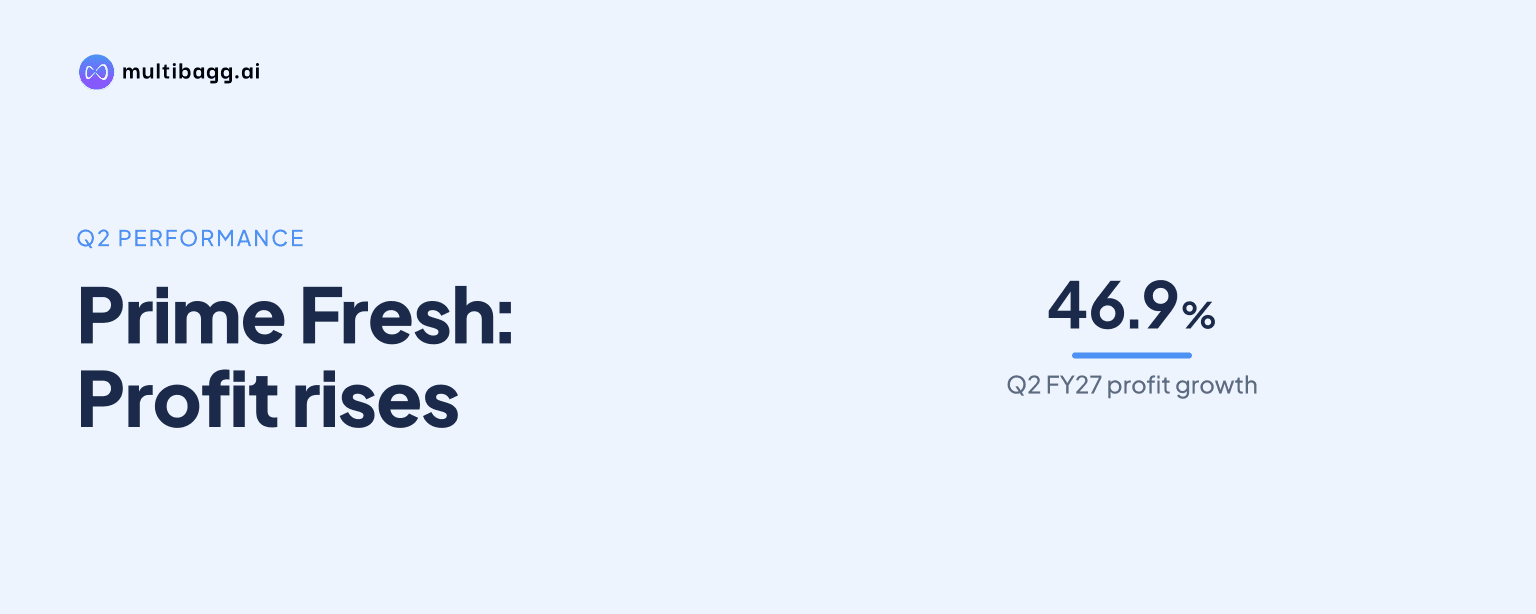
Prime Fresh Limited reported consolidated profit attributable to owners of ₹4.44 crore for the quarter ended September 30, 2026, a 46.9% year-on-year increase, while consolidated total income stood at ₹80.33 crore. The result matters because the fresh-produce distributor also recorded higher standalone profit and a larger consolidated income base during the quarter.
Know Prime Fresh inside out
Results, valuation, peers and who's buying, in one view.
What did Prime Fresh report for Q2 FY27?
Prime Fresh reported consolidated net profit of ₹4.95 crore in Q2 FY27, of which ₹4.44 crore was attributable to owners. Consolidated profit before tax was ₹6.73 crore and tax expense was ₹1.78 crore for the September quarter.
On a standalone basis, Prime Fresh posted net profit of ₹3.62 crore, representing year-on-year growth of 35.1%. Standalone profit before tax was ₹4.89 crore after total income of ₹61.88 crore and total expenses of ₹56.99 crore. The board approved the unaudited standalone financial results for the quarter and half year ended September 30, 2026.
The reported figures distinguish between the company's standalone operations and its consolidated performance. The consolidated statement includes results reported for the group, while the profit attributable to owners identifies the share attributable to the company's owners.
How did Prime Fresh's income and expenses move?
Prime Fresh's consolidated total income was ₹80.33 crore in Q2 FY27, while total expenses were ₹73.59 crore. The difference resulted in consolidated profit before tax of ₹6.73 crore before the reported tax charge.
Standalone total income reached ₹61.88 crore, compared with expenses of ₹56.99 crore. This produced standalone profit before tax of ₹4.89 crore and net profit of ₹3.62 crore. The available results provide the income and expense totals but do not give a detailed category-wise explanation for the changes.
For the first half of FY27, consolidated total income was ₹182.16 crore and net profit was ₹9.22 crore. Profit attributable to owners for the half year was ₹8.61 crore. Standalone total income for the six-month period was ₹126.69 crore, while standalone profit before tax was ₹9.82 crore.
What do the earnings-per-share figures show?
Prime Fresh reported consolidated basic earnings per share of ₹3.20 and diluted earnings per share of ₹3.18 for Q2 FY27. For the first half, consolidated basic and diluted earnings per share were ₹6.20 and ₹6.14, respectively.
Standalone basic earnings per share for the September quarter was ₹2.61, while diluted earnings per share was ₹2.59. The paid-up equity capital reported in the standalone results was ₹13.89 crore. Earnings per share is a per-share measure of the period's reported profit and is presented alongside the income statement results.
The gap between consolidated and standalone earnings per share is consistent with the difference between the two reported profit measures. Investors assessing the release can compare both sets of figures, particularly because the headline year-on-year growth figure of 46.9% applies to consolidated profit attributable to owners.
Got a follow-up? Ask IRIS
How does Q2 compare with Prime Fresh's Q1 FY27 performance?
Prime Fresh had reported Q1 FY27 revenue from operations of ₹61.71 crore, up 15.7% year on year, and net profit of ₹4.36 crore. In that quarter, profit attributable to owners was reported at ₹4.18 crore, while sales tonnage increased 68% year on year to 17,982 metric tonnes.
The company had also reported Q1 EBITDA of ₹6.07 crore, up 51.0% year on year, with an EBITDA margin of 9.83%. Management had cited performance in onions, mangoes and pomegranates, along with growth in the services business, as part of the operating context for that quarter.
Q2 standalone total income of ₹61.88 crore was broadly similar to the ₹61.71 crore revenue from operations reported for Q1, though these are not identical measures and should not be treated as a direct like-for-like comparison. The supplied Q2 results do not disclose EBITDA, sales tonnage, segment performance, or management commentary on product mix.
What does the Q2 result mean for investors and operations?
The Q2 release shows that Prime Fresh increased consolidated profit attributable to owners by 46.9% year on year and standalone net profit by 35.1%. Consolidated income of ₹80.33 crore and a half-year income total of ₹182.16 crore provide the reported scale of group operations during the period.
For investors, the main figures to track are the distinction between total consolidated net profit of ₹4.95 crore and the ₹4.44 crore attributable to owners, as well as the reported earnings per share. The release does not provide a share-price movement, forward guidance, or a detailed explanation of expense changes.
Prime Fresh had previously stated that it was pursuing backward and forward integration, including the Nashik Cluster Development Programme and value-added products. It had also indicated planned expansion in Uttar Pradesh, the Northeast and southern India. These initiatives provide context for the company's operating direction, but the Q2 financial statement does not quantify their contribution to the September-quarter results.
Conclusion
Prime Fresh delivered a higher Q2 FY27 profit, with consolidated profit attributable to owners rising 46.9% year on year to ₹4.44 crore. Consolidated total income was ₹80.33 crore, while standalone net profit reached ₹3.62 crore, reflecting higher reported profitability across both financial presentations.
The next disclosures to watch are any update on planned regional expansion, the Nashik Cluster Development Programme, value-added products, and the company's stated expectation of 15% to 25% consistent volume growth. Investors will also look for subsequent quarterly data on sales tonnage, margins and the contribution from the services business.