










Quadrant Televentures Limited NCLT Approves Resolution Plan
Key highlights
- The NCLT Mumbai Bench-I allowed Quadrant Televentures Limited's resolution plan on November 3, 2026.
- Quadrant Televentures' Committee of Creditors approved the plan with 100% voting support in August 2026.
- Quadrant Televentures had admitted secured financial creditor claims of ₹688.80 crore in its September 2025 claims list.
- The CIRP for Quadrant Televentures began on September 2, 2025.
powered by IRIS
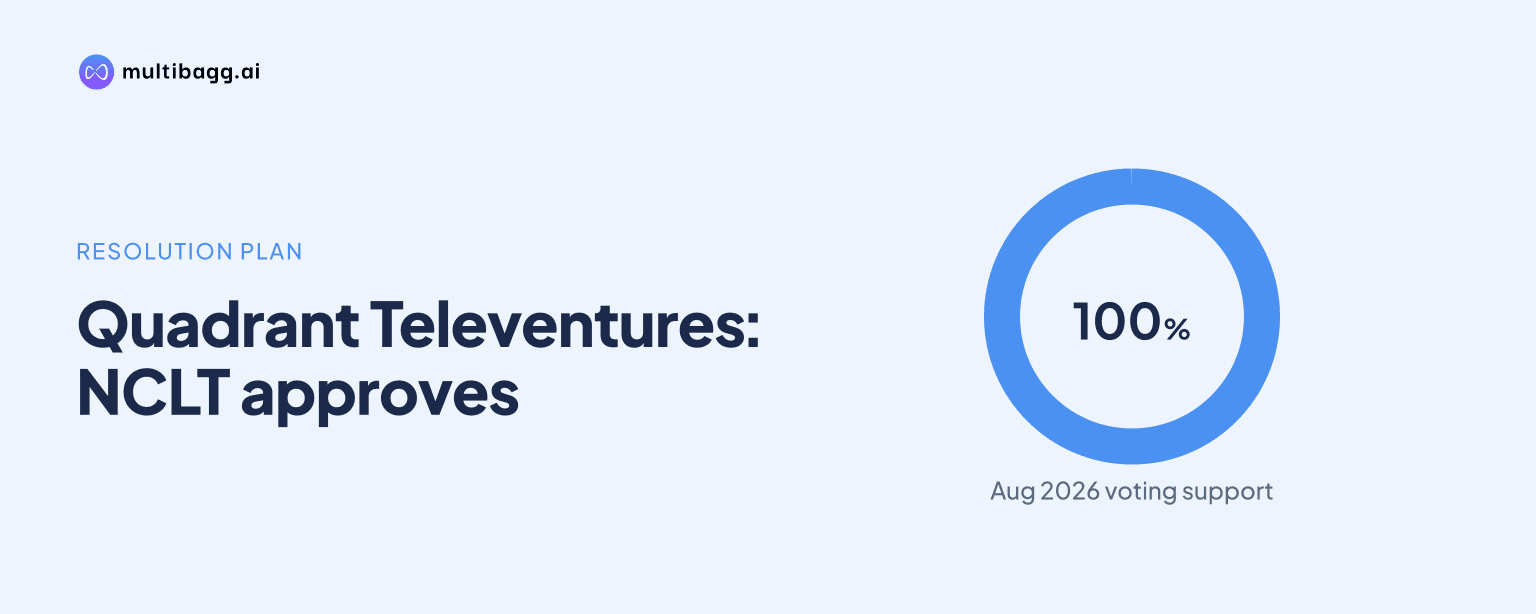
Quadrant Televentures Limited received approval from the National Company Law Tribunal, Mumbai Bench-I, for its corporate insolvency resolution plan on November 3, 2026, following 100% creditor approval for the plan in August 2026. The tribunal order is awaited, but the approval marks a formal step in the company’s process to exit insolvency proceedings.
Know Quadrant Televentures inside out
Results, valuation, peers and who's buying, in one view.
What did the NCLT approve for Quadrant Televentures Limited?
The National Company Law Tribunal, Mumbai Bench-I, allowed the resolution plan for Quadrant Televentures Limited on November 3, 2026. The company disclosed that the order is awaited. The approval concerns the resolution plan submitted under the Corporate Insolvency Resolution Process, or CIRP, governed by the Insolvency and Bankruptcy Code.
The tribunal’s approval follows the plan’s consideration by the Committee of Creditors, or CoC. A resolution plan sets out the proposed framework for resolving a distressed company’s obligations within the insolvency process. The source material does not disclose the plan’s financial terms, the identity of a successful resolution applicant, or the recovery proposed for individual creditors.
Quadrant Televentures operates under the Connect Broadband brand. Its CIRP began after an NCLT order dated September 2, 2025. The November 3 development therefore follows more than a year of creditor meetings, deadline revisions and filings before the Mumbai bench.
How did the resolution plan move through the insolvency process?
The resolution plan moved to the tribunal after the CoC approved it with 100% voting approval at its 12th meeting, disclosed on August 13, 2026. The company subsequently filed the approved plan with the NCLT Mumbai Bench for final approval on August 27, 2026.
The process involved several earlier extensions. At the ninth CoC meeting held on May 21, 2026, all four resolutions placed before creditors were approved with 77.19% voting in favour. These included ratification of extensions for submission of the resolution plan and for the CIRP timeline beyond May 30, 2026.
The deadline for submitting a resolution plan was extended from May 16, 2026, to May 20, 2026, and then to May 25, 2026. Earlier, an updated Form G filed with BSE on February 22, 2026 extended the final-list issue date for expressions of interest from March 18, 2026, to March 27, 2026.
After the August filing, the company reported the outcomes of its 17th and 18th CoC meetings. The provided disclosures do not specify the resolutions considered at those meetings. The available sequence indicates that creditor and tribunal processes continued after the plan was filed.
Got a follow-up? Ask IRIS
What creditor claims were reported during the CIRP?
The creditor lists supplied in the disclosures show substantial secured financial claims. As of September 16, 2025, secured financial creditors had claims of ₹826.69 crore, of which ₹688.80 crore was admitted. The list identified IDBI Bank Limited, through IDBI Trusteeship Services Limited, as the largest admitted creditor at ₹432.89 crore.
Life Insurance Corporation of India, through IDBI Trusteeship Services Limited, had ₹95.41 crore admitted, while Punjab National Bank, through IDBI Trusteeship Services Limited, had ₹96.89 crore admitted. Kotak Mahindra Bank Limited had ₹32.67 crore admitted and State Bank of India had ₹30.95 crore admitted. These figures are from the disclosed claims list and do not state eventual recoveries under the approved plan.
The company also reported related-party financial creditor claims of ₹1,811.41 crore, with ₹159.85 crore admitted. Akai Consumer Electronics Indian Limited accounted for the admitted amount in the cited list, while the claim from Electroparts (India) Private Limited was shown as not admitted.
Separate figures cited in the material included a ₹10.13 crore claim from the Telecom Regulatory Authority of India and a ₹70.10 crore claim from the Department of Telecommunications, with an aggregate amount of ₹132.46 crore shown in that section. The disclosures do not provide a distribution schedule under the resolution plan for these claims.
Why does the tribunal approval matter to creditors and investors?
The tribunal approval matters because it moves Quadrant Televentures beyond the stage of creditor selection and plan submission. The CoC had already voted unanimously in favour of the plan, and the NCLT’s approval is the next disclosed legal milestone. However, the detailed order remains awaited, so the source material does not establish the implementation timeline or the precise treatment of creditors.
For creditors, the resolution process is intended to determine recovery through an approved plan rather than through an unresolved insolvency proceeding. The reported admitted secured financial creditor claims of ₹688.80 crore show the scale of obligations considered in the CIRP. But neither the percentage recovery nor the payment timing is available in the provided disclosures.
For investors and market participants, the key confirmed fact is that the resolution plan has been allowed by the Mumbai Bench-I. The disclosures do not provide a revised business plan, funding arrangement, ownership structure, or operational target for Connect Broadband. Those matters cannot be inferred from the approval announcement alone.
What is the background to Quadrant Televentures Limited’s CIRP?
Quadrant Televentures entered CIRP on September 2, 2025, following the NCLT order cited in its filings. During the process, the company issued an updated invitation for expressions of interest and held successive CoC meetings as creditors considered extensions and the eventual plan.
The sequence highlights the formal stages of an insolvency resolution: invitation of interest, consideration of bids or plans, creditor voting, filing before the tribunal and judicial approval. In this case, the CoC approval announced in August 2026 and the NCLT decision in November 2026 are the principal disclosed end-stage events.
The available filings also show that the company’s creditor structure included banks, institutional creditors and telecom-related authorities. This makes the awaited tribunal order important because it should provide the formal basis for giving effect to the plan approved through the CIRP process.
Conclusion
Quadrant Televentures Limited has received NCLT approval for its resolution plan after the CoC gave the proposal 100% voting support. The decision is a significant procedural development in a CIRP that began in September 2025 and involved reported admitted secured financial creditor claims of ₹688.80 crore.
The next item to watch is the detailed NCLT order, which is awaited. The provided disclosures do not state the plan’s financial terms, creditor recoveries, implementation schedule or the resolution applicant, making the order the relevant source for further confirmed details.