










Quasar India enters CIRP as NCLT admits Rs 6.1452745 crore claim
Key highlights
- The NCLT admitted CIRP against Quasar India on October 31, 2026 for a Rs 6.1452745 crore claim.
- Bikit paid Quasar India a Rs 5.395 crore advance under a Rs 15 crore agricultural-goods purchase order.
- The NCLT found the first delivery was due by August 30, 2024 and no delivery or repayment was shown.
- Raghunath Bhandari was appointed interim resolution professional and Quasar India’s board powers stand suspended.
powered by IRIS
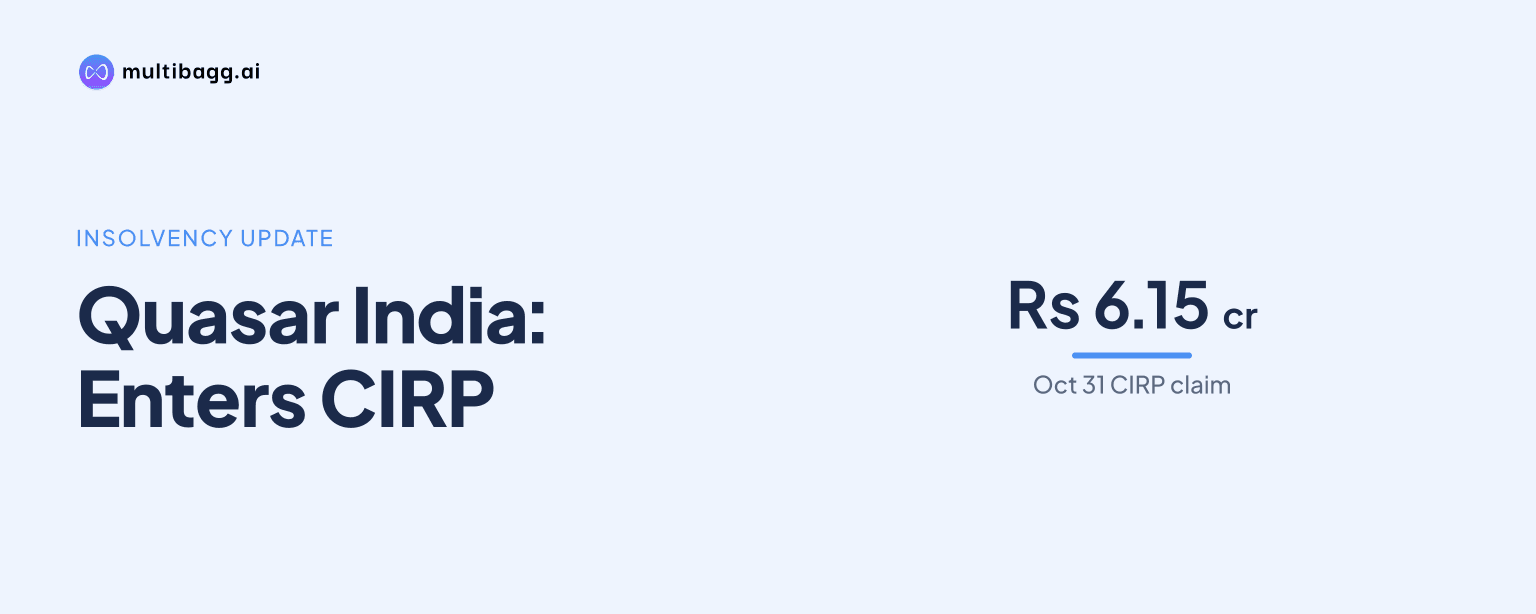
Quasar India Limited entered the Corporate Insolvency Resolution Process (CIRP) on October 31, 2026 after the National Company Law Tribunal (NCLT) admitted Bikit Private Limited’s Rs 6.1452745 crore operational-debt claim, including a Rs 5.395 crore advance paid for agricultural goods that were not delivered or refunded.
Know Quasar India inside out
Results, valuation, peers and who's buying, in one view.
Why did Quasar India enter CIRP?
Quasar India entered CIRP after the NCLT’s New Delhi Bench admitted Bikit’s Section 9 application under the Insolvency and Bankruptcy Code, 2016 (IBC), on October 31, 2026. Petition CP IB 697/ND/2025 claimed Rs 6.1452745 crore, comprising Rs 5.395 crore principal and Rs 75.02745 lakh of contractual simple interest at 12% a year.
The claim arose from a memorandum of understanding dated June 25, 2024, under which Quasar India was to supply agricultural and allied trading goods. Bikit’s purchase order of the same date had a value of Rs 15 crore, and the agreement required the first lot to be delivered within 60 days of receipt of the advance.
Bikit paid Rs 5.395 crore in three transfers: Rs 50 lakh on June 29, 2024, Rs 50 lakh on June 30, 2024, and Rs 4.395 crore on July 1, 2024. The NCLT held that a buyer’s claim for repayment of an advance connected with a supply transaction can qualify as operational debt under the IBC.
What did the NCLT find about Quasar India’s default?
The NCLT found that the first delivery was due by August 30, 2024 and that Quasar India had not shown delivery of goods or repayment of the Rs 5.395 crore advance. Under the agreement, the supplier had to refund the advance within 15 days of a written demand if it did not deliver on schedule or commence work within 60 days.
Bikit issued a written demand on September 9, 2024, seeking supply or a refund within 15 days. The tribunal treated September 24, 2024 as the final refund date and September 25, 2024 as the date of default. Bikit then issued a Form 3 demand notice under Section 8 of the IBC on November 22, 2025, with no payment recorded thereafter.
The NCLT did not finally determine the interest amount at admission. It said the claim, including interest under the memorandum, must be verified through the insolvency process. However, it found the Rs 5.395 crore principal independently established and above the notified default threshold.
Why did Quasar India’s payment argument not succeed?
Quasar India’s argument that Bikit had not paid a further 20% tranche did not succeed because the NCLT found that tranche was due only after delivery of the first lot. The memorandum required delivery, followed by the buyer’s acknowledgement and confirmation, before the next 20% payment became payable.
Quasar India had argued that Bikit’s non-payment within 60 days prevented supply. The NCLT distinguished the payment clause from the delivery schedule: the 60-day period set the supplier’s first-lot delivery deadline, rather than a deadline for Bikit to make the next payment. Since no first lot was delivered, the tribunal held that the further tranche had not fallen due.
The tribunal also rejected the contention that there was a pre-existing dispute. It recorded that Quasar India’s August 12, 2024 letter said supply would be completed within a week, while its August 30 letter apologised for delays attributed to suppliers and logistics. A October 12, 2024 letter acknowledged the refund obligation, cited supplier defaults and liquidity constraints, and sought two months to process the refund.
Those letters did not allege that Bikit had failed to pay an amount already due, according to the NCLT. Quasar India also said it was profit-making and that the IBC petition was a recovery action, but the tribunal said those submissions did not displace the evidence of unpaid operational debt under the applicable Section 9 test.
Got a follow-up? Ask IRIS
Who controls Quasar India and what does the moratorium cover?
Quasar India’s board powers stand suspended during CIRP and are exercised by interim resolution professional Raghunath Bhandari, whom the NCLT appointed on October 31, 2026. Quasar India’s disclosure stated that commencement of CIRP affects management and control in accordance with the IBC.
The NCLT directed Bikit to deposit Rs 2 lakh with Bhandari within one week of receiving the order for process expenses. The amount is subject to adjustment by the committee of creditors and is to be repaid to Bikit. Bhandari was also directed to submit written consent, registration documentation and a valid authorisation for assignment within five days of receiving the order.
The moratorium began on October 31, 2026, although the order was uploaded to the NCLT website on November 3, 2026. It continues until CIRP is completed, a resolution plan is approved, or Quasar India is ordered into liquidation. During that period, suits and proceedings against Quasar India, enforcement of judgments, asset transfers and security-enforcement actions are prohibited as set out in the order.
The order also bars recovery of property held by Quasar India by an owner or lessor. Licences, permits, registrations, quotas and concessions cannot be suspended solely due to insolvency, provided current dues for their use are paid. Essential goods or services specified under the IBC cannot be terminated, suspended or interrupted during the moratorium.
Conclusion
The NCLT’s admission places Quasar India in a statutory resolution process after it found documentary support for an unpaid Rs 5.395 crore advance tied to a Rs 15 crore agricultural-goods order. While Bikit’s petition totals Rs 6.1452745 crore with interest, the tribunal said the unpaid principal alone supported admission and found no genuine pre-existing dispute.
The next disclosed steps are Bikit’s Rs 2 lakh process-expense deposit within one week of receiving the order, the interim resolution professional’s required filings within five days, and verification of the interest component of Bikit’s claim. The moratorium remains effective from October 31, 2026 until completion of CIRP, approval of a resolution plan, or a liquidation order.