










Rajkot Investment Trust Declares Q2 FY27 Results on BSE
Key highlights
- Rajkot Investment Trust declared Q2 FY27 results on November 12, 2026.
- June 2026 quarterly sales were ₹0.22 crore, up 37.5% from ₹0.16 crore a year earlier.
- June 2026 net profit was ₹0.10 crore, unchanged year on year.
- FY26 sales were ₹0.574 crore, down 37.34% from ₹0.917 crore in FY25.
powered by IRIS
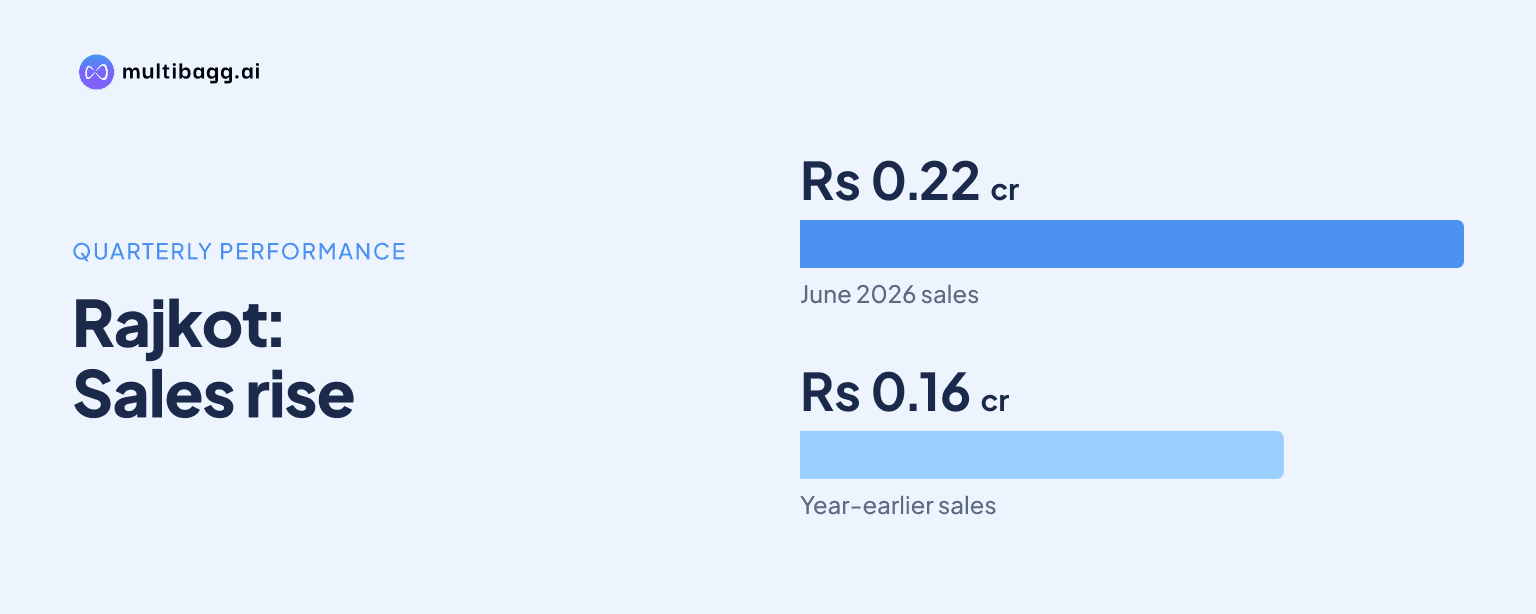
Rajkot Investment Trust Limited declared its second-quarter FY27 results on November 12, 2026, following a board meeting convened to approve unaudited standalone numbers for the quarter and half-year ended September 30, 2026. The latest financial figures were not included in the available disclosure, while Q1 sales stood at ₹0.22 crore.
Know Rajkot Investment Trust inside out
Results, valuation, peers and who's buying, in one view.
What did Rajkot Investment Trust announce on November 12, 2026?
Rajkot Investment Trust announced that its board would consider and approve unaudited standalone financial results for Q2 FY27 and the first half of FY27 at its November 12 meeting. The meeting was disclosed to BSE on November 5 under Regulation 33 of the SEBI Listing Obligations and Disclosure Requirements Regulations, 2015.
The available update states that results were declared on November 12, but it does not provide the Q2 FY27 revenue, profit, earnings per share, expenses, or balance-sheet figures. Investors therefore have confirmation of the results event, but need the detailed exchange filing to assess the company’s financial performance for the September quarter and six-month period.
Rajkot Investment Trust operates as a non-banking financial company, or NBFC, and is registered with the Reserve Bank of India. Its disclosed activities include financing and investment operations. The company was incorporated in 1982 and is headquartered in Surat, after its shareholders approved the shifting of the registered office from Rajkot to Surat.
The November 12 board agenda was specifically for standalone results. This distinction matters because the available quarterly performance table is described as consolidated, while the board-meeting intimation refers to standalone unaudited financial statements. The two reporting bases should not be treated as interchangeable unless the company’s detailed filing provides a reconciliation.
How did Rajkot Investment Trust perform in the June 2026 quarter?
Rajkot Investment Trust reported sales of ₹0.22 crore and net profit of ₹0.10 crore for the quarter ended June 2026, according to the available quarterly-results data. Sales increased 37.5% from ₹0.16 crore in the corresponding quarter a year earlier, while net profit was unchanged year on year.
The June-quarter sales figure was also higher than the ₹0.11 crore reported for the March 2026 quarter. The data indicates a recovery in reported quarterly sales after ₹0.04 crore in each of the September 2025 and December 2025 quarters. However, the small base means that percentage comparisons can vary sharply between periods.
The company’s reported trailing-twelve-month revenue was ₹0.628 crore and net income attributable to common shareholders was ₹0.128 crore in the available market data. These figures provide context for the scale of operations, but they are not a substitute for the company’s Q2 FY27 standalone filing.
What is the background to the company’s recent financial reporting?
Rajkot Investment Trust had previously approved audited financial results for the quarter and year ended March 31, 2026. Available annual income-statement data puts FY26 sales at ₹0.574 crore, down from ₹0.917 crore in FY25. That represents a 37.34% decline in reported annual sales.
For an earlier reporting period, the company said Q2 FY26 total revenue declined 52.73% year on year to ₹0.1075 crore, while net profit fell 36.93% to ₹0.0818 crore. It reported first-half FY26 revenue of ₹0.3331 crore and net profit of ₹0.1770 crore. The statutory auditors gave an unmodified review conclusion on those financial statements.
The company also stated that a routine regulatory inspection conducted by the Reserve Bank of India had been completed. Separately, it addressed a BSE notice related to compliance with SEBI insider-trading regulations, saying that it maintained the required entries in its system. The information provided does not indicate any financial penalty or further action arising from that notice.
Got a follow-up? Ask IRIS
Why do the Q2 FY27 results matter for investors?
The Q2 FY27 filing matters because it will show whether the improvement in June-quarter sales continued into the September quarter. For a small NBFC with modest reported revenue, quarterly changes in financing and investment income can materially affect year-on-year growth rates and profitability.
Investors will also need to examine the composition of revenue, operating expenses, profit after tax, loans or investments, and any changes in asset quality or provisioning disclosed in the standalone statements. None of these details are present in the results announcement available here, so conclusions on the September-quarter performance would be premature.
The company has also disclosed a board-approved plan to raise funds through a rights issue. The provided information does not specify the issue size, price, record date, use of proceeds, or timetable. Those terms would be important for shareholders because a rights issue can affect the company’s capital base and the number of shares held by investors who do not participate.
How could recent disclosures affect Rajkot Investment Trust’s operations?
Rajkot Investment Trust’s NBFC status places it within the RBI-regulated financial-services framework. Routine regulatory inspections, financial reporting, and listing-compliance disclosures are therefore relevant operational matters alongside quarterly profit and revenue. The company’s confirmation that the RBI inspection was completed provides an update on this process, but the supplied information contains no further findings.
The appointment of Ravindra Dhakar and Associates as internal auditor for FY27, based on the audit committee’s recommendation, is another governance-related disclosure. Internal-audit appointments are part of a company’s control framework, though the available material does not link the appointment to any specific operational issue or financial outcome.
For market participants, the immediate focus remains the detailed Q2 FY27 financial statement and any accompanying notes. These documents can clarify whether the June-quarter increase in sales was sustained, whether profitability changed, and whether the company has provided fresh details on the proposed rights issue.
Conclusion
Rajkot Investment Trust has confirmed the declaration of Q2 FY27 results after its board considered unaudited standalone financial statements for the September 2026 quarter and half-year. The available announcement does not disclose the latest financial figures, making the company’s detailed BSE filing essential for a full assessment. The most recent supplied quarterly data showed ₹0.22 crore in June 2026 sales and ₹0.10 crore in net profit.
The next item to watch is the detailed Q2 FY27 result disclosure, including revenue, profit, balance-sheet information, and management notes. Investors should also monitor further announcements on the approved rights issue, particularly its size, pricing, eligibility date, and stated use of funds.