










Rajkot Investment Trust filing conflicts on review status
Key highlights
- Rajkot Investment Trust reported Rs 18.92 lakh net profit for the six months ended 30 September 2026, compared with Rs 17.70 lakh a year earlier.
- The filing describes the September 2026 half-year figures as both limited-reviewed and neither reviewed nor audited.
- The auditor’s report dated 12 November 2026 says the Board approved the September 2026 statement on 14 February 2023.
- Rajkot Investment Trust reported non-current borrowings of Rs 27.3021 crore at 30 September 2026, down from Rs 28.7237 crore at 31 March 2026.
powered by IRIS
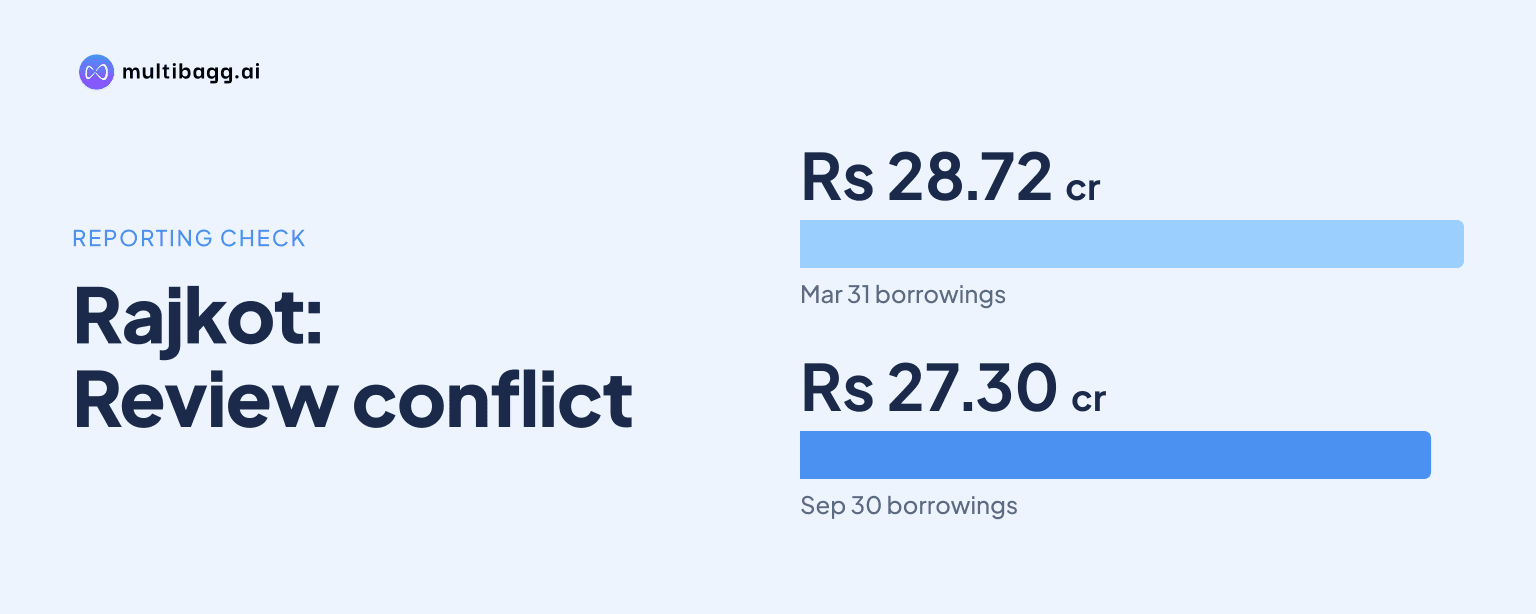
Rajkot Investment Trust Limited’s filing for the six months ended 30 September 2026 reports Rs 18.92 lakh net profit but gives incompatible statements on whether those figures were reviewed or audited. Its 12 November 2026 Board announcement and limited review report describe a review, while one results note says the half-year figures were neither reviewed nor audited.
Know Rajkot Investment Trust inside out
Results, valuation, peers and who's buying, in one view.
Did Rajkot Investment Trust’s September results receive a review?
Yes, most of Rajkot Investment Trust’s 12 November 2026 disclosure says the standalone results for the quarter and six months ended 30 September 2026 received a limited review. The Board announcement says the Board approved unaudited results, including the balance sheet and cash-flow statement, together with a Limited Review Report. It records that the meeting began at 3:30 p.m. and concluded at 4:15 p.m.
The results notes also state that the statutory auditors carried out a limited review of the standalone quarter and half-year figures and issued an unmodified review conclusion. C.P. Jaria & Co.’s report says it reviewed the unaudited standalone financial results for the quarter and six months ended 30 September 2026 under Standard on Review Engagement 2410, or SRE 2410.
However, another note in the same results package says the quarter ended 30 September 2025 and the six months ended 30 September 2026 were “neither reviewed nor subject to audit.” The note says management exercised due diligence to ensure that those figures presented a true and fair view. This conflicts directly with the stated limited review of the September 2026 quarter and half-year.
What Board approval date appears in the auditor’s report?
The auditor’s report says Rajkot Investment Trust’s Board approved the September 2026 statement at a meeting held on 14 February 2023. That date appears in the report’s description of management’s responsibility for the statement covering the quarter and six months ended 30 September 2026.
The company’s Board announcement instead says the Board approved the second-quarter and half-year results on 12 November 2026. The results notes likewise say the Audit Committee reviewed the results and the Board approved them at meetings held on 12 November 2026. The report itself is dated 12 November 2026 in Surat, creating a mismatch between its report date, reporting period and stated Board-approval date.
The filing does not explain whether 14 February 2023 was a clerical carryover or whether the report was amended before release. The discrepancy matters because the auditor’s report identifies the statement as prepared under Indian Accounting Standard 34, Interim Financial Reporting, and Regulation 33 of the Securities and Exchange Board of India’s Listing Obligations and Disclosure Requirements Regulations, 2015.
What did Rajkot Investment Trust report for September 2026?
Rajkot Investment Trust reported total revenue of Rs 47.29 lakh and net profit of Rs 18.92 lakh for the six months ended 30 September 2026. Total revenue was Rs 33.31 lakh in the corresponding six months ended 30 September 2025, while net profit was Rs 17.70 lakh. Basic and diluted earnings per share increased to Rs 1.89 from Rs 1.77.
Revenue from operations increased to Rs 35.92 lakh in the September 2026 half-year from Rs 19.93 lakh a year earlier. Other income declined to Rs 11.37 lakh from Rs 13.38 lakh, while total expenses rose to Rs 28.37 lakh from Rs 15.70 lakh. Profit before tax was Rs 18.92 lakh, compared with Rs 17.61 lakh in the prior-year period.
For the quarter ended 30 September 2026, Rajkot Investment Trust reported revenue from operations of Rs 13.74 lakh, down from Rs 22.18 lakh in the quarter ended 30 June 2026 but above Rs 4 lakh a year earlier. Quarterly total revenue was Rs 19.43 lakh and net profit was Rs 9.45 lakh, compared with Rs 9.56 lakh in the preceding quarter and Rs 8.18 lakh in the September 2025 quarter. The notes say there were no separate reportable segments under Indian Accounting Standard 108.
Got a follow-up? Ask IRIS
What other status conflict appears in Rajkot Investment Trust’s filing?
Rajkot Investment Trust’s cash-flow statement labels both its 30 September 2026 and 31 March 2026 columns as “Audited.” This differs from the Board announcement and financial-results heading, which present the September 2026 results as unaudited, and from the balance sheet, where the 30 September 2026 column is specifically labelled unaudited.
The cash-flow statement is headed as a statement for the half-year ended 30 September 2026, although its columns are described as “For the Year ended.” It reports net cash generated from operating activities of Rs 64.42 lakh, net cash from investing activities of Rs 91.18 lakh and net cash used in financing activities of Rs 1.5369 crore. Cash and cash equivalents rose to Rs 3.8192 crore at 30 September 2026 from Rs 3.8001 crore at the beginning of the year.
The balance sheet reports total assets of Rs 33.0673 crore at 30 September 2026, compared with Rs 34.40 crore at 31 March 2026. Non-current borrowings declined to Rs 27.3021 crore from Rs 28.7237 crore, while total equity increased to Rs 5.0489 crore from Rs 4.8597 crore. Other equity rose to Rs 4.0489 crore from Rs 3.8597 crore.
Why does the review and audit distinction matter?
A limited review and an audit are different procedures under the auditor’s own description. C.P. Jaria & Co. says its review was based primarily on inquiries of company personnel and analytical procedures, with the objective of obtaining moderate assurance that the financial statements were free from material misstatement.
The auditor expressly says it did not perform an audit and therefore did not express an audit opinion on the September 2026 statement. Its conclusion was that nothing came to its attention indicating that the statement failed to disclose the information required by Regulation 33, including the required manner of disclosure, or that it contained a material misstatement.
That review conclusion does not resolve the conflicting language elsewhere in the filing. The Board announcement refers to unaudited results accompanied by a Limited Review Report, the notes state both that a limited review occurred and that the half-year figures were neither reviewed nor audited, and the cash-flow statement labels its figures audited. The filing provides no reconciliation among those descriptions.
Conclusion
Rajkot Investment Trust’s September 2026 filing combines reported financial improvement with inconsistent assurance and approval disclosures. Half-year net profit increased to Rs 18.92 lakh from Rs 17.70 lakh, revenue from operations rose to Rs 35.92 lakh from Rs 19.93 lakh, and non-current borrowings fell to Rs 27.3021 crore from Rs 28.7237 crore. Yet the package uses conflicting review and audit labels for the same reporting period.
The next item to watch is whether Rajkot Investment Trust issues an exchange clarification or corrected filing addressing the 14 February 2023 Board-approval date in the 12 November 2026 auditor’s report. A clarification would also need to reconcile the note saying the September 2026 half-year was neither reviewed nor audited with the stated limited review and the cash-flow statement’s audited label.