










Rajnandini Metal Limited Q2 FY27 Revenue Falls 88.6%, Loss
Key highlights
- Rajnandini Metal Limited reported Q2 FY27 revenue of ₹8.11 crore, down 88.6% year-on-year.
- The company reported a Q2 FY27 net loss of ₹0.03 crore, against profit of ₹0.03 crore a year earlier.
- Q2 FY27 EBITDA was ₹0.52 crore and the reported EBITDA margin was 6.4%.
- GST and income-tax demands disclosed in the review report totalled ₹301.38 crore.
powered by IRIS
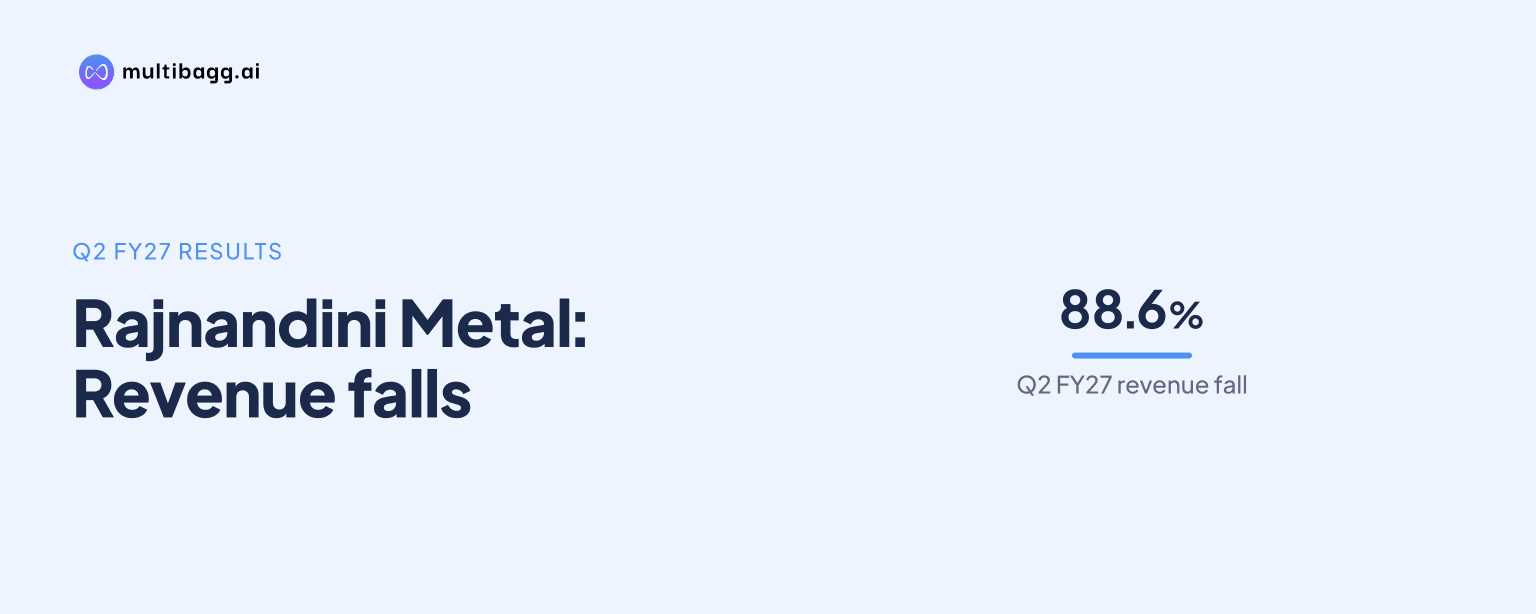
Rajnandini Metal Limited reported Q2 FY27 standalone revenue of ₹8.11 crore, an 88.6% year-on-year decline from ₹71.16 crore, and posted a net loss of ₹0.03 crore for the quarter ended September 30, 2026. The result also followed revenue of ₹51.95 crore and profit of ₹0.39 crore in the preceding quarter.
Know Rajnandini Metal inside out
Results, valuation, peers and who's buying, in one view.
How did Rajnandini Metal perform in Q2 FY27?
Rajnandini Metal reported a steep contraction in quarterly revenue, with revenue from operations falling to ₹8.11 crore from ₹71.16 crore in Q2 FY26. On a sequential basis, revenue declined 84.4% from ₹51.95 crore in Q1 FY27. Total income, including other income, stood at ₹8.22 crore, compared with ₹71.66 crore a year earlier and ₹52.61 crore in the prior quarter.
The company recorded EBITDA of ₹0.52 crore in Q2 FY27, lower than ₹0.70 crore in Q2 FY26 and ₹1.04 crore in Q1 FY27. However, the reported EBITDA margin was 6.4%, against 1.0% a year earlier and 2.0% sequentially, reflecting the much lower revenue base during the quarter.
Profit before tax came in at ₹0.02 crore, compared with ₹0.13 crore in the year-ago period and ₹0.52 crore in Q1 FY27. After a tax charge of ₹0.05 crore, Rajnandini Metal reported a net loss of ₹0.03 crore. It had reported a net profit of ₹0.03 crore in Q2 FY26 and ₹0.39 crore in Q1 FY27. Basic earnings per share were ₹0.00.
Why did the quarterly comparison weaken sharply?
The reported figures show that the principal driver of the weak comparison was the reduction in revenue from operations. Revenue fell by ₹63.05 crore from the corresponding quarter of the prior year and by ₹43.84 crore from Q1 FY27. Total expenses also declined substantially, broadly in line with the reduction in activity, falling to ₹8.20 crore from ₹71.53 crore a year earlier.
Despite the higher reported EBITDA margin, absolute EBITDA declined by ₹0.18 crore year-on-year and by ₹0.52 crore quarter-on-quarter. The movement illustrates that percentage margins should be read alongside the underlying scale of revenue and operating profit. The company did not provide a consolidated result in the material provided, and the figures are standalone.
The quarter also marked a reversal from the immediately preceding three months, when Rajnandini Metal reported profit after tax of ₹0.39 crore. The Q2 loss was small in absolute terms, but it followed a significant sequential decline in total income and profit before tax.
Got a follow-up? Ask IRIS
What was Rajnandini Metal's first-half FY27 performance?
For H1 FY27, Rajnandini Metal reported revenue of ₹60.06 crore, down 58.6% from ₹145.04 crore in H1 FY26. The half-year performance includes the stronger first-quarter revenue of ₹51.95 crore and the sharply lower Q2 revenue of ₹8.11 crore.
Profit after tax for the first half was ₹0.36 crore, compared with a net loss of ₹1.96 crore in H1 FY26. This means the company remained profitable for the six-month period despite the second-quarter loss. The comparison also indicates that the first-quarter profit of ₹0.39 crore accounted for the bulk of the H1 FY27 profit.
The first-half figures present a mixed operating picture. Revenue was lower on a year-on-year basis, while the company moved from a loss to a profit at the net level. The available results do not include management guidance or an earnings-call transcript explaining the quarterly revenue movement.
What tax demands did the auditor highlight?
The standalone limited review report highlighted GST demands aggregating ₹290.70 crore and an income-tax demand of ₹10.68 crore. The GST demand includes interest and penalty and relates to alleged availment of ineligible input tax credit, according to the information provided with the results.
Management has filed appeals against these demands. It has maintained that the input tax credit was legitimately availed and that no provision is required in the current financial results. The auditor stated that it was unable to comment on the ultimate outcome and consequential impact of the proceedings.
These amounts are substantially larger than the company's quarterly revenue and reported profit figures, making the disclosed proceedings a material item for investors assessing the standalone financial statements. The demands remain under appeal, and the results do not record a provision for them based on management's assessment.
How do the Q2 results affect investors and operations?
For investors, the key financial data points are the 88.6% year-on-year revenue decline, the return to a quarterly net loss, and the fall in absolute EBITDA. The 6.4% EBITDA margin was higher than the comparable periods, but EBITDA in rupee terms was lower both year-on-year and sequentially.
The results also put focus on revenue consistency in the second half of FY27. Rajnandini Metal generated ₹60.06 crore of H1 revenue, with more than 86% of that amount reported in Q1 FY27. The quarterly pattern shows a substantial difference between the first and second quarters of the year.
The tax proceedings are a separate consideration from quarterly operating performance. Their eventual resolution is not specified in the filing, while management's position remains that no provision is necessary. Investors therefore have the reported operating figures, the disclosed demands, and the pending appeals as distinct factors to monitor.
Conclusion
Rajnandini Metal's Q2 FY27 standalone result was marked by a sharp reduction in revenue to ₹8.11 crore and a net loss of ₹0.03 crore. While the reported EBITDA margin improved, lower revenue and lower absolute EBITDA resulted in weaker profit before tax and a reversal from profit in both Q1 FY27 and Q2 FY26.
The next reported results will show whether revenue activity changes after the weak September quarter. Investors will also watch developments in the company's appeals against the ₹290.70 crore GST demand and ₹10.68 crore income-tax demand, for which management has not made a provision.