










Rajnandini Metals review qualified over Rs 301.38 crore tax demands
Key highlights
- Krishna & Associates qualified its review of Rajnandini Metals’ September 30, 2026 standalone results.
- The GST order totals Rs 290.70 crore, including Rs 98.42 crore of interest and Rs 96.14 crore of penalty.
- A Rs 10.68 crore income-tax demand takes Rajnandini Metals’ combined disputed demands to Rs 301.38 crore.
- Rajnandini Metals reported a half-year profit of Rs 36 lakh, compared with a Rs 1.96 crore loss a year earlier.
powered by IRIS
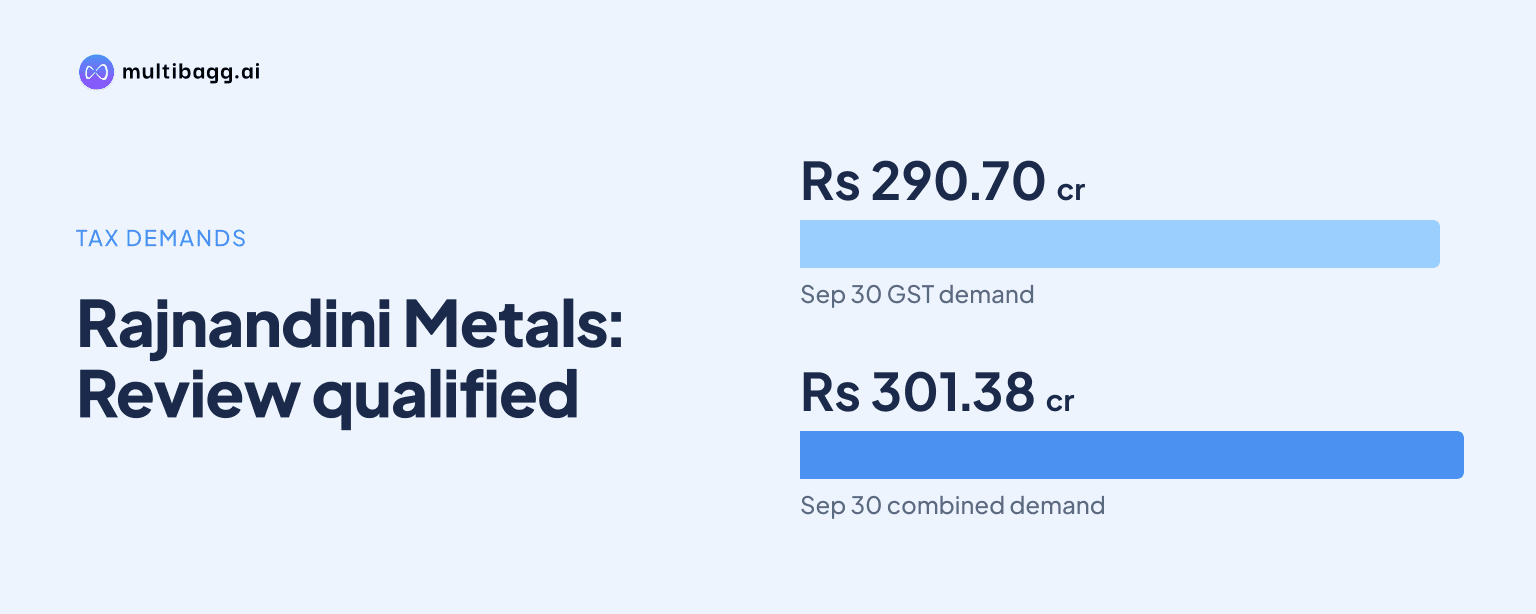
Rajnandini Metals Limited’s limited review for the quarter and half year ended September 30, 2026 was qualified because its auditor could not determine the eventual financial effect of Rs 301.38 crore in disputed GST and income-tax demands, for which management made no provision in the results.
Know Rajnandini Metal inside out
Results, valuation, peers and who's buying, in one view.
Why was Rajnandini Metals’ September 2026 review qualified?
Rajnandini Metals’ review was qualified because Krishna & Associates could not comment on the ultimate outcome or consequential financial impact of its pending GST and income-tax proceedings. The November 14, 2026 report covered unaudited standalone results for the quarter ended September 30, 2026 and the six months from April 1, 2026 to September 30, 2026.
The auditor stated that management considers no provision necessary while the proceedings remain unresolved. Except for the possible effects of this matter, Krishna & Associates said nothing came to its attention indicating that the financial statements did not make disclosures required under Regulation 33 of the Securities and Exchange Board of India, or SEBI, listing regulations.
The engagement was a limited review under Standard on Review Engagements, or SRE, 2410, rather than a full audit. The auditor said a review uses enquiries and analytical procedures and provides moderate assurance, but is substantially less extensive than an audit and does not result in an audit opinion.
What is included in Rajnandini Metals’ GST demand?
Rajnandini Metals’ GST demand totals Rs 290.70 crore, comprising Rs 96.14 crore of alleged ineligible input tax credit, Rs 98.42 crore of interest and Rs 96.14 crore of penalty. GST authorities issued the order under Section 74 of the Central Goods and Services Tax Act, 2017 on January 16, 2025.
The order followed a search of Rajnandini Metals’ business premises during the financial year ended March 31, 2025. The authorities alleged that the business had claimed fraudulent and ineligible GST input credit in earlier years, an allegation Rajnandini Metals disputes.
Rajnandini Metals said it has appealed the entire GST demand before the appellate authority. Management said it believes the input credit was legitimately claimed and cited supporting documents, the facts of the case and legal advice in concluding that the GST liability will not crystallise.
What is the status of Rajnandini Metals’ income-tax demand?
Rajnandini Metals faces a separate income-tax demand of Rs 10.68 crore that was raised during the financial year ended March 31, 2026. The auditor included this matter with the GST proceedings in the basis for its qualified conclusion.
Rajnandini Metals said it is seeking legal recourse and has appealed to the appropriate authorities for deletion of the entire income-tax demand. The filing does not provide a split between tax, interest and penalty, or disclose a hearing date, settlement amount or expected completion date.
The GST and income-tax matters therefore arose in different financial years and involve different authorities. Their common accounting feature is that management made no provision in the September 30, 2026 results, while the auditor could not determine their eventual financial effect.
Got a follow-up? Ask IRIS
How do Rajnandini Metals’ tax demands compare with its finances?
The Rs 301.38 crore combined disputed demands are larger than Rajnandini Metals’ reported total assets of Rs 110.33 crore and total equity of Rs 56.78 crore at September 30, 2026. This comparison indicates the scale of the disputes against reported balance-sheet figures, but does not establish a final liability because both matters are under appeal.
Rajnandini Metals reported total income of Rs 60.83 crore for the half year ended September 30, 2026, down from Rs 146.08 crore in the corresponding 2025 half year. The business identified manufacturing and trading of copper wires as its single operating segment under Indian Accounting Standard, or Ind AS, 108.
The half-year result moved to a profit of Rs 36 lakh from a loss of Rs 1.96 crore a year earlier, while profit before tax moved to Rs 54 lakh from a loss before tax of Rs 2.33 crore. Net operating cash flow declined to Rs 1.91 crore from Rs 18.16 crore, and these reported figures do not include a provision for the disputed demands.
At September 30, 2026, Rajnandini Metals held cash and cash equivalents of Rs 8 lakh, compared with Rs 17 lakh at March 31, 2026. Total liabilities declined to Rs 53.55 crore from Rs 62.76 crore over the same period, while total equity increased to Rs 56.78 crore from Rs 56.34 crore.
What did Rajnandini Metals report for September 2026?
Rajnandini Metals reported a loss of Rs 3 lakh for the quarter ended September 30, 2026, compared with a profit of Rs 3 lakh in the corresponding quarter of 2025. Quarterly total income fell to Rs 8.22 crore from Rs 71.66 crore, while total expenses fell to Rs 8.20 crore from Rs 71.53 crore.
For the six months ended September 30, 2026, Rajnandini Metals recorded Rs 18 lakh of total tax expense, comprising Rs 27 lakh of current tax and a deferred-tax credit of Rs 9 lakh. That reported tax expense is separate from the Rs 290.70 crore GST matter and the Rs 10.68 crore income-tax demand addressed by the qualified review.
Current borrowings decreased to Rs 2.34 crore at September 30, 2026 from Rs 4.21 crore at March 31, 2026. Non-current borrowings increased to Rs 9.59 crore from Rs 9.12 crore, while trade payables to creditors other than micro and small enterprises declined to Rs 34.61 crore from Rs 43.31 crore.
Conclusion
The qualified review centres on Rajnandini Metals’ no-provision treatment for Rs 301.38 crore of disputed tax demands, rather than a conclusion that the September 2026 financial results are materially misstated. Management contests the GST allegation and is pursuing appeals for both the GST and income-tax demands, but the auditor cannot determine their final financial impact while proceedings remain pending.
The next development to watch is the outcome of Rajnandini Metals’ appeal against the January 16, 2025 GST order and its legal recourse over the Rs 10.68 crore income-tax demand raised in the year ended March 31, 2026. Any appellate decision, settlement or revised assessment could affect whether management continues to record no provision in future standalone results.