










Ram Ratna Wires Limited FY26 EBITDA outpaced revenue growth
Key highlights
- RRWL’s FY26 consolidated EBITDA rose 68.6% to Rs 263.6 crore, outpacing the 40.8% increase in revenue to Rs 5,176.6 crore.
- RRWL’s EBITDA margin improved to 5.1% in FY26 from 4.3% in FY25, while gross margin increased to 10.1% from 9.1%.
- RRWL’s FY26 profit for the period increased 54.7% to Rs 108.6 crore, and ROCE rose to 25.1% from 22.4%.
- RRWL’s total borrowings increased to Rs 654.1 crore at March 2026 from Rs 296.2 crore a year earlier, taking net debt to equity to 0.46 times.
powered by IRIS
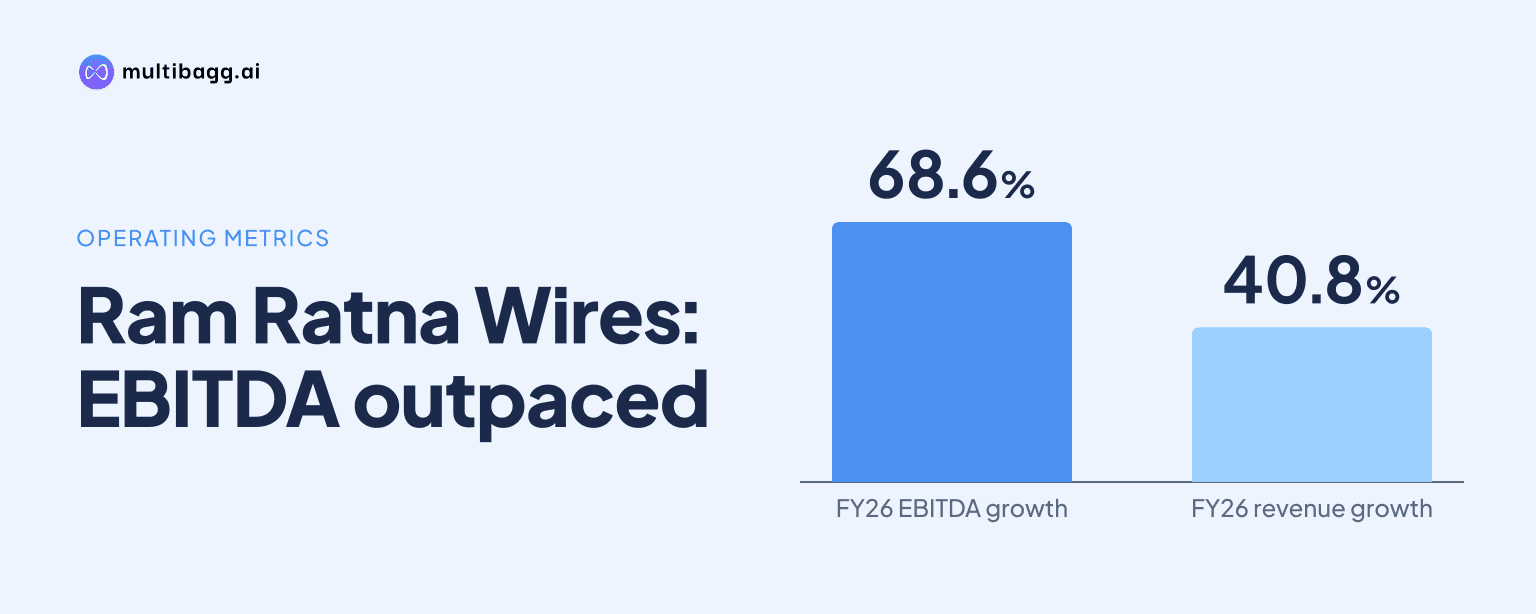
Ram Ratna Wires Limited reported that FY26 consolidated EBITDA increased 68.6% to Rs 263.6 crore, exceeding the 40.8% rise in revenue from operations to Rs 5,176.6 crore. The resulting EBITDA margin reached 5.1%, versus 4.3% in FY25, while profit for the period rose 54.7% to Rs 108.6 crore.
Know Ram Ratna Wires inside out
Results, valuation, peers and who's buying, in one view.
How did RRWL's FY26 earnings compare with revenue growth?
RRWL's FY26 EBITDA and profit grew faster than revenue. Consolidated revenue from operations increased to Rs 5,176.6 crore in FY26 from Rs 3,676.7 crore in FY25, while EBITDA rose to Rs 263.6 crore from Rs 156.3 crore and profit for the period increased to Rs 108.6 crore from Rs 70.2 crore.
The FY26 change extended the trend reported across the past three financial years. Revenue from operations rose from Rs 2,649.6 crore in FY23 to Rs 5,176.6 crore in FY26, a 25.0% compound annual growth rate, or CAGR. EBITDA increased from Rs 108.7 crore to Rs 263.6 crore over that period, representing a 34.4% CAGR, while profit for the period rose from Rs 47.0 crore to Rs 108.6 crore at a 32.2% CAGR.
From FY24 to FY26, revenue rose 73.5% from Rs 2,983.3 crore, whereas EBITDA increased 2.2 times from Rs 119.0 crore and profit for the period rose 98.9% from Rs 54.6 crore. RRWL described growth as consistent across its Winding Wires and Copper Tubes core businesses, although the presentation does not provide separate segment revenue or profit figures.
Why did RRWL's EBITDA margin reach 5.1% in FY26?
RRWL's EBITDA margin reached 5.1% in FY26, up from 4.3% in FY25 and 4.0% in FY24. The 0.8-percentage-point increase from FY24 accompanied EBITDA growth of Rs 144.6 crore over two years, compared with a Rs 2,193.3 crore increase in revenue from operations. The presentation states that EBITDA excludes other income.
Gross margin also increased in FY26. Gross profit was Rs 522.4 crore, compared with Rs 335.9 crore in FY25 and Rs 270.1 crore in FY24, while gross margin was 10.1% in FY26 against 9.1% in both earlier years. Compared with the FY23 gross margin of 9.3%, the FY26 result was 0.8 percentage points higher.
Earnings before interest and tax, or EBIT, rose to Rs 244.2 crore in FY26 from Rs 152.0 crore in FY25. Profit before exceptional items and tax increased to Rs 156.5 crore from Rs 97.2 crore, but FY26 included Rs 3.6 crore of exceptional items, leaving reported profit before tax, or PBT, at Rs 153.0 crore. FY25 and FY24 recorded no exceptional items in the presentation.
Got a follow-up? Ask IRIS
How did RRWL's net profit and returns change in FY26?
RRWL's profit after tax, or PAT, margin increased to 2.1% in FY26 from 1.9% in FY25 and 1.8% in FY24. Profit for the period increased by Rs 38.4 crore year on year to Rs 108.6 crore, after reported tax expense rose to Rs 44.4 crore from Rs 27.0 crore.
The FY26 tax expense was recorded against PBT of Rs 153.0 crore, compared with FY25 tax expense of Rs 27.0 crore on PBT of Rs 97.2 crore. In FY24, RRWL reported Rs 20.0 crore of tax expense, PBT of Rs 74.6 crore and profit for the period of Rs 54.6 crore. The FY26 profit figure therefore reflects the exceptional-item charge and a higher tax expense.
Reported returns rose alongside the earnings increase. Return on equity was 20.9% in FY26, compared with 15.3% in FY25 and 14.4% in FY24. Return on capital employed, or ROCE, increased to 25.1% from 22.4% in FY25 and was 6.3 percentage points above the FY24 level of 18.8%.
What balance-sheet changes accompanied RRWL's FY26 growth?
RRWL's FY26 growth was accompanied by increases in fixed assets, inventories, receivables and borrowings. Property, plant and equipment rose to Rs 565.4 crore at March 2026 from Rs 351.7 crore at March 2025. Inventories increased to Rs 486.1 crore from Rs 233.7 crore, while trade receivables rose to Rs 640.6 crore from Rs 390.1 crore.
Total borrowings were Rs 654.1 crore at March 2026, compared with Rs 296.2 crore a year earlier. The March 2026 balance comprised Rs 265.3 crore of non-current borrowings and Rs 388.8 crore of current borrowings. Total assets increased to Rs 1,993.5 crore from Rs 1,300.4 crore, while total equity rose to Rs 584.9 crore from Rs 487.7 crore.
RRWL stated that inventories and receivables rise with volumes and copper prices independently of capital expenditure. Net debt to equity increased to 0.46 times in FY26 from 0.34 times in FY25 and 0.20 times in FY24. The presentation also reported long-term bank facilities rated CARE A- with a Stable outlook and short-term facilities rated CARE A2+.
The presentation separately discloses a proposed acquisition of EPACK Durable's 50% stake in EPAVO Electricals for Rs 15 crore, with expected closing on 30 November 2026. RRWL said the transaction would make EPAVO a wholly owned subsidiary and would result in a one-time non-cash standalone loss on investment of Rs 7.12 crore, with no cash impact.
Conclusion
RRWL's FY26 figures show a widening gap between revenue and earnings growth: revenue increased 40.8%, EBITDA increased 68.6% and profit for the period increased 54.7%. Gross margin rose to 10.1%, EBITDA margin reached 5.1%, PAT margin was 2.1%, and ROCE increased to 25.1%, while the balance sheet also carried higher inventory, receivables and borrowings.
The next disclosed event to watch is the expected 30 November 2026 closing of the Rs 15 crore EPAVO stake acquisition and the related Rs 7.12 crore one-time non-cash standalone loss. RRWL also identifies volumes and copper prices as drivers of working capital, following the March 2026 increase in inventories to Rs 486.1 crore and receivables to Rs 640.6 crore.