










Ram Ratna Wires Limited ROCE reached 25.1% as debt rose
Key highlights
- Ram Ratna’s ROCE rose to 25.1% in FY26 from 22.4% in FY25.
- Total borrowings increased by Rs 357.9 crore to Rs 654.1 crore at March 2026 from Rs 296.2 crore a year earlier.
- Revenue from operations grew 40.8% to Rs 5,176.6 crore in FY26, while EBITDA margin widened to 5.1% from 4.3%.
- Net debt-to-equity increased to 0.46 times in FY26 from 0.34 times in FY25.
powered by IRIS
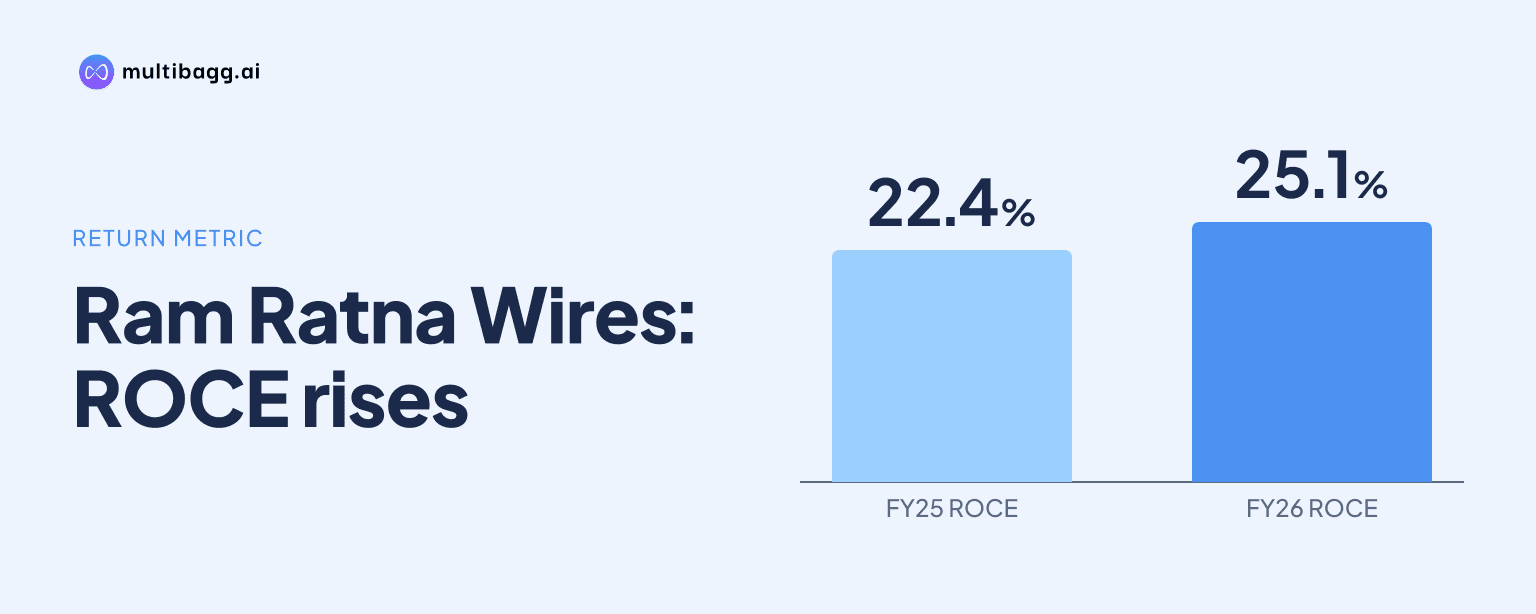
Ram Ratna reported return on capital employed, or ROCE, of 25.1% in FY26, up from 22.4% in FY25, while total borrowings rose from Rs 296 crore to Rs 654 crore. Its presentation links the increase to Rs 565 crore of plant and equipment and larger copper-linked inventories and receivables as revenue grew 40.8%.
Know Ram Ratna Wires inside out
Results, valuation, peers and who's buying, in one view.
Why did Ram Ratna’s borrowings rise to Rs 654 crore?
Ram Ratna’s borrowings rose because asset investment and working-capital needs expanded with FY26 revenue growth. Total borrowings increased by Rs 357.9 crore, from Rs 296.2 crore at March 2025 to Rs 654.1 crore at March 2026, based on the detailed consolidated balance sheet. Revenue from operations increased to Rs 5,176.6 crore in FY26 from Rs 3,676.7 crore in FY25.
Current borrowings accounted for most of the increase. They rose by Rs 283.6 crore to Rs 388.8 crore at March 2026 from Rs 105.2 crore a year earlier, while non-current borrowings increased by Rs 74.3 crore to Rs 265.3 crore. The presentation’s rounded balance-sheet summary reports total borrowings of Rs 654 crore at March 2026.
The presentation identifies plant and equipment, inventories and trade receivables as the main asset categories associated with the expanded funding. Plant and equipment increased to Rs 565.4 crore at March 2026 from Rs 351.7 crore at March 2025. Inventories rose to Rs 486.1 crore from Rs 233.7 crore, while trade receivables increased to Rs 640.6 crore from Rs 390.1 crore.
Ram Ratna says working capital is copper-linked, with inventories and receivables rising with volumes and copper prices independently of capital expenditure. The Rs 252.4 crore increase in inventories and Rs 250.5 crore increase in receivables together exceeded the Rs 213.7 crore increase in property, plant and equipment between March 2025 and March 2026.
How did Ram Ratna’s assets change in FY26?
Ram Ratna’s total assets increased to Rs 1,993.5 crore at March 2026 from Rs 1,300.4 crore at March 2025. Total current assets rose by Rs 539.6 crore to Rs 1,252 crore, while total non-current assets increased by Rs 153.6 crore to Rs 741.6 crore.
Property, plant and equipment became the largest non-current asset line, reaching Rs 565.4 crore at March 2026. Capital work-in-progress declined to Rs 33.6 crore from Rs 113.5 crore, while other non-current assets increased to Rs 142.6 crore from Rs 122.8 crore, shifting the non-current asset mix toward plant and equipment.
Cash and cash equivalents remained smaller than the main working-capital balances, rising to Rs 7.8 crore at March 2026 from Rs 1.7 crore a year earlier. Other current assets increased to Rs 117.5 crore from Rs 86.9 crore. Inventories and trade receivables together reached Rs 1,126.7 crore at March 2026.
Got a follow-up? Ask IRIS
Did Ram Ratna’s higher capital base improve returns?
Yes. Ram Ratna reported ROCE of 25.1% in FY26, compared with 22.4% in FY25 and 18.8% in FY24. Return on equity, or ROE, also rose to 20.9% in FY26 from 15.3% in FY25 and 14.4% in FY24.
The presentation says earnings followed capital, with FY26 revenue from operations growing 40.8% and ROCE increasing from 22.4% to 25.1%. Earnings before interest, tax, depreciation and amortisation, or EBITDA, rose to Rs 263.6 crore in FY26 from Rs 156.3 crore in FY25. EBITDA margin widened to 5.1% from 4.3%.
Profit after tax increased to Rs 108.6 crore in FY26 from Rs 70.2 crore in FY25, while profit before tax rose to Rs 153 crore from Rs 97.2 crore. The presentation states that FY26 profit before tax was after Rs 3.6 crore of exceptional items. Net profit margin was 2.1% in FY26, compared with 1.9% in FY25.
Across FY24 to FY26, revenue from operations rose from Rs 2,983 crore to Rs 5,177 crore and EBITDA increased from Rs 119 crore to Rs 264 crore on the presentation’s rounded figures. Ram Ratna reports 73.5% revenue growth, 2.2 times EBITDA growth and 98.9% profit-after-tax growth across the period, with Winding Wires and Copper Tubes identified as core-business contributors.
What happened to Ram Ratna’s leverage and equity base?
Ram Ratna’s net debt-to-equity ratio increased to 0.46 times in FY26 from 0.34 times in FY25 and 0.20 times in FY24. The ratio therefore increased by 0.12 times in FY26 as borrowings supported additional plant and working capital.
Total equity increased to Rs 584.9 crore at March 2026 from Rs 487.7 crore at March 2025. Other equity rose by Rs 71.5 crore to Rs 532.8 crore, while equity share capital increased to Rs 46.7 crore from Rs 22 crore. Non-controlling interest rose to Rs 5.4 crore from Rs 4.4 crore.
Total current liabilities increased to Rs 1,089.9 crore at March 2026 from Rs 598 crore a year earlier. Other current liabilities and provisions rose to Rs 701.1 crore from Rs 492.8 crore, alongside the increase in current borrowings to Rs 388.8 crore from Rs 105.2 crore. Total non-current liabilities rose to Rs 318.7 crore from Rs 214.6 crore.
The presentation reports a CARE A- (Stable) rating for long-term bank facilities and CARE A2+ for short-term facilities. It discloses these ratings alongside the net debt-to-equity trend but does not provide an interest-expense figure, debt-maturity schedule or a future leverage target.
Conclusion
Ram Ratna’s FY26 expansion coincided with higher operating earnings and returns. Borrowings increased from Rs 296 crore to Rs 654 crore as plant and equipment, inventories and receivables expanded, while ROCE rose from 22.4% to 25.1%, EBITDA margin reached 5.1% and profit after tax increased to Rs 108.6 crore.
The next measure to watch is whether revenue and returns continue to rise while the enlarged working-capital base is carried. Ram Ratna identifies copper prices and sales volumes as drivers of inventories and receivables, and it reported net debt-to-equity of 0.46 times in FY26 without disclosing a debt-reduction target or maturity schedule.