










Ramco Cements operating cash flow falls 58% in first half
Key highlights
- Ramco Cements’ operating cash flow fell 58% to Rs 273.61 crore in the half-year ended 30 September 2026.
- Trade payables and other liabilities used Rs 250.40 crore of cash, versus a Rs 27.74 crore inflow a year earlier.
- Revenue from operations rose to Rs 4,735.80 crore from Rs 4,312.76 crore, while profit before tax fell to Rs 95.41 crore.
- Cash and cash equivalents for cash-flow reporting closed at Rs 24.15 crore, down from Rs 188.32 crore at the start of the half-year.
powered by IRIS
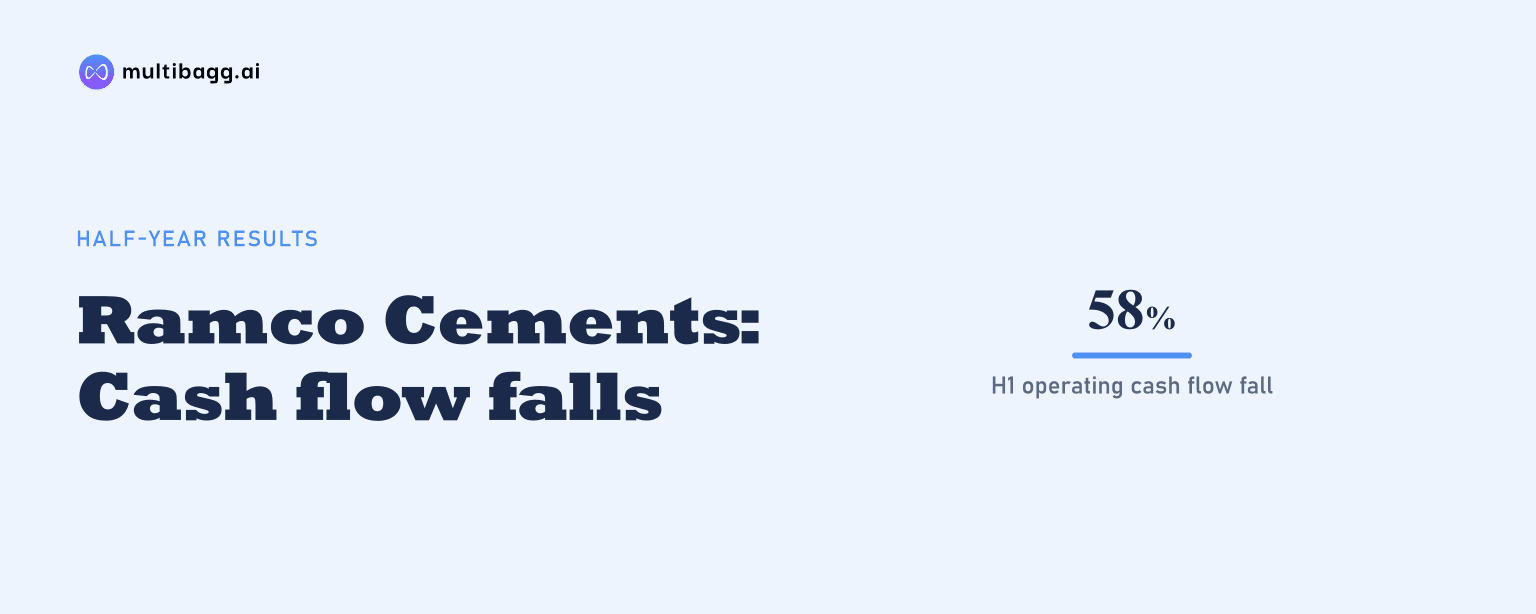
The Ramco Cements Limited reported net operating cash flow of Rs 273.61 crore for the half-year ended 30 September 2026, down 58% from Rs 645.74 crore a year earlier, as a Rs 250.40 crore outflow in trade payables and other liabilities reduced cash generated from operations. Ramco Cements remained profitable, but its pre-tax profit also declined to Rs 95.41 crore.
Know The Ramco Cements inside out
Results, valuation, peers and who's buying, in one view.
Why did Ramco Cements’ operating cash flow decline?
Ramco Cements’ operating cash flow declined because working-capital movements turned materially more negative in the half-year ended 30 September 2026. Net cash generated from operating activities was Rs 273.61 crore, compared with Rs 645.74 crore in the corresponding half-year of 2025, a fall of Rs 372.13 crore. Cash generated from operations before direct taxes was Rs 288.88 crore, down from Rs 654.24 crore, while direct taxes paid increased to Rs 15.27 crore from Rs 8.50 crore.
The starting level of operating profit before working-capital changes also decreased, to Rs 641.74 crore from Rs 805.13 crore. Profit before tax was Rs 95.41 crore, versus Rs 214.70 crore in the prior-year half, while finance costs fell to Rs 188.51 crore from Rs 216.12 crore. Depreciation and amortisation increased to Rs 380.08 crore from Rs 367.24 crore, adding back a larger non-cash charge, but this did not offset the decline in profit and the subsequent working-capital outflows.
Which working-capital items used cash at Ramco Cements?
Trade payables and other liabilities used Rs 250.40 crore of cash at Ramco Cements in the half-year ended 30 September 2026, compared with a Rs 27.74 crore source of cash in the previous year. This Rs 278.14 crore year-on-year swing was the largest stated change within working capital. It meant that even though the company reported Rs 641.74 crore of operating profit before working-capital changes, only Rs 288.88 crore was converted into cash from operations before tax payments.
Inventory consumed Rs 102.20 crore, compared with Rs 120.06 crore a year earlier, an improvement of Rs 17.86 crore but still an outflow. Trade receivables and other assets used Rs 0.26 crore, substantially below the Rs 58.57 crore outflow in the comparable period. On the balance sheet, inventories rose to Rs 1,131.92 crore at 30 September 2026 from Rs 1,029.72 crore at 31 March 2026, while trade receivables declined to Rs 774.74 crore from Rs 792.69 crore.
The cash-flow statement groups trade payables and other liabilities together, rather than separately quantifying each balance-sheet component of the Rs 250.40 crore outflow. Trade payables to creditors other than micro and small enterprises were Rs 1,281.69 crore at 30 September 2026, up from Rs 1,193.47 crore at 31 March 2026, while other financial liabilities declined to Rs 1,705.30 crore from Rs 1,966.14 crore.
How did profit and revenue compare with cash generation?
Ramco Cements’ revenue rose while profit and operating cash generation declined in the half-year ended 30 September 2026. Consolidated revenue from operations increased to Rs 4,735.80 crore from Rs 4,312.76 crore a year earlier. Total income rose to Rs 4,749.59 crore from Rs 4,325.28 crore, but profit before tax fell to Rs 95.41 crore from Rs 214.70 crore, and profit for the period declined to Rs 71.66 crore from Rs 162.37 crore.
The company’s reported operating margin was 14% for the half-year ended 30 September 2026, compared with 18% in the corresponding period. Net profit margin was 2%, down from 4%. The cash-flow outcome therefore reflected both a lower profit base and adverse working-capital movements, rather than a decline in revenue. The cash-flow statement also included Rs 17.42 crore of exceptional profit from the sale of surplus land during the 2026 half-year.
Got a follow-up? Ask IRIS
How did investing and financing affect Ramco Cements’ cash balance?
Ramco Cements used Rs 332.50 crore in investing activities in the half-year ended 30 September 2026, lower than the Rs 545.13 crore used a year earlier. Purchases of property, plant and equipment, intangible assets and investment properties, including movements in capital work in progress and capital advances, totalled Rs 372.57 crore, compared with Rs 600.61 crore. The company received Rs 29.11 crore from sales of property, plant and equipment and investment properties, against Rs 5.83 crore in the prior-year period.
Financing activities used Rs 105.28 crore, compared with Rs 202.93 crore in the prior-year half. Ramco Cements raised Rs 175.00 crore in long-term borrowings and repaid Rs 198.98 crore, while net proceeds from short-term borrowings were Rs 112.36 crore. Dividend payments, including tax deducted at source on dividends, were Rs 59.13 crore, and interest paid was Rs 134.33 crore. The lower investment and financing outflows did not prevent an overall net decrease in cash and cash equivalents of Rs 164.17 crore.
Cash and cash equivalents for the cash-flow statement closed at Rs 24.15 crore on 30 September 2026, down from an opening Rs 188.32 crore. This closing figure comprises Rs 44.50 crore of cash and cash equivalents less Rs 20.35 crore of cash credit. At 30 September 2025, the comparable closing cash-flow balance was Rs 69.82 crore, comprising Rs 88.76 crore of cash and cash equivalents less Rs 18.94 crore of cash credit.
What does Ramco Cements’ balance sheet show after the first half?
Ramco Cements’ current assets decreased to Rs 2,359.62 crore at 30 September 2026 from Rs 2,387.13 crore at 31 March 2026, while current liabilities increased to Rs 4,753.97 crore from Rs 4,392.37 crore. Cash and cash equivalents on the balance sheet fell to Rs 44.50 crore from Rs 188.32 crore. Current borrowings rose to Rs 1,584.92 crore from Rs 1,048.16 crore, including current maturities of long-term borrowings.
Non-current borrowings fell to Rs 2,378.22 crore at 30 September 2026 from Rs 2,803.89 crore at 31 March 2026. Total equity increased slightly to Rs 8,105.79 crore from Rs 8,093.88 crore. The reported debt-equity ratio was 0.49 times at 30 September 2026, versus 0.62 times a year earlier, while the current ratio was 1.08 times, compared with 1.11 times a year earlier and 1.20 times at 31 March 2026.
Ramco Cements also disclosed a pending dispute over Tamil Nadu’s Mineral Bearing Land Tax. The company said Rs 8.61 crore remitted under protest between 22 August 2026 and 30 September 2026 had not been recognised as an expense because it believes the levy is no longer payable under the Mines and Minerals (Development and Regulation) Amendment Act, 2026, effective 22 August 2026.
Conclusion
The period combined higher revenue with lower profitability and a material working-capital cash requirement. Operating margin declined by 4 percentage points to 14%, while cash used for inventories and for trade payables and other liabilities totalled Rs 352.60 crore, compared with Rs 92.32 crore in the prior-year half.
The next disclosed unresolved matter is the limestone-tax representation before the Tamil Nadu government. Ramco Cements said the state’s Mineral Management System portal had not been updated for issuing transport permits, and the Rs 8.61 crore remitted under protest through 30 September 2026 was not booked as an expense.