










Ramco Cements H1 profit drops 56% despite 10% revenue rise
Key highlights
- Ramco Cements’ 1HFY27 revenue rose 10% to Rs 4,742 crore while profit after tax fell 56% to Rs 70 crore.
- Ramco Cements’ 1HFY27 total sale volume increased 10% year on year to 9.56 million tonnes.
- Ramco Cements reported a 22% year-on-year increase in 1HFY27 power and fuel cost per tonne.
- The Tamil Nadu limestone levy had an estimated Rs 72 crore impact on Ramco Cements’ 1HFY27 profitability.
powered by IRIS
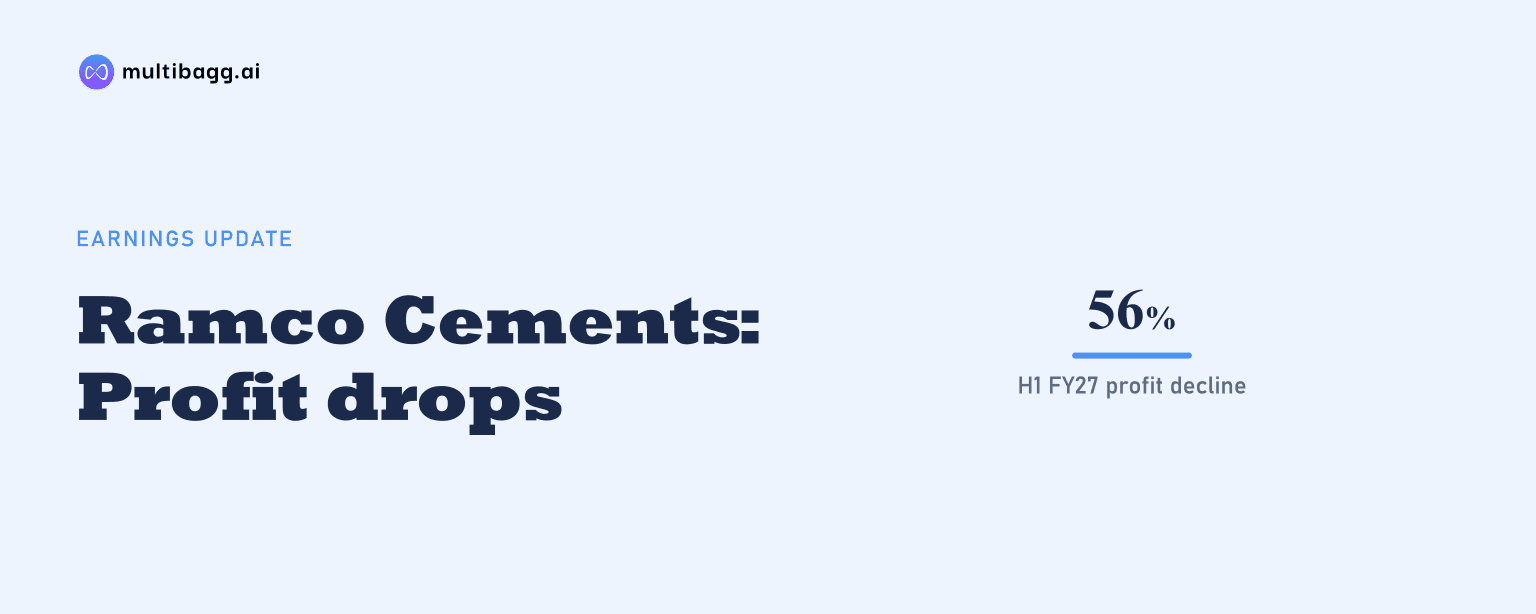
The Ramco Cements Limited reported 1HFY27 revenue of Rs 4,742 crore, up 10% year on year, but profit after tax fell 56% to Rs 70 crore as power and fuel cost per tonne increased 22% and the Tamil Nadu limestone levy had an estimated Rs 72 crore impact. Ramco Cements’ average cement price was flat for the half year.
Know The Ramco Cements inside out
Results, valuation, peers and who's buying, in one view.
Why did Ramco Cements’ 1HFY27 profit fall?
Ramco Cements’ profit fell because higher fuel costs and the Tamil Nadu mineral bearing land tax outweighed higher sales volume. Profit after tax declined from Rs 160 crore in 1HFY26 to Rs 70 crore in 1HFY27, while profit before tax, including exceptional items, fell 57% from Rs 217 crore to Rs 94 crore. Cash profit, defined by the company as profit before tax plus depreciation less current tax including exceptional items, decreased 19% to Rs 470 crore.
Power and fuel cost per tonne rose 22% year on year in 1HFY27, which Ramco Cements attributed to fuel-price increases associated with the West Asia War. The company also said that 10% year-on-year rupee depreciation during the half year affected fuel costs. Average cement price remained flat year on year in 1HFY27, despite an improvement of 2% year on year and 1% quarter on quarter in 2QFY27.
The Tamil Nadu levy created an additional reported cost. Ramco Cements put the mineral bearing land tax at Rs 160 per tonne of limestone and estimated its 1HFY27 impact at about Rs 72 crore. The company said it disputed the levy effective August 22, 2026, citing the cessation of the levy through the Mines and Minerals (Development and Regulation) Amendment Act, 2026.
How did Ramco Cements’ volume and revenue change?
Ramco Cements increased total sale volume 10% year on year to 9.56 million tonnes in 1HFY27, supporting a 10% increase in total revenue to Rs 4,742 crore. Cement sales rose to 92.18 lakh tonnes from 83.98 lakh tonnes, while cement capacity utilisation increased to 71% from 69%. The company’s standalone cement revenue grew 9% to Rs 4,510.37 crore from Rs 4,139.32 crore.
The second quarter accounted for a higher share of half-year cement sales. Cement sales reached 47.38 lakh tonnes in 2QFY27, up 8% from 44.00 lakh tonnes in 2QFY26 and 6% from 44.80 lakh tonnes in 1QFY27. Ramco Cements said total sale volume rose 9% year on year and 7% quarter on quarter in 2QFY27 despite monsoon-related demand disruption.
Regional pricing was uneven in the quarter. Trade prices in the South were 1% above the June 2026 exit price, while East-region trade prices were flat. The South represented 83% of 2QFY27 volume and the East 17%, unchanged from 2QFY26. Premium products accounted for 32% of South sales, up from 30%, but the East premium share declined to 23% from 24%.
Got a follow-up? Ask IRIS
What happened to Ramco Cements’ 2QFY27 operating profit?
Ramco Cements’ earnings before interest, tax, depreciation and amortisation, or EBITDA, fell 16% year on year to Rs 331 crore in 2QFY27 even as revenue increased 10% to Rs 2,466 crore. EBITDA per tonne fell to Rs 669 from Rs 866 in 2QFY26, while power and fuel cost per tonne rose 36% year on year. The quarterly levy impact was estimated at about Rs 33 crore.
The sequential comparison showed EBITDA rising 5% from Rs 314 crore in 1QFY27, while revenue rose 8% from Rs 2,276 crore. However, EBITDA per tonne declined from Rs 681 because power and fuel cost per tonne increased Rs 71 quarter on quarter. Ramco Cements also reported a Rs 368 per tonne year-on-year increase in quarterly power and fuel cost.
Profit after tax was Rs 38 crore in 2QFY27, down 49% from Rs 74 crore in 2QFY26 but up from Rs 32 crore in 1QFY27. Profit before tax declined 48% year on year to Rs 52 crore, while cash profit fell 14% to Rs 242 crore. The quarter included Rs 5 crore of profit from the sale of non-core assets recorded under exceptional items.
Interest expense partly moved against the operating-cost trend. Interest declined 17% year on year to Rs 93 crore in 2QFY27 from Rs 111 crore, and the effective interest rate decreased to 7.04% from 7.18%. For 1HFY27, interest fell 13% to Rs 189 crore and the effective rate reduced 37 basis points to 7.04%, which Ramco Cements attributed to lower borrowings.
Which businesses supported Ramco Cements’ revenue growth?
Ramco Cements’ cement business remained its largest revenue contributor, generating Rs 2,327.51 crore in 2QFY27, up 8% from Rs 2,147.58 crore in 2QFY26. Ordinary Portland cement accounted for 34% of 2QFY27 sales, compared with 35% a year earlier, while business-to-business sales accounted for 31% in both periods.
Construction chemicals grew faster than cement from a smaller base. Reported construction-chemicals revenue rose 31% to Rs 216.88 crore in 1HFY27 and 50% to Rs 130.77 crore in 2QFY27. Sales volume in the business increased 26% to 3.39 lakh tonnes in the half year and 38% to 2.04 lakh tonnes in the quarter.
Reported construction-chemicals revenue excludes captive consumption by the cement division under Indian Accounting Standards reporting. Captive consumption was Rs 3.07 crore in 1HFY27, down 61% from Rs 7.81 crore, while the 2QFY27 amount was Rs 2.66 crore, up 34% from Rs 1.98 crore. Other income increased 9% to Rs 14.77 crore in 1HFY27.
Depreciation increased 4% to Rs 380 crore in 1HFY27 and to Rs 190 crore in 2QFY27. Ramco Cements linked the increase to manufacturing facilities commissioned in the prior year, including a waste-heat recovery system at RR Nagar and a railway siding at Kolimigundla.
Conclusion
Ramco Cements converted 10% growth in 1HFY27 sales volume and revenue into lower earnings because pricing was flat for the half year while energy costs and the Tamil Nadu limestone levy increased expenses. EBITDA fell 19% to Rs 645 crore and profit after tax declined 56% to Rs 70 crore, despite lower interest expense and growth in construction chemicals.
The next disclosed issue to watch is Ramco Cements’ dispute of the Rs 160-per-tonne Tamil Nadu mineral bearing land tax, which had an estimated Rs 72 crore 1HFY27 impact and which the company said it disputed effective August 22, 2026. Subsequent periods will also show whether cement prices move relative to fuel costs after the Rs 243 per tonne year-on-year increase in half-year power and fuel cost.