










RCF contests ₹203.41 crore gas exposure after DoF stance
Key highlights
- RCF continues to recognise ₹79.84 crore as receivable for FY 2021-22 to FY 2022-23.
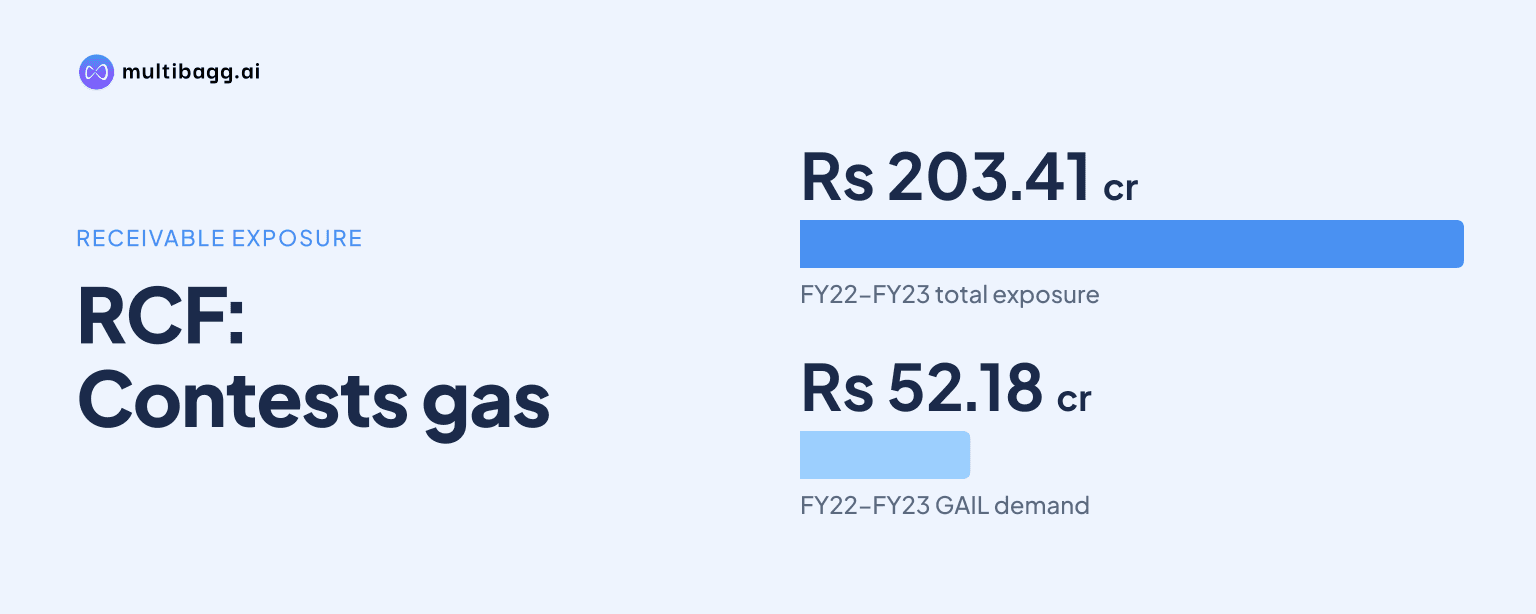
- RCF stated total gas-pooling exposure of about ₹203.41 crore, including GAIL’s ₹52.18 crore demand.
- The Department of Fertilizers said on October 23, 2026 that FICC’s treatment was in accordance with policy.
- RCF sought reconsideration through a November 11, 2026 representation and made no provision.
powered by IRIS
Rashtriya Chemicals and Fertilizers Limited is contesting about ₹203.41 crore of gas-pooling exposure, retaining a ₹79.84 crore receivable and making no provision, after the Department of Fertilizers said on October 23, 2026 that FICC’s treatment of EPMC gas non-recognition for urea production accords with policy.
Know Rashtriya Chemicals & Fertilizers inside out
Results, valuation, peers and who's buying, in one view.
Why is RCF contesting the gas-pooling calculation?
RCF is contesting the calculation because the gas-pool operator used cheaper market-price gas contracted by RCF for non-urea operations to determine its pool-account contribution. The auditor’s note says this was done instead of considering EPMC and spot gas sourced for urea operations under Department of Fertilizers directives for the half year ended September 30, 2026.
RCF says EPMC and spot gas were specifically meant for urea operations and should be subsumed into the final pool price. It further says the resulting cost should be considered in urea subsidy because gas cost is a pass-through. The dispute is therefore about the gas-price basis used in the pooling mechanism, rather than a disclosed difference in gas volumes or urea output.
RCF has continued to recognise the difference between EPMC or spot-gas prices and cheaper market-gas prices as receivable from the Department of Fertilizers. The amount recognised is ₹79.84 crore for FY 2021-22 to FY 2022-23, based on RCF’s view that non-recognition of gas sourced under the department’s directives is inconsistent with gas-pooling principles.
What amounts are included in RCF’s stated exposure?
RCF stated total gas-pooling exposure of about ₹203.41 crore in the auditor’s note, which also identifies a ₹52.18 crore demand from GAIL and a ₹79.84 crore receivable. The filing does not present a fully reconciled schedule showing how each cited amount combines into the stated total.
For FY 2022-23, RCF disputed GAIL’s ₹52.18 crore demand towards pool-price differential. The note also refers to a ₹71.39 crore receivable for FY 2022-23 arising from FICC’s non-recognition of EPMC and spot gas in urea, and says the audited amount for that year stands at ₹123.57 crore.
The ₹203.41 crore figure should be read as RCF’s stated exposure rather than as an independently derived sum from the table. The note’s ₹123.57 crore audited amount appears alongside the GAIL demand and FY 2022-23 receivable, so treating every line as separate additive exposure would risk double counting.
What did the Department of Fertilizers say on October 23, 2026?
The Department of Fertilizers disposed of RCF’s representation on October 23, 2026, stating that FICC’s action regarding non-recognition of EPMC gas for urea production by RCF was in accordance with the policies of the department and the Ministry of Petroleum & Natural Gas. That position differs from RCF’s contention that EPMC and spot gas should be included in the final urea pool price.
The filing says FICC did not recognise EPMC and spot gas in urea and instead substituted cheaper market-price gas for the calculation challenged by RCF. The department’s communication supports FICC’s policy treatment, but the source does not say that GAIL’s ₹52.18 crore demand has been withdrawn or that RCF’s ₹79.84 crore receivable has been settled.
The independent auditor drew attention to the gas-pooling issue while leaving its conclusion unmodified for the quarter and half year ended September 30, 2026. The auditor said its review found nothing that led it to believe the unaudited consolidated results had not disclosed required information or contained a material misstatement.
Got a follow-up? Ask IRIS
Has RCF provided for the gas-pooling exposure?
RCF has not made a provision for the about ₹203.41 crore exposure because management says the matter will be resolved in its favour. This is RCF’s stated assessment in the November 12, 2026 filing, not a confirmation that the Department of Fertilizers, FICC or GAIL has accepted its position.
The no-provision stance is linked to RCF’s continued recognition of ₹79.84 crore as receivable for FY 2021-22 to FY 2022-23. If the contested treatment changes, the filing does not provide an alternative accounting estimate, recovery timetable or a deadline for deciding the receivable and GAIL demand.
A separate policy-related item affected RCF’s reported subsidy income in 2026. A Department of Fertilizers notification dated July 30, 2026 reduced the Thal unit’s energy norm to 5.984 gigacalories per metric tonne from 6.200 gigacalories per metric tonne, retrospectively from April 1, 2025, and RCF recorded a ₹132.52 crore impact in the quarter ended June 30, 2026.
That Thal energy-norm revision is distinct from the gas-pooling dispute, even though both concern urea subsidy treatment. Separately, the auditor noted ₹217.50 crore pending for settlement by the Department of Fertilizers as at September 30, 2026 in relation to price adversity on imported phosphatic and potassic fertilisers.
What has RCF done after the departmental communication?
RCF submitted a further representation on November 11, 2026 to the Department of Finance, as named in the filing, reiterating its earlier position and seeking reconsideration. The representation followed the October 23, 2026 office memorandum from the Department of Fertilizers and was unresolved when the auditor signed the review report on November 12, 2026.
The filing does not disclose a hearing date, response deadline or expected settlement date for the reconsideration request. It also does not state whether RCF has paid, deferred or otherwise settled GAIL’s ₹52.18 crore demand while it continues to seek recognition of the disputed urea gas costs.
RCF’s broader half-year financial results show profit after tax of ₹204.47 crore for the half year ended September 30, 2026, compared with ₹159.78 crore a year earlier. The gas-pooling matter remains a separately highlighted accounting and policy issue because RCF has retained the ₹79.84 crore receivable without a provision for the stated exposure.
Conclusion
RCF remains opposed to the gas-pooling treatment after the Department of Fertilizers said FICC’s approach accords with policy. The company continues to recognise ₹79.84 crore as receivable, disputes GAIL’s ₹52.18 crore demand and reports total exposure of about ₹203.41 crore without making a provision.
The next disclosed step is RCF’s November 11, 2026 request for reconsideration to the Department of Finance. Any response, together with the eventual treatment of the GAIL demand and the ₹79.84 crore receivable, is the key item to watch in a subsequent reporting period.