










RCF recognises ₹231.71 crore impact from Thal norm revision
Key highlights
- RCF recognised a cumulative ₹231.71 crore impact from the Thal energy-norm revision through September 30, 2026.
- Thal’s urea energy norm was reduced to 5.984 Gcal/MT from 6.200 Gcal/MT, effective April 1, 2025.
- The revised Thal norm remains applicable until March 31, 2028, while Trombay remains at 6.50 Gcal/MT.
- RCF reported standalone profit after tax of ₹205.74 crore for the half year ended September 30, 2026, versus ₹159.81 crore a year earlier.
powered by IRIS
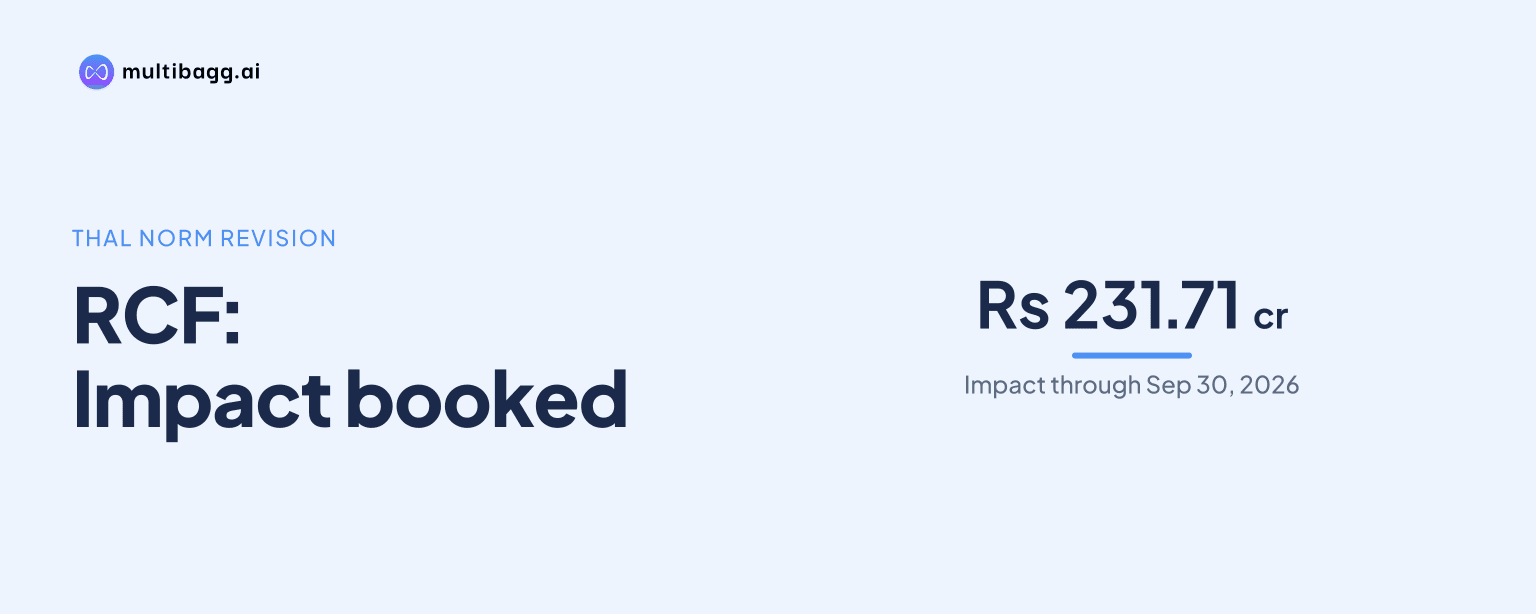
Rashtriya Chemicals and Fertilizers Limited recognised a ₹231.71 crore financial impact through September 30, 2026 after the Department of Fertilizers cut the Thal urea unit’s energy norm to 5.984 Gcal/MT from 6.200 Gcal/MT, retrospectively effective from April 1, 2025. The revised norm applies until March 31, 2028.
Know Rashtriya Chemicals & Fertilizers inside out
Results, valuation, peers and who's buying, in one view.
What changed in RCF’s Thal urea energy norm?
RCF’s applicable Thal energy norm fell by 0.216 gigacalories per metric tonne, or Gcal/MT, under a Department of Fertilizers notification dated July 30, 2026. The revised Urea Pricing Policy norm is 5.984 Gcal/MT, replacing the 6.200 Gcal/MT norm set under a May 25, 2015 notification.
The lower norm applies from April 1, 2025, rather than only from the July 2026 notification date, and remains effective up to March 31, 2028. RCF had calculated FY 2025-26 subsidy income using the earlier 6.200 Gcal/MT norm, so the retrospective change reduced subsidy income already recognised for that year.
The filing identifies the Thal unit as the affected facility and says the Trombay unit’s norm has not changed. Trombay continues to operate at 6.50 Gcal/MT, meaning the ₹231.71 crore financial impact recognised through September 30, 2026 relates to the Thal urea unit.
How much subsidy income has RCF recognised as affected?
RCF recognised a cumulative ₹231.71 crore financial impact from the Thal norm revision through September 30, 2026. The company states that the policy change decreased subsidy income, with the recognised amount covering FY 2025-26 and the first two quarters of FY 2026-27.
The largest disclosed component was ₹132.52 crore for FY 2025-26, which RCF accounted for during the quarter ended June 30, 2026. That accounting treatment reflected the notification’s retrospective April 1, 2025 effective date rather than the July 30, 2026 date on which the revised norm was issued.
RCF then recognised ₹39.02 crore for Q1 FY 2026-27 and an additional ₹60.17 crore in Q2 FY 2026-27. The Q2 amount exceeded the Q1 amount by ₹21.15 crore, taking the impact recognised for the six months ended September 30, 2026 to ₹99.19 crore.
How did RCF’s reported results compare after the recognition?
RCF reported standalone profit after tax of ₹205.74 crore for the half year ended September 30, 2026, compared with ₹159.81 crore in the corresponding half year ended September 30, 2025. The filing does not provide a profit figure excluding the ₹231.71 crore impact from the Thal energy-norm revision.
Standalone revenue from operations was ₹8,648.90 crore in the six months ended September 30, 2026, compared with ₹8,663.16 crore a year earlier, a decline of ₹14.26 crore. Profit before tax increased to ₹279.78 crore from ₹215.76 crore, while total tax expense rose to ₹74.04 crore from ₹55.95 crore.
The Fertilizers segment generated revenue of ₹6,513.02 crore in the first half of FY 2026-27, up from ₹5,090.82 crore a year earlier. Its segment result moved to a loss of ₹65.36 crore from a profit of ₹68.40 crore, although RCF does not attribute that movement solely or partly to the revised Thal norm.
Industrial Chemicals showed a contrasting six-month trend, with revenue rising to ₹1,214.09 crore from ₹709.55 crore and segment result increasing to ₹445.40 crore from ₹136.65 crore. Trading revenue declined to ₹914.51 crore from ₹2,854.86 crore over the same periods.
Got a follow-up? Ask IRIS
What other subsidy matters remain relevant for RCF?
RCF had ₹217.50 crore pending for settlement by the Department of Fertilizers as of September 30, 2026 under its phosphatic and potassic fertiliser procurement matter. The company had recognised differential subsidy claims through March 31, 2025 after Department directions said adverse procurement prices beyond applicable nutrient-based subsidy rates would be addressed on a no-profit-no-loss basis.
RCF also recognised ₹179.28 crore of subsidy income above notified nutrient-based subsidy rates during the six months ended September 30, 2026 for imported diammonium phosphate and triple superphosphate shipments. The estimate covered quantities sold from imports under May 29, 2026 operational guidelines for Kharif 2026, including ₹151.52 crore recognised in the September quarter.
Separately, RCF continued to record ₹79.84 crore as receivable from the Department of Fertilizers at September 2026 in a gas-pooling dispute. RCF maintains that EPMC and spot gas sourced under Department directives for urea operations should be included in the final pool price used to calculate urea subsidy.
For FY 2022-23, RCF disputed a ₹52.18 crore demand from GAIL (India) Limited for a pool-price differential against a ₹71.39 crore receivable claimed by RCF. The total disputed amount for that year was ₹123.57 crore, and RCF submitted a reconsideration request after an October 23, 2026 Department of Fertilizers office memorandum disposed of its earlier representation.
What does the filing say about RCF’s next policy period?
RCF will calculate Thal subsidy income using the 5.984 Gcal/MT energy norm until March 31, 2028 under the July 30, 2026 notification. The filing gives no further target, revision mechanism or estimated future financial impact for the period after September 30, 2026, while Trombay remains at 6.50 Gcal/MT.
The filing says the gas-pooling matter remained under examination by the Department of Fertilizers after RCF sought reconsideration in October 2026. The outstanding matters comprise the ₹217.50 crore phosphatic and potassic fertiliser settlement, the ₹79.84 crore gas-related receivable and the ₹123.57 crore disputed FY 2022-23 gas-pooling amount.
Conclusion
The Thal policy revision reduced the energy norm from 6.200 Gcal/MT to 5.984 Gcal/MT and produced a quantified ₹231.71 crore reduction in subsidy income recognised through September 30, 2026. RCF nonetheless reported half-year profit after tax of ₹205.74 crore, up from ₹159.81 crore a year earlier, but did not disclose earnings excluding the norm effect.
The next disclosures should show the continuing effect of the 5.984 Gcal/MT Thal norm through March 31, 2028 and any progress on the ₹217.50 crore pending settlement and gas-pooling representations. RCF’s October 2026 request for reconsideration leaves the ₹79.84 crore receivable and the ₹123.57 crore FY 2022-23 disputed amount unresolved.