










Reliance Communications faces ₹801.91 crore guarantee encashment
Key highlights
- DoT bank guarantee encashment related to RCOM's spectrum obligations is reported at ₹801.91 crore.
- DoT's August 18, 2026 direction sought partial guarantee encashment of ₹5.72 crore from RCOM and RTL.
- The August direction included ₹5.55 crore from State Bank of India for RCOM and ₹0.16 crore from Bank of Baroda for RTL.
- The Delhi High Court listed the next hearing for September 3 and said non-encashment would not be considered a default until then.
powered by IRIS
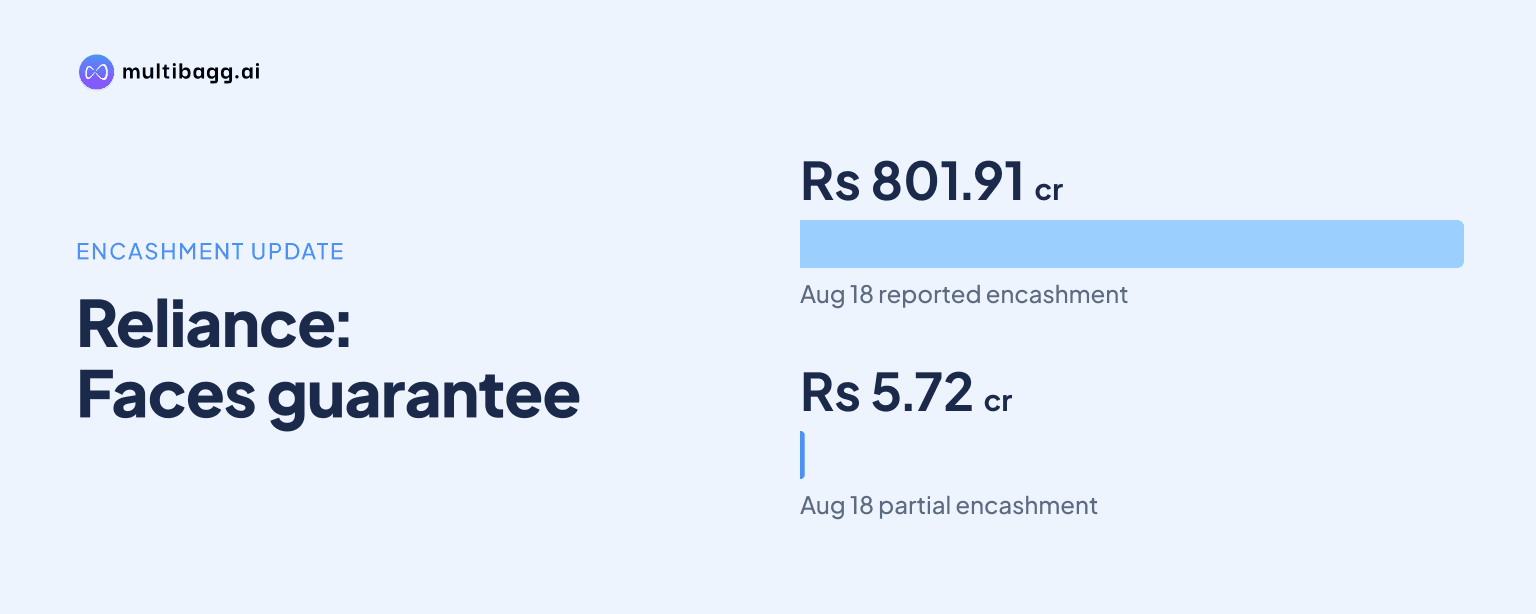
Reliance Communications faces Department of Telecommunications bank guarantee encashment of ₹801.91 crore linked to spectrum-related dues, while a separate August 18, 2026 communication sought partial encashment of ₹5.72 crore from guarantees of Reliance Communications and its subsidiary Reliance Telecom Limited.
Know Reliance Communications inside out
Results, valuation, peers and who's buying, in one view.
What action has the Department of Telecommunications taken against RCOM?
The Department of Telecommunications, or DoT, has moved to invoke financial bank guarantees furnished in connection with RCOM's obligations. Data cited in the available disclosures places the broader bank guarantee encashment at ₹801.91 crore, relating to defaults in deferred spectrum obligations. The guarantees were furnished for spectrum-related dues, according to the reported information.
In a separate filing disclosed on August 19, 2026, RCOM said it and Reliance Telecom Limited, or RTL, had received another DoT letter dated August 18. The letter concerned partial encashment of specified financial bank guarantees. This followed an earlier communication referred to by the company as having been received on August 15, 2026.
The August 18 communication directed partial encashment of guarantees totalling ₹5.72 crore for outstanding licence-fee defaults across FY24, FY25 and FY26. The reported amount was ₹5,55,42,271 from State Bank of India for RCOM and ₹16,25,000 from Bank of Baroda for RTL. Together, these amounts equal ₹5,71,67,271.
RCOM is undergoing the corporate insolvency resolution process, or CIRP. The company said it was reviewing the legal and financial implications of the partial encashment in the context of the Insolvency and Bankruptcy Code framework.
What have the Supreme Court and Delhi High Court said?
The Supreme Court dismissed petitions by RCOM and four lenders challenging DoT's move to invoke bank guarantees of about ₹800 crore. The court said the lenders should have approached the High Court first in relation to the matter, as reported in the available material.
The lenders had argued that an earlier Supreme Court judgment did not justify the guarantee invocation and that DoT's action affected the insolvency resolution framework. DoT, on the other hand, maintained that it had an independent right to proceed against the petitioners and the banks.
The Delhi High Court subsequently stated that it would not treat non-encashment of RCOM's bank guarantees as a default until the next hearing, scheduled for September 3. The banks and RCOM entities had challenged DoT's decision to invoke the guarantees, and the High Court is to consider the legality of DoT's action and the banks' objections.
The High Court observation does not resolve the underlying dispute over the guarantees. It provides a limited position on how non-encashment would be viewed pending the scheduled hearing, based on the reported court proceedings.
What are the key figures and dates in the RCOM guarantee matter?
The key figures show two reported layers of the issue: a ₹801.91 crore DoT bank guarantee encashment related to spectrum obligations and a later ₹5.72 crore partial encashment direction connected with licence-fee defaults. The latter is specifically identified in RCOM's August 19 disclosure.
The difference in the amounts reflects the separate descriptions in the available information. The ₹801.91 crore figure is cited as the amount of DoT bank guarantee encashment in respect of spectrum-related dues, while ₹5.72 crore refers to the partial encashment directed through the August 18 communication for RCOM and RTL.
Got a follow-up? Ask IRIS
Why do the bank guarantees matter during RCOM's insolvency process?
Bank guarantees are commitments issued by banks that can be invoked by the beneficiary subject to their terms and the applicable legal position. In this case, DoT has sought to enforce guarantees connected to RCOM's telecom-related obligations, while RCOM and lenders have raised objections through legal proceedings.
The matter is significant because RCOM is in CIRP, and the lenders have said the invocation affects the insolvency resolution process. The available information does not establish the final legal outcome. However, it confirms that the dispute involves both the government's asserted right to invoke the guarantees and the lenders' objections under the insolvency framework.
For creditors and other stakeholders, the guarantee proceedings are relevant because they concern obligations associated with the company and its subsidiary RTL. The reported ₹801.91 crore spectrum-related amount is substantially larger than the ₹5.72 crore partial encashment detailed in the August 18 letter.
The case also reflects the interaction between telecom licence and spectrum obligations, bank guarantees, and insolvency proceedings. These issues are being considered through the court process rather than being resolved solely through the company's stock-exchange disclosure.
How could this affect RCOM investors and operations?
The disclosed action adds a legal and financial issue for RCOM at a time when it is already in CIRP. The immediate market relevance lies in the enforcement of financial bank guarantees, the court challenges by RCOM and lenders, and the continuing review of the matter under the insolvency framework.
Investors should distinguish between the two reported figures. The ₹801.91 crore amount concerns the wider DoT bank guarantee encashment tied to spectrum-related obligations, whereas the ₹5.72 crore amount is the specific partial encashment direction disclosed after DoT's August 18 letter. The available information does not provide a confirmed final financial impact from the legal proceedings.
The reported data also noted that the ₹5.72 crore partial encashment represented about 1.82% of trailing-12-month revenue. That comparison relates only to the specified partial encashment and should not be read as a measure of the full ₹801.91 crore guarantee matter.
Separate from the guarantee dispute, the available market-tracking information said a PMLA authority had confirmed attachment of assets worth ₹581.65 crore against RCOM. That is a separate regulatory development and illustrates the multiple legal matters surrounding the company, but it is not part of the DoT guarantee amount.
Conclusion
The available disclosures establish that Reliance Communications is dealing with DoT action on financial bank guarantees at two reported levels: ₹801.91 crore related to deferred spectrum obligations and ₹5.72 crore in a specified partial encashment request covering RCOM and RTL licence-fee defaults. The Supreme Court has dismissed the lenders' petitions on the route taken, while the Delhi High Court is examining the underlying challenge.
The next disclosed event to watch is the Delhi High Court hearing scheduled for September 3. RCOM's future filings may also clarify the status of the August 18 partial encashment direction, the company's legal review under the Insolvency and Bankruptcy Code, and any further action by DoT or the concerned banks.