










Refex says TReDS raises finance cost but cuts procurement costs
Key highlights
- Refex said finance cost increased to Rs 17 crore in Q2 FY27 from Rs 13 crore in Q1 FY27 because of TReDS-funded vendor payments.
- Refex reported Rs 1,251 crore of trade receivables and said its collection cycle remained 120 to 130 days.
- An analyst cited Rs 322 crore of cash and cash equivalents and Rs 153 crore of bank balances at the quarter-end.
- Other expenses fell to Rs 11 crore in Q2 FY27 from Rs 23 crore in Q1 FY27, including around Rs 4.5 crore of one-time Q1 bank charges.
powered by IRIS
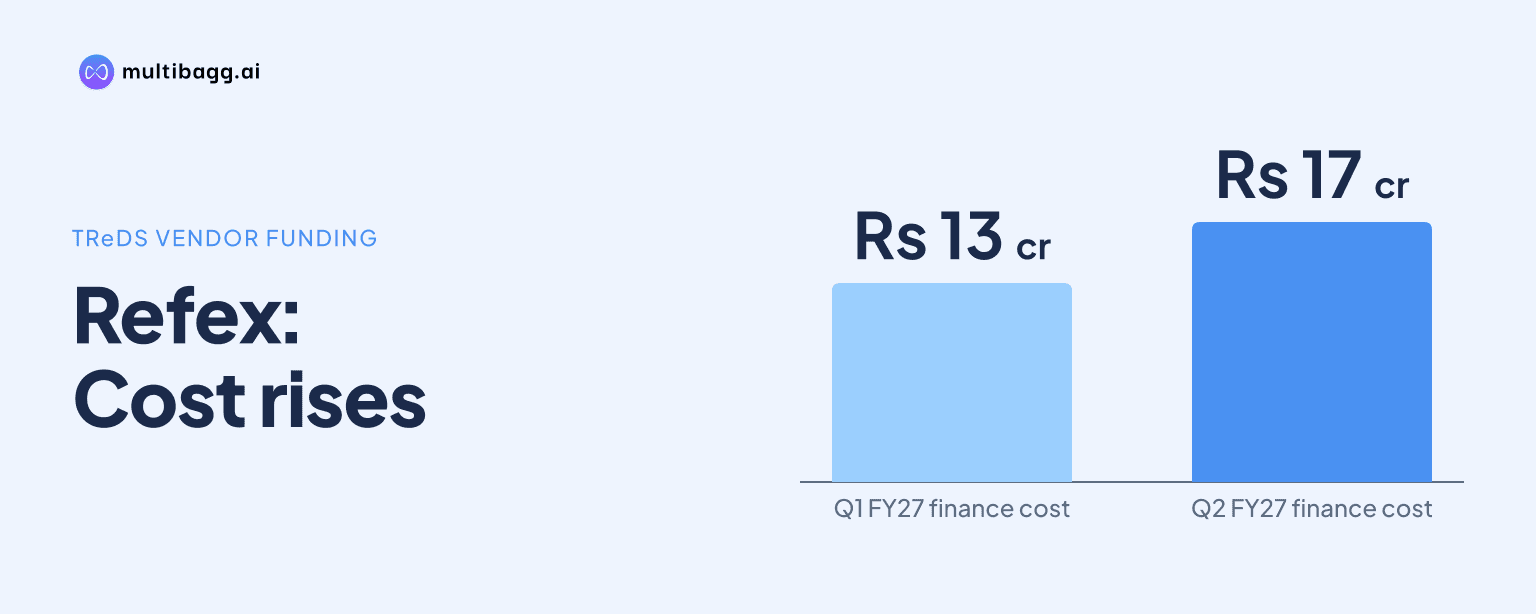
In Q2 FY27, Refex Industries Limited said finance cost rose to Rs 17 crore from Rs 13 crore in Q1 FY27 because it paid vendors through TReDS, while related vendor discounts reduced direct procurement costs. Refex said trade receivables were Rs 1,251 crore and its collection cycle remained 120 to 130 days.
Know Refex Industries inside out
Results, valuation, peers and who's buying, in one view.
Why did Refex's finance cost rise despite its cash balance?
Refex's finance cost rose because it began using the Trade Receivables Discounting System, or TReDS, to pay vendors rather than using bank balances for those payments. Management said the financing charge from this route is recorded in indirect costs, explaining the increase to Rs 17 crore in Q2 FY27 from Rs 13 crore in Q1 FY27.
An analyst cited cash and cash equivalents of Rs 322 crore and bank balances of Rs 153 crore, but Refex said these balances did not mean it used cash for every vendor payment. The company said its TReDS limit was used instead of bank cash, while the bank balance reflected collections on the quarter-end date.
Refex said the Rs 153 crore bank balance can rise or fall during a quarter as collections are received, rather than remaining at the quarter-end level throughout the period. Management described cash as fungible over time, while TReDS provided a separate payment mechanism for micro, small and medium enterprise, or MSME, vendors.
The Rs 4 crore quarter-on-quarter rise in finance cost was therefore linked to the TReDS payment route, according to management, rather than presented as evidence that Refex had depleted cash. The transcript does not disclose the size of the TReDS limit, its financing rate or the proportion of vendor payments routed through the platform.
How does TReDS reduce Refex's procurement costs?
Refex said TReDS reduces procurement costs because vendors provide an additional discount when paid through the platform. Management said that discount is recorded in cost of goods sold, or COGS, while the financing charge is recorded separately in finance cost within indirect costs.
The company said the reduction in vendor cost at the COGS level offsets the higher finance-cost line, or provides a greater benefit. Thus, the Rs 17 crore Q2 FY27 finance-cost figure does not capture the corresponding direct-cost reduction that Refex said arose from vendor discounts.
This accounting treatment means finance cost and gross margin need to be read together. Refex said the platform benefits MSME vendors through payment financing and benefits the company through lower direct vendor costs, but it did not quantify the vendor discount, COGS saving or gross-margin effect for Q2 FY27.
The mechanism differs from simply using the Rs 322 crore cash-and-cash-equivalent balance to settle bills. Under the arrangement described on the call, TReDS funds the vendor payment and Refex records the financing expense and purchase-cost discount in different parts of its profit and loss statement.
Got a follow-up? Ask IRIS
What does Refex's 120-to-130-day receivable cycle mean?
Refex said its receivable cycle remains 120 to 130 days, with no collection-period reduction target disclosed on the call. The comment followed an analyst's observation that trade receivables stood at Rs 1,251 crore against first-half revenue of Rs 1,677 crore.
Management attributed the Rs 1,251 crore receivable balance to higher turnover, rather than saying collection timing had deteriorated. In other words, Refex said receivables increased in rupee terms as business expanded, while the stated 120-to-130-day collection cycle remained unchanged.
The collection cycle also provides context for the Rs 153 crore bank balance cited at quarter-end. Refex said customer collections affect bank balances over time, while TReDS lets it pay vendors without relying solely on cash available on a particular reporting date.
The transcript does not provide a receivable ageing schedule for the Rs 1,251 crore balance or split collection days by business. It also does not say whether the 120-to-130-day range differs between ash and coal handling, wind energy and newer operations.
What other cost movements did Refex disclose in Q2 FY27?
Refex said other expenses fell to Rs 11 crore in Q2 FY27 from Rs 23 crore in Q1 FY27, partly because Q1 included around Rs 4.5 crore of one-time bank prepayment charges and processing fees. The charges related to changing banking arrangements from HDFC Bank to Indian Overseas Bank and Canara Bank.
Management also cited lower travel costs in Q2 FY27, saying more activity took place in the South during the period. Refex did not provide a numerical split between travel savings and other cost movements, so the recurring expense level after the Rs 4.5 crore banking charge cannot be calculated from the call.
For its stand-alone business, management maintained its expectation of 20% to 25% revenue growth and an earnings before interest, tax, depreciation and amortisation, or EBITDA, margin of 15% to 18% for the current financial year. These are management targets, not reported Q2 FY27 outcomes, and the call did not specify TReDS's contribution to them.
Management separately said wind energy was expected to deliver EBITDA margin of 4% to 5% and profit after tax, or PAT, margin of 2.5% to 3% in the current financial year and the following financial year's first half. The differing stated margin ranges show that Refex's overall working-capital discussion spans businesses with different economics, although no segment-level receivable days were provided.
Conclusion
Refex's explanation is that the Rs 4 crore increase in Q2 FY27 finance cost and lower procurement cost are connected outcomes of the same TReDS vendor-payment mechanism. The company said its Rs 1,251 crore receivable balance increased with turnover, while the underlying collection cycle remained at 120 to 130 days.
The next disclosures to watch are any update on TReDS usage, the value of vendor-cost savings and movement in the 120-to-130-day receivable cycle. Management has maintained stand-alone revenue-growth guidance of 20% to 25% and an EBITDA-margin range of 15% to 18% for the current financial year, providing benchmarks for subsequent updates.