










Reliance Power cash fell ₹686.37 crore after debt repayments
Key highlights
- Reliance Power's cash and cash equivalents fell ₹686.37 crore to ₹538.09 crore at September 30, 2026.
- Reliance Power generated ₹1,550.26 crore of operating cash in the half year ended September 30, 2026.
- Reliance Power repaid ₹1,157.63 crore of long-term borrowings and recorded ₹1,675.31 crore of financing cash outflow.
- Reliance Power's combined current and non-current borrowings declined ₹1,009.96 crore to ₹13,802.07 crore.
powered by IRIS
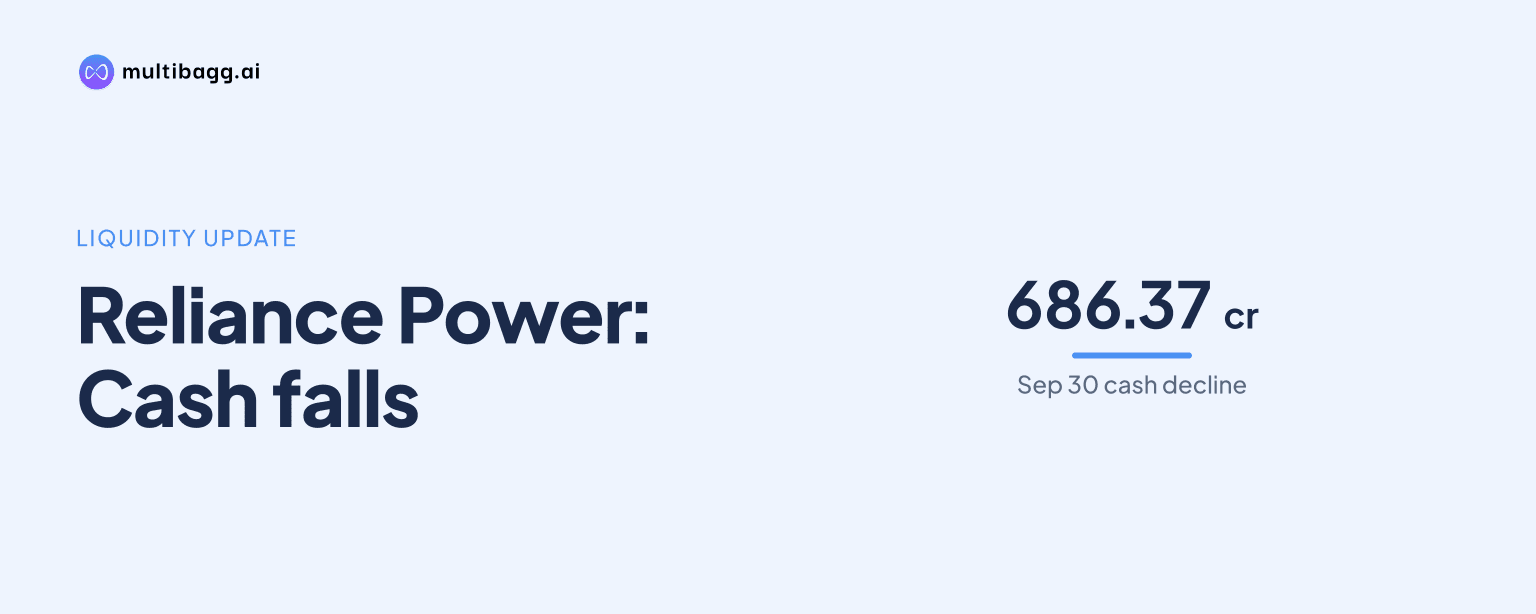
Reliance Power Limited reported that cash and cash equivalents fell ₹686.37 crore in the half year ended September 30, 2026, to ₹538.09 crore, after ₹1,157.63 crore of long-term debt repayments helped drive a ₹1,675.31 crore financing outflow that exceeded its ₹1,550.26 crore operating cash generation.
Know Reliance Power inside out
Results, valuation, peers and who's buying, in one view.
How did Reliance Power's cash balance change?
Reliance Power's cash and cash equivalents declined to ₹538.09 crore at September 30, 2026, from ₹1,224.46 crore at March 31, 2026. The ₹686.37 crore reduction matched the net decrease in cash and cash equivalents reported in the consolidated cash-flow statement for the six-month period.
The reduction in cash equivalents occurred alongside an increase in bank balances other than cash and cash equivalents, which rose ₹575.03 crore to ₹1,055.73 crore at September 30, 2026. These balances are separately classified on the consolidated balance sheet, meaning their increase did not change the reported cash-and-cash-equivalents balance.
Reliance Power's current assets were ₹293.06 crore lower over the six months, including a ₹253.80 crore decrease in inventories to ₹762.64 crore. Trade receivables moved in the other direction, rising ₹40.59 crore to ₹1,350.69 crore, while the cash-flow statement recorded a corresponding ₹40.59 crore working-capital outflow from receivables.
What cash did Reliance Power generate from operations?
Reliance Power generated ₹1,550.26 crore of net cash from operating activities in the half year ended September 30, 2026, compared with ₹1,365.56 crore in the corresponding 2025 period. The ₹184.70 crore increase came despite operating profit before working-capital changes declining ₹7.25 crore to ₹1,377.07 crore.
Working-capital movements produced a ₹212.52 crore net inflow in the 2026 half year, compared with ₹7.90 crore a year earlier. The main contributor was a ₹253.80 crore cash release from inventories, partly offset by ₹40.59 crore used by the increase in trade receivables and ₹69.96 crore used in trade payables.
Cash taxes paid rose to ₹39.33 crore in the six months ended September 30, 2026, from ₹26.54 crore a year earlier. Finance cost added back in the operating-cash-flow reconciliation was ₹800.01 crore, below ₹820.89 crore in the prior-year period, while depreciation and amortisation declined to ₹475.21 crore from ₹505.92 crore.
Where did Reliance Power deploy its operating cash?
Reliance Power used ₹561.32 crore in investing activities and ₹1,675.31 crore in financing activities during the half year ended September 30, 2026. Those combined outflows of ₹2,236.63 crore exceeded the ₹1,550.26 crore operating inflow by ₹686.37 crore, producing the reported decrease in cash equivalents.
Investing cash use was lower than the ₹895.66 crore used in the corresponding 2025 half year. Investment in fixed deposits or margin-money deposits with original maturity of more than three months was ₹601.15 crore, down from ₹900 crore, while interest received increased to ₹66.72 crore from ₹46.97 crore.
Financing cash use was ₹1,050.59 crore higher than a year earlier because Reliance Power reported no proceeds from long-term borrowings in the 2026 half year, compared with ₹5,576.36 crore in the corresponding 2025 period. It repaid ₹1,157.63 crore of long-term borrowings, versus ₹5,758.38 crore a year earlier, while interest and finance charges paid were broadly unchanged at ₹584.77 crore.
Got a follow-up? Ask IRIS
How did Reliance Power's borrowings and liabilities change?
Reliance Power's non-current borrowings declined ₹1,027.16 crore to ₹8,928.36 crore at September 30, 2026, from ₹9,955.52 crore at March 31, 2026. This balance-sheet reduction was broadly consistent with the ₹1,157.63 crore repayment of long-term borrowings recorded in the cash-flow statement, although reported debt balances also reflect other period movements.
Current borrowings increased ₹17.20 crore to ₹4,873.71 crore over the same period. Combined current and non-current borrowings were therefore ₹13,802.07 crore at September 30, 2026, down ₹1,009.96 crore from ₹14,812.03 crore at March 31, 2026.
Total non-current liabilities declined ₹955.65 crore to ₹14,116.87 crore, while total current liabilities rose ₹176.88 crore to ₹10,357.53 crore. Within current liabilities, other financial liabilities increased ₹250.66 crore to ₹5,064.13 crore, partly offsetting the reduction in longer-dated borrowings.
Reliance Power also disclosed a ₹25.32 crore loan-prepayment charge at Rosa Power Supply Company Limited during the quarter ended September 30, 2026, presented as an exceptional item. The charge was separate from the half-year financing cash outflow, which included ₹584.77 crore of interest and finance charges paid.
What subsidiary liabilities and uncertainties did Reliance Power disclose?
Reliance Power disclosed material uncertainty relating to the group's ability to continue as a going concern, particularly at Rajasthan Sun Technique Energy Private Limited and Samalkot Power Limited. Management stated that the group remained positive about meeting liabilities in the ordinary course and through time-bound monetisation of subsidiary assets.
Rajasthan Sun Technique Energy Private Limited had repayment defaults on borrowings aggregating ₹2,335.47 crore and negative net worth of ₹2,729.54 crore at September 30, 2026. The subsidiary recorded a net loss of ₹119.52 crore in the half year, and its auditors said the going-concern assessment depended critically on raising finance and generating future cash flows.
Samalkot Power Limited had borrowing defaults of ₹1,892.39 crore and negative net worth of ₹2,894.15 crore at September 30, 2026. Its lender had invoked a corporate guarantee against Reliance Power and filed an application under Section 7 of the Insolvency and Bankruptcy Code, 2016, while the company said it was evaluating the appropriate legal course.
Samalkot Power Limited entered an agreement on June 6, 2026, to sell equipment from Modules 2 and 3 of its 1,508 megawatt combined-cycle power plant, subject to lender approval. The subsidiary received a US$10 million standby letter of credit from the buyer during the September 2026 quarter, and management said the proposed asset monetisation and lender discussions formed part of its going-concern assessment.
Conclusion
Reliance Power generated ₹1,550.26 crore of operating cash in the half year ended September 30, 2026, up ₹184.70 crore from the prior-year period. However, ₹1,157.63 crore of long-term debt repayments, ₹584.77 crore of interest and finance charges paid, and ₹561.32 crore of investing outflows reduced cash and cash equivalents by ₹686.37 crore, while combined reported borrowings declined ₹1,009.96 crore.
The next disclosed development to watch is lender approval for Samalkot Power Limited's proposed sale of equipment from Modules 2 and 3 of its 1,508 megawatt plant. Reliance Power said the sale, supported by a US$10 million standby letter of credit, is intended to address lender obligations, while the company continues to assess its response to the lender's insolvency application against the parent company.