










Reliance Power auditors flag Rs 4,227.86 crore defaults
Key highlights
- RSTEPL and SMPL had combined borrowing defaults of Rs 4,227.86 crore at September 30, 2026.
- RSTEPL reported a Rs 119.52 crore half-year loss and Rs 2,729.54 crore negative net worth.
- SMPL’s current liabilities exceeded current assets by Rs 4,629.89 crore at September 30, 2026.
- SMPL’s lender initiated a Section 7 CIRP application against Reliance Power in the June 2026 quarter.
powered by IRIS
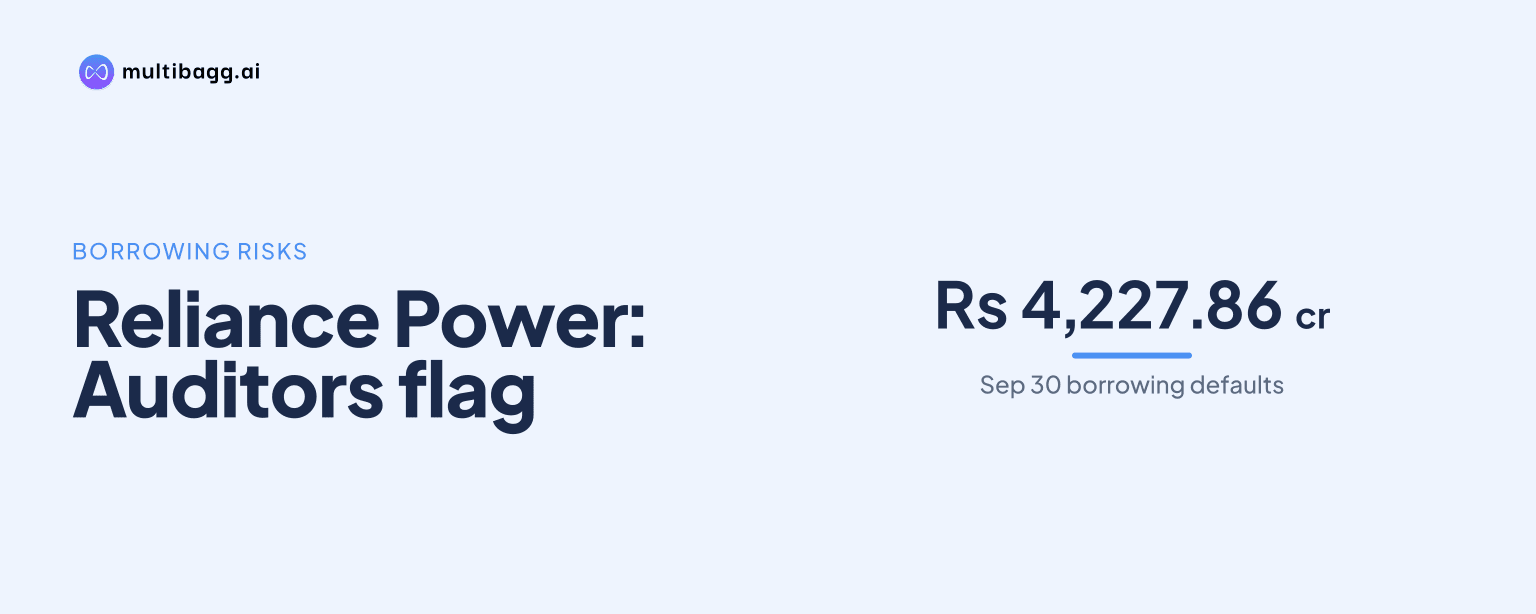
Reliance Power Limited’s auditors flagged material uncertainty over two subsidiaries’ ability to continue as going concerns after their borrowing defaults reached Rs 4,227.86 crore at September 30, 2026. Rajasthan Sun Technique Energy Private Limited and Samalkot Power Limited also reported sustained losses and negative net worth, while Samalkot’s lender pursued insolvency action against Reliance Power.
Know Reliance Power inside out
Results, valuation, peers and who's buying, in one view.
Why did auditors flag going-concern risks at the subsidiaries?
Auditors flagged going-concern risks because Rajasthan Sun Technique Energy Private Limited, or RSTEPL, and Samalkot Power Limited, or SMPL, reported continuing losses, negative net worth and repayment defaults at September 30, 2026. The consolidated reviewer said these conditions created material uncertainty that could cast significant doubt on the subsidiaries’ ability to continue as going concerns.
RSTEPL reported a net loss of Rs 119.52 crore for the half year ended September 30, 2026, following losses in preceding financial years. Its negative net worth was Rs 2,729.54 crore and its borrowing repayment defaults were Rs 2,335.47 crore. RSTEPL’s auditors said they could not obtain adequate evidence supporting management’s use of the going-concern assumption.
SMPL reported a Rs 62.31 crore net loss for the same half year and had negative net worth of Rs 2,894.15 crore at September 30, 2026. Its current liabilities exceeded current assets by Rs 4,629.89 crore, while borrowing defaults totalled Rs 1,892.39 crore. The current-liability gap was therefore larger than the combined defaults of both subsidiaries.
What is the lender claim against Reliance Power?
SMPL’s lender invoked the corporate guarantee issued by Reliance Power and demanded Rs 1,892.39 crore, including interest. During the quarter ended June 30, 2026, the lender initiated a Corporate Insolvency Resolution Process, or CIRP, application under Section 7 of the Insolvency and Bankruptcy Code, 2016, against Reliance Power.
Reliance Power told the lender and Citibank N.A., the facility agent, that it considers the debt not to have fallen due and that no default occurred under the relevant agreements. An arbitration tribunal issued a partial final award on June 23, 2026 finding it lacked jurisdiction over SMPL’s claim, without determining its substantive merits. SMPL then withdrew the arbitration on July 30, 2026.
How do RSTEPL and SMPL plan to address their liabilities?
Management’s disclosed plan for RSTEPL is to improve operations and resolve lender dues through discussions with lenders. RSTEPL said the technology used for its project had failed to deliver the desired results despite multiple improvement measures, leading to continuing losses and defaults. Management said it was in advanced discussions with lenders on resolving the outstanding debt.
RSTEPL also cited a July 26, 2022 Appellate Tribunal for Electricity order related to foreign exchange rate variation. Procurers challenged that order in the Supreme Court, which stayed its implementation, leaving the matter pending at September 30, 2026. Reliance Power stated that the parent remained unaffected by RSTEPL’s defaults.
For SMPL, management signed an equipment-sale agreement on June 6, 2026 covering Module 2 and Module 3 of its 1,508 megawatt combined-cycle power plant. The buyer issued a standby letter of credit during the September 2026 quarter, but the sale requires lender approval. Management expects the outstanding lender obligations to be addressed only after the necessary approvals.
Got a follow-up? Ask IRIS
What did the consolidated reviewer conclude?
Kailash Chand Jain & Co. issued a qualified conclusion on Reliance Power’s consolidated results because of matters involving RSTEPL, SMPL and Dhursar Solar Power Private Limited. The reviewer did not modify its conclusion specifically for the Group-level going-concern uncertainty, although it said the Group’s ability to meet obligations depended on events and conditions, particularly at RSTEPL and SMPL.
The Group prepared its September 30, 2026 consolidated results on a going-concern basis, saying it expected to meet liabilities in the ordinary course and through time-bound monetisation of subsidiary assets. The reviewer said it could not obtain adequate evidence on management’s going-concern assessments at RSTEPL and SMPL. A limited review is narrower in scope than an audit and does not provide an audit opinion.
Consolidated revenue from operations declined to Rs 3,786.36 crore in the half year ended September 30, 2026 from Rs 3,859.61 crore a year earlier. Cash and cash equivalents fell to Rs 538.09 crore at September 30, 2026 from Rs 1,224.46 crore at March 31, 2026. Total current and non-current borrowings declined to Rs 13,802.07 crore from Rs 14,812.03 crore over the same balance-sheet comparison.
What other qualifications did the review identify?
Dhursar Solar Power Private Limited, or DSPPL, had property, plant and equipment with a carrying value of Rs 321.54 crore at September 30, 2026, representing 38.64% of its total assets. DSPPL’s management relied on a March 31, 2026 external valuation to conclude recoverable value exceeded carrying value, but its auditors could not obtain sufficient evidence over valuation assumptions including projected revenue and weighted average cost of capital.
DSPPL also had Rs 288.80 crore in advances, trade receivables, inter-corporate deposits, accrued interest and other receivables due from Reliance Infrastructure Limited at September 30, 2026. Management cited recoveries of Rs 92.68 crore in the year ended March 31, 2026 and Rs 88.68 crore in the preceding year in concluding that no additional expected credit-loss provision was needed. The auditor could not comment on whether adjustments were required.
Reliance Power also disclosed ongoing Enforcement Directorate, Central Bureau of Investigation, Economic Offences Wing and Securities and Exchange Board of India matters. The filing said the Enforcement Directorate’s attachment of certain assets had been extended for 365 days or until the Adjudicating Authority concludes proceedings. Management said these proceedings had not affected the Group’s business operations.
Conclusion
The review identifies RSTEPL and SMPL as the central sources of going-concern uncertainty within Reliance Power’s Group. Their combined defaults were Rs 4,227.86 crore at September 30, 2026, alongside losses, negative net worth and SMPL’s Rs 4,629.89 crore excess of current liabilities over current assets. The lender’s invocation of Reliance Power’s guarantee links SMPL’s position directly to the parent.
The next matters to watch are lender approval for SMPL’s June 6, 2026 equipment sale, progress in RSTEPL’s lender discussions and Reliance Power’s legal response to the Section 7 CIRP application. The pending Supreme Court adjudication over the July 26, 2022 Appellate Tribunal for Electricity order also remains relevant to RSTEPL’s stated resolution plan.