










Remi Edelstahl Tubulars Ltd order book is 57.2% power-led
Key highlights
- REMI’s current order book totals ₹173 crore.
- Thermal and nuclear power accounts for 57.2% of REMI’s order book.
- Oil and gas represents 23.1% of the order book, versus 14.4% for water treatment and desalination.
- REMI reported H1 FY27 total income of ₹89.4601 crore, up 46.81% year on year.
powered by IRIS
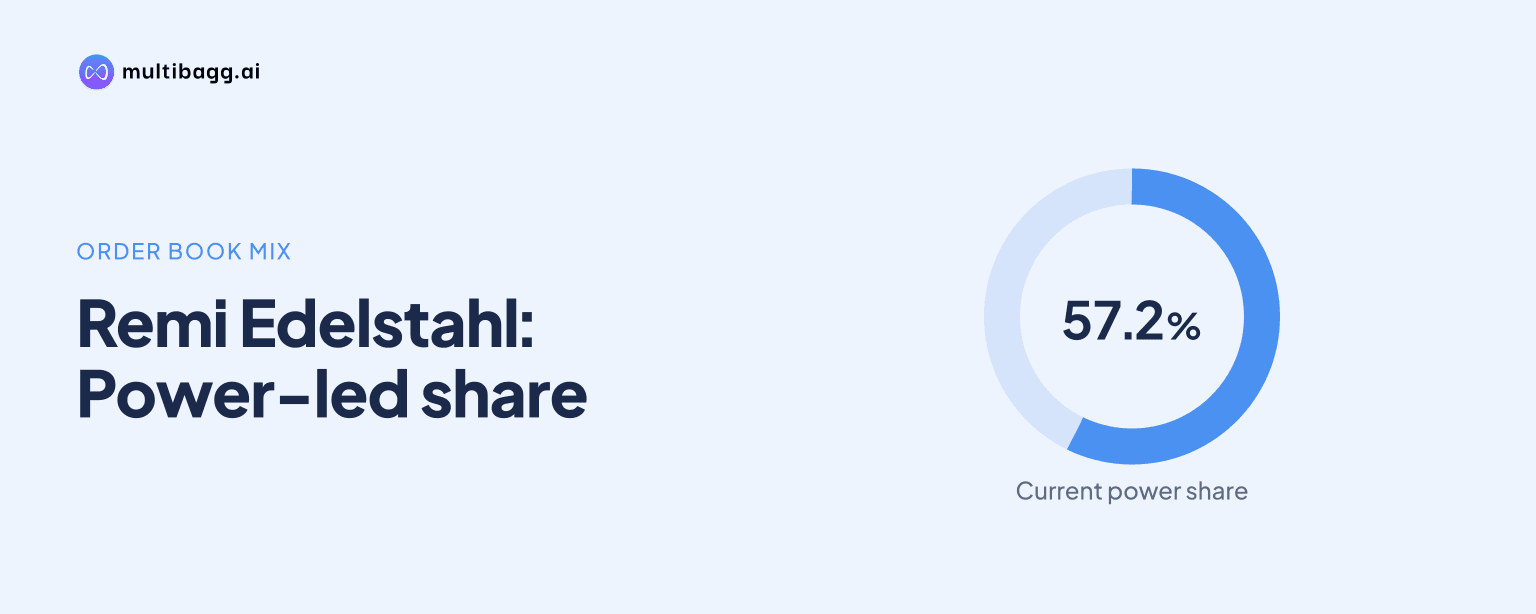
Remi Edelstahl Tubulars Ltd has a ₹173 crore current order book, with thermal and nuclear power accounting for 57.2% of it, ahead of oil and gas at 23.1% and water treatment and desalination at 14.4%. The disclosed mix means power projects represent more than half of REMI’s near-term order visibility.
Know Remi Edelstahl Tubulars inside out
Results, valuation, peers and who's buying, in one view.
How is REMI’s ₹173 crore order book split?
REMI’s ₹173 crore order book is split among thermal and nuclear power at 57.2%, oil and gas at 23.1%, water treatment and desalination at 14.4%, and others at 5.3%. The company describes the order book as diversified across multiple industries and as providing revenue visibility.
Thermal and nuclear power exceeds the other three disclosed categories combined, which total 42.8% of the book. Oil and gas is the second-largest segment, at 23.1%, or 8.7 percentage points above water treatment and desalination, while the source does not break down the 5.3% “others” category.
The presentation does not disclose order values by customer, project count, delivery schedules, or the portions of the 57.2% category attributable separately to thermal and nuclear projects. It therefore establishes end-market concentration, but not the timing of revenue recognition from the ₹173 crore book.
Why does thermal and nuclear power account for 57.2% of REMI’s orders?
Thermal and nuclear power accounts for 57.2% of REMI’s orders because its product portfolio includes cold-drawn seamless tubes and welded tubes used in those industries. REMI identifies heat-exchanger, condenser and feedwater-heater tubes as components used across conventional and nuclear steam cycles.
Its cold-drawn seamless tube range covers outside diameters from 6 millimetres to 76 millimetres and wall thicknesses from 0.8 millimetres to 10 millimetres. The company also says its welded tubes serve thermal and nuclear power, alongside chemicals, heating, ventilation and air conditioning, food, dairy and pharmaceutical applications.
REMI’s timeline records diversification into thermal power in 2005 and delivery of critical tubing for nuclear power projects in 2016. In FY26, it supplied specialty seamless pipes to the Indian Navy for submarine-grade precision, a separate use of the same cold-drawn seamless-tube capability.
The presentation links the power opportunity to India’s planned capacity build, stating that thermal and nuclear installed capacity is set to nearly double from 566 gigawatts to about 1,054 gigawatts by FY36. It also cites nuclear capacity increasing from 22 gigawatts to 100 gigawatts by 2047, although these market figures do not indicate future orders or revenue for REMI.
What supports REMI’s oil, gas and water-treatment orders?
Oil and gas represents 23.1% of REMI’s ₹173 crore book and is supported by both welded pipes and cold-drawn seamless tubes. The welded-pipe portfolio serves oil and gas, water treatment and fertilisers, with sizes from one-half inch nominal bore to 80 inches outside diameter and wall thicknesses up to 80 millimetres.
The welded pipes are manufactured to specifications including ASTM A-358, A-778, A-928 and A-312, where ASTM refers to American Society for Testing and Materials standards. REMI’s Tarapur facility has annual installed capacity of 12,000 metric tonnes and covers 51,000 square metres, according to the presentation.
Water treatment and desalination accounts for 14.4% of the book, making it 8.7 percentage points smaller than oil and gas. REMI cites seven sewage-treatment plants under construction in Mumbai with combined capacity of about 2,464 million litres per day, while Bengaluru has 185 million litres per day under construction and 20 existing-plant upgrades.
Management says stainless steel is increasingly specified for corrosion resistance in continuous wastewater contact and says this trend was reflected in new customer wins during the quarter. However, the presentation gives no customer names, order values or commissioning dates for the water-treatment and desalination work within the 14.4% category.
Got a follow-up? Ask IRIS
How do the order book and FY27 financial results compare?
REMI reported total income of ₹54.0884 crore in Q2 FY27, compared with ₹35.3717 crore in Q1 FY27, an increase of 52.91% quarter on quarter. Earnings before interest, tax, depreciation and amortisation, or EBITDA, rose 129.22% to ₹4.6854 crore, while profit after tax, or PAT, rose 327.31% to ₹1.9289 crore.
For H1 FY27, total income increased 46.81% year on year to ₹89.4601 crore from ₹60.9356 crore in H1 FY26. EBITDA rose 65.52% to ₹6.7294 crore and PAT rose 91.63% to ₹2.3803 crore over the same period.
The financial results show higher reported income and profit in FY27 alongside the current ₹173 crore order book, but the source does not provide a prior-period order-book figure. It also does not allocate Q2 FY27 or H1 FY27 revenue, EBITDA or PAT among thermal and nuclear power, oil and gas, water treatment, or other end-markets.
What expansion plans could broaden REMI’s product mix?
REMI says its technology partnership with WSG Co. Ltd., South Korea, has moved from trials to commercial execution, with machinery installation and trial orders completed. The company says it is executing multiple high-purity tube orders for the pharmaceutical industry under the partnership.
Management says Phase 2 will extend the high-purity size range to 6 inches, add high-precision in-process equipment and upgrade polishing machinery. The planned equipment is intended for tighter tolerances, finer surface finish and applications including ultra-high-purity and semiconductor requirements.
Commercial production of electropolished tubes commenced in 2026 under the WSG partnership for food, dairy, pharmaceutical and semiconductor uses. The presentation does not disclose Phase 2 capital expenditure, a commissioning date, an incremental capacity figure or a revenue target, so its financial effect is not stated.
Conclusion
REMI’s disclosed order mix places thermal and nuclear power at the centre of its current revenue visibility, with 57.2% of the ₹173 crore book compared with 42.8% across oil and gas, water treatment and other applications. Its tube portfolio serves the equipment used in conventional and nuclear steam cycles, while FY27 results show higher income and profit than in the comparable periods.
The next disclosed development to watch is management’s Phase 2 WSG expansion, which is intended to take high-purity tube sizes to 6 inches and add precision and polishing equipment. Future updates would also need to clarify changes in the ₹173 crore book, the split between thermal and nuclear orders, and delivery timing by project.