










Aster DM Quality Care posts record Q2 revenue, 24% margin
Key highlights
- Q2 FY27 revenue was Rs 2,829 crore, up 19% year on year from Rs 2,382 crore.
- Operating EBITDA rose 25% year on year to Rs 678 crore and margin increased 111 basis points to 24.0%.
- Total patient volumes increased 12% to 2.18 million, while occupancy rose to 68% from 65%.
- Aster DM Quality Care realised Rs 16.6 crore of synergies in Q2 FY27 against stated full potential of Rs 200 crore.
powered by IRIS
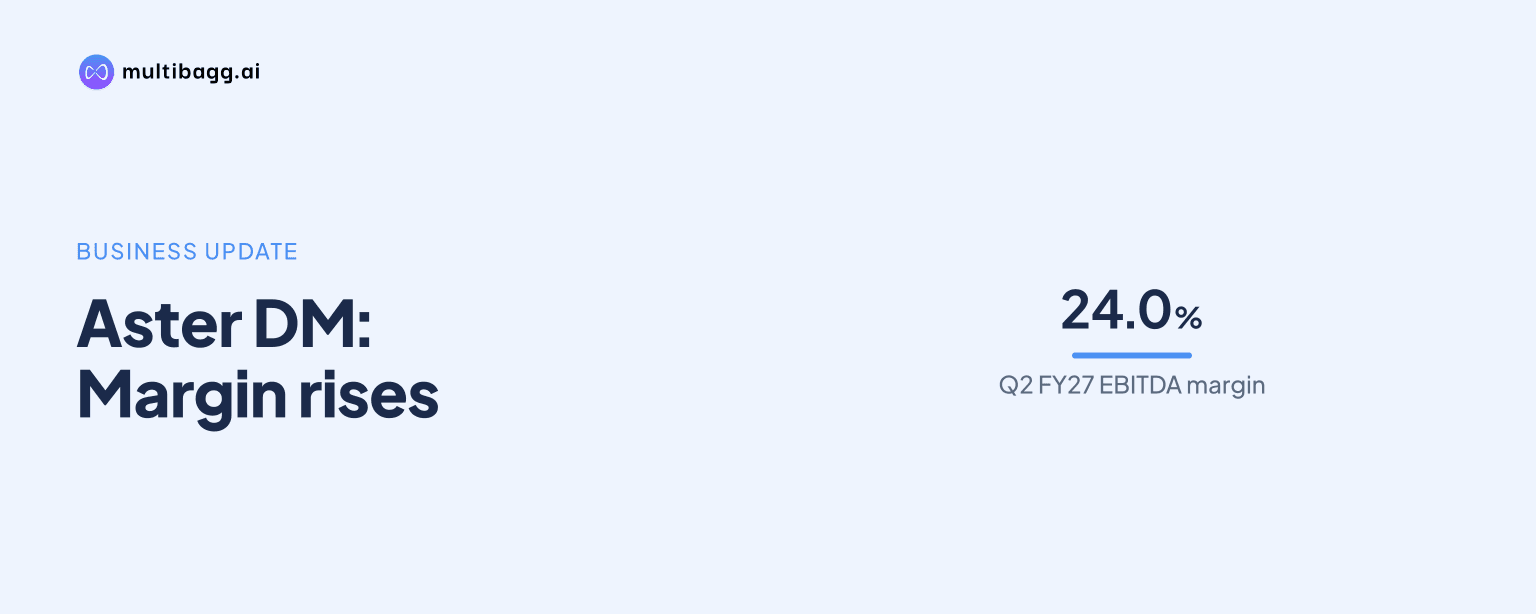
Aster DM Quality Care Limited posted record Q2 FY27 revenue of Rs 2,829 crore, up 19% year on year, and operating EBITDA of Rs 678 crore, up 25%, as margin rose 111 basis points to 24.0% in the combined group’s first quarter after the merger.
Know Aster DM Quality Care inside out
Results, valuation, peers and who's buying, in one view.
How did Aster DM Quality Care perform in Q2 FY27?
Aster DM Quality Care reported revenue from operations of Rs 2,829 crore in Q2 FY27, compared with Rs 2,382 crore in Q2 FY26 on a pro forma basis, a 19% increase. Operating EBITDA, excluding other income, was Rs 678 crore, up from Rs 545 crore, while normalised profit after tax, or PAT, rose 34% to Rs 281 crore from Rs 210 crore.
The quarter was the highest in the seven-quarter revenue series disclosed from Q4 FY25 through Q2 FY27. Revenue increased by Rs 229 crore from Rs 2,600 crore in Q1 FY27, while operating EBITDA rose by Rs 102 crore from Rs 576 crore and margin increased from 22.2% to 24.0%. The presentation describes Q2 FY27 as the first quarter of the merged entity.
The comparison requires an important qualification: Q2 FY26 figures combine Aster’s limited-review financial information with Quality Care India Limited’s pro forma financial information. For Q2 FY27, operating EBITDA excludes employee stock option plan cost, variable operations and maintenance fee, and other expenses; normalised PAT excludes merger-related exceptional expenses and the share of loss from equity-accounted investees.
What drove Aster DM Quality Care’s revenue growth?
Aster DM Quality Care attributed the 19% revenue increase to a 12% rise in total patient volumes, greater clinical complexity and only 4% growth in operational beds. Total patients reached 2.18 million in Q2 FY27, up from 1.95 million a year earlier, while operational beds rose to 10,611 from 10,222.
Occupancy climbed 335 basis points to 68% from 65%, while average length of stay, or ALOS, remained unchanged at 3.3 days. The company said higher footfall in key specialties and greater medical value travel, or MVT, patient flows lifted occupancy. MVT revenue grew 36% year on year, led by Maldives and Gulf Cooperation Council markets, with contribution also rising from West Africa and other Middle East and North Africa markets.
Complex-care activity was another stated revenue mechanism. CONGO revenue grew 16% year on year and represented 53% of total revenue; within high-end tertiary care, robotic surgeries increased 39%, kidney transplants 31% and joint replacements 29%. In the payor mix, third-party administrator, or TPA, revenue increased to 33% from 31%, while walk-in revenue declined to 54% from 56%; MVT and government health schemes each remained at 4% and 9%, respectively.
Why did Aster DM Quality Care’s margin rise to 24.0%?
Aster DM Quality Care said operating leverage in material and other operating costs, higher patient footfall, more complex procedures and a favourable payor mix increased the operating EBITDA margin by 111 basis points to 24.0%. Gross margin also expanded to 78.3% from 77.6%, while operating EBITDA grew faster than revenue, at 25% versus 19%.
For H1 FY27, the same direction continued: revenue rose 20% to Rs 5,429 crore, operating EBITDA increased 27% to Rs 1,255 crore and the operating EBITDA margin reached 23.1%, compared with 21.8% in H1 FY26. Normalised PAT for the half year was Rs 457 crore, up 27% from Rs 360 crore, and the normalised PAT margin increased to 8.4% from 7.9%.
The hospital-only maturity data also shows differing earnings contributions. Mature units accounted for 64% of operational beds but generated 73% of revenue and 83% of operating EBITDA in H1 FY27, with a 30.2% margin. Emerging hospitals represented 10% of beds and 6% of revenue, but their revenue grew 62% and operating EBITDA grew 163%, with their margin reaching 16.3%.
Got a follow-up? Ask IRIS
Which hospital segments contributed most to Aster DM Quality Care earnings?
Aster DM Quality Care’s mature hospitals were the largest earnings contributor, generating 83% of hospital operating EBITDA in H1 FY27, while focus units generated 10%, emerging units 4% and underperforming units 2%. These segment figures exclude corporate costs, adjacent businesses and Wayand Institute of Medical Sciences, or WIMS.
Mature hospitals recorded 18% revenue growth and 25% operating EBITDA growth, supported by volume and case complexity, according to the presentation. Focus hospitals, defined as units more than three years old with EBITDA margins between 15% and 25%, reported 13% revenue growth and an 18.6% margin. Underperforming hospitals, which had margins below 15%, delivered 24% revenue growth and a 12.1% margin after a 722-basis-point year-on-year improvement.
The network had 10,840 capacity beds across 38 hospitals in 27 cities as of September 30, 2026, with 76% of beds in non-metro locations and 24% in metro locations. Kerala was the largest state presence, with 11 hospitals and 4,664 beds, while the group also had two international hospitals with 621 beds in Dhaka and Chattogram.
What integration and clinical investments did Aster DM Quality Care make?
Aster DM Quality Care realised Rs 16.6 crore of merger synergies in Q2 FY27 and reported an annualised synergy runway of Rs 65 crore against full synergy potential of Rs 200 crore. The stated levers include talent sharing, renewable-energy savings, indirect-cost optimisation, capital-expenditure efficiencies, information-technology integration, material-cost optimisation and medical tourism.
The company added a 32-bed CARE Cancer Institute in Raipur and made a net addition of 66 doctors across the hospital network in H1 FY27. Management said the added doctors were contributing about Rs 5 crore of monthly revenue. It also added one linear accelerator, one digital PET-CT scanner, three surgical robots, two catheterisation laboratories and one magnetic resonance imaging machine in Q2 FY27.
Over the preceding 18 months, Aster DM Quality Care invested more than Rs 600 crore in medical technology. As of September 30, 2026, the network had 44 cath labs, 13 linear accelerators, 32 MRI machines, 33 robots and seven PET-CT systems. The quarter also included launches of the ARISE Robotic Spine Institute at Aster CMI in July 2026, the Raipur cancer institute in August, and a fetal medicine centre at Aster Medcity in September.
Conclusion
Aster DM Quality Care’s Q2 FY27 outcome combines higher patient throughput, improved occupancy and a greater contribution from complex care with cost leverage and early integration benefits. Revenue grew Rs 447 crore year on year, while operating EBITDA increased Rs 133 crore and margin expanded 111 basis points, with mature hospitals remaining the main source of hospital earnings.
The next disclosed milestone is capacity expansion: Aster DM Quality Care plans to add 4,230 beds, taking capacity from 10,840 to a projected 15,070. The plan lists 454 beds in FY27, 1,330 in FY28, 770 in FY29 and 1,676 in FY30 and beyond, while the company has yet to realise most of its stated Rs 200 crore synergy potential.