










Aster reports Rs 16.6 crore Q2 synergies, Rs 65 crore runway
Key highlights
- Aster realised Rs 16.6 crore of merger synergies in Q2 FY27.
- Aster reported a Rs 65 crore annualised synergy runway against Rs 200 crore of identified potential.
- Aster’s Q2 FY27 revenue rose 19% year on year to Rs 2,829 crore and operating EBITDA rose 25% to Rs 678 crore.
- Aster reported 10,611 operational beds and 2.18 million total patients in Q2 FY27.
powered by IRIS
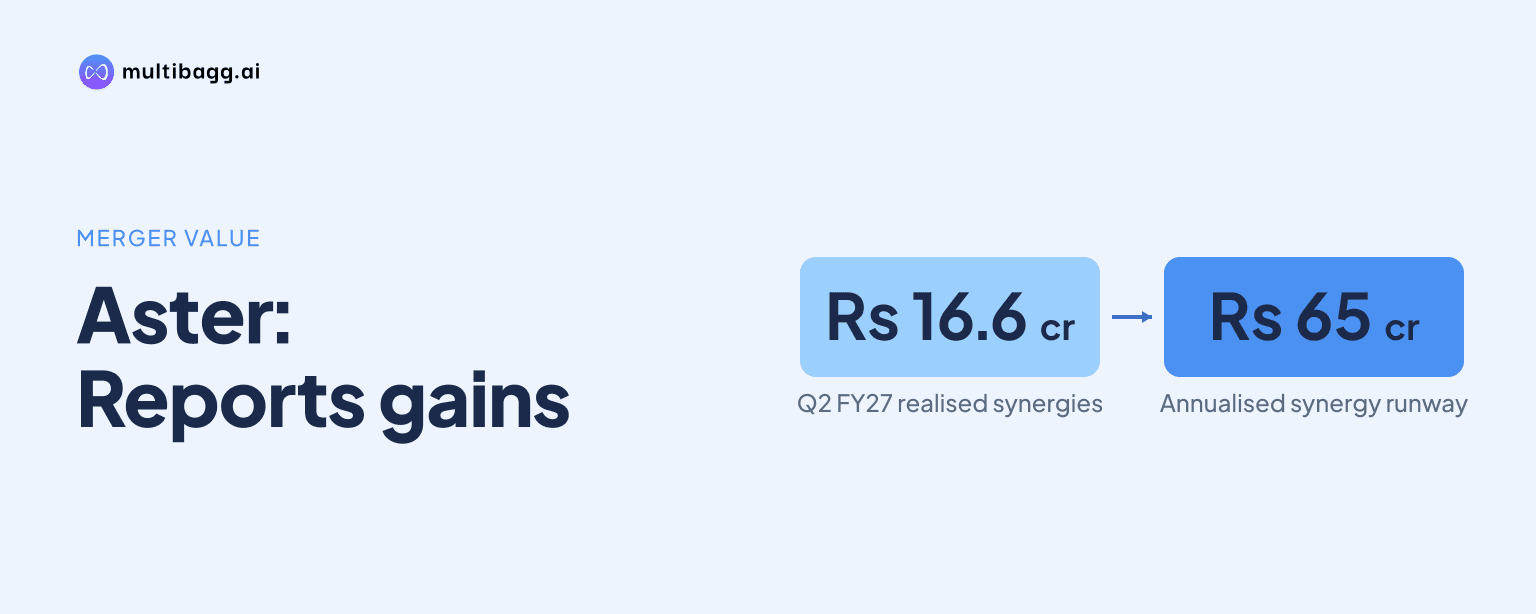
Aster DM Quality Care Limited realised Rs 16.6 crore of merger synergies in Q2 FY27, its first quarter as a combined entity, and reported a Rs 65 crore annualised synergy runway. The runway includes the realised amount and represents 32.5% of Aster’s disclosed Rs 200 crore full synergy potential.
Know Aster DM Quality Care inside out
Results, valuation, peers and who's buying, in one view.
How much merger synergy has Aster realised?
Aster realised Rs 16.6 crore of synergies in Q2 FY27 and reported a Rs 65 crore annualised runway, according to its integration update. The company explicitly said the Rs 65 crore runway includes the Rs 16.6 crore already achieved, so the two figures should not be added together.
Aster has identified Rs 200 crore of full synergy potential, leaving Rs 135 crore not yet reflected in the reported annualised runway. The Rs 65 crore run-rate is therefore 32.5% of the stated opportunity. The presentation does not provide a deadline for achieving the full amount or a rupee split between realised savings, runway initiatives and initiatives yet to be achieved.
Aster described Q2 FY27 as the first quarter of the merger, following the start of the combined organisation on 1 July 2026. The Rs 16.6 crore is consequently an early-quarter delivery measure, while the Rs 65 crore figure is an annualised run-rate rather than a separately reported quarterly saving.
Which initiatives are included in Aster’s synergy plan?
Aster listed 10 synergy areas: academics, nursing and talent sharing; renewable-energy savings; indirect-cost optimisation; capital-expenditure efficiencies; information-technology integration; business key-performance-indicator reporting standardisation; material-cost optimisation; international medical tourism and third-party administrator activity; quality and accreditation; and food-and-beverage insourcing.
The IT work includes call-centre, customer-relationship-management and digital-app integration, while the operating work includes common business reporting and material-cost management. Aster did not assign a savings number or completion date to any of the 10 workstreams, so the presentation does not show which initiatives account for the Rs 16.6 crore achieved in Q2 FY27.
The plan also includes clinical and workforce collaboration. In its first 100 days, Aster said Aster CMI expertise helped CARE Banjara perform adaptive deep brain stimulation, while academics, nursing and talent sharing were listed as synergy areas. This indicates that the Rs 200 crore opportunity covers network capability sharing alongside cost and procurement measures.
What integration work has Aster completed since July 2026?
Aster said it had formed one team across Aster, CARE Hospitals, Evercare and KIMSHEALTH from 1 July 2026, with group leaders in finance, operations, people, clinical and digital in place. It also reported zero disruptions to patient care since Day 1 of integration, without publishing a separate service-quality metric for that statement.
The company conducted 18 culture engagements with every employee and more than 50 townhalls across units and offices during the quarter. A survey found that 98% of surveyed employees felt energised by the Go Greater programme, and Aster said eight shared cultural tenets had been cascaded across all four brands through the 18 engagements.
Aster reported 2.2 million patients served together in its integration update for the quarter. Its operating table recorded 2.18 million total patients for Q2 FY27, a 12% increase from 1.95 million in Q2 FY26. The two figures are close but presented at different levels of rounding in the company materials.
Got a follow-up? Ask IRIS
How did Aster perform in its first merger quarter?
Aster reported Rs 2,829 crore of revenue in Q2 FY27, up 19% from Rs 2,382 crore in Q2 FY26, while operating earnings before interest, tax, depreciation and amortisation, or operating EBITDA, increased 25% to Rs 678 crore from Rs 545 crore. The Q2 FY26 comparison is presented on a pro forma basis combining Aster’s financial information with QCIL’s pro forma financial information.
Operating EBITDA margin rose 111 basis points to 24.0% from 22.9%, and normalised profit after tax increased 34% to Rs 281 crore from Rs 210 crore. Aster said Q2 FY27 operating EBITDA excludes employee stock-option-plan cost, variable operations-and-maintenance fee amounts and other expenses; normalised profit after tax excludes merger-related exceptional expenses and share of loss from equity-accounted investees.
The combined company also improved from Q1 FY27, when revenue was Rs 2,600 crore, operating EBITDA was Rs 576 crore and margin was 22.2%. Operational beds rose 4% year on year to 10,611 and occupancy increased 335 basis points to 68%, while average length of stay was unchanged at 3.3 days.
Aster attributed the quarter’s performance to clinical complexity, operating leverage and synergy realisation, but it did not isolate the effect of the Rs 16.6 crore synergies on operating EBITDA. Mature units represented about 64% of operational beds, about 73% of revenue and 83% of operating EBITDA, while emerging units including Kasargod and Nagercoil grew revenue 62% year on year.
What remains undisclosed in Aster’s synergy programme?
Aster has not disclosed the savings contribution, implementation cost or delivery schedule for each of its 10 synergy areas. As a result, the presentation does not establish how much of the Rs 135 crore outside the current annualised runway may be expected from renewable energy, material costs, capital expenditure, IT integration or food-and-beverage insourcing.
The company also did not separate merger benefits from other factors behind the 111-basis-point margin increase in Q2 FY27. Aster cited operating leverage in material and other operating costs, increased patient footfall, complex procedures and a favourable payor mix alongside synergy realisation, which means the disclosed data do not support attributing all margin expansion to the integration.
Integration is continuing alongside expansion spending. Aster commissioned a 32-bed CARE Cancer Institute in Raipur and added one linear accelerator, one digital PET-CT scanner, three robots, two catheterisation laboratories and one MRI machine in Q2 FY27. It also reported investment of more than Rs 600 crore in medical technology over the preceding 18 months, separate from the Rs 200 crore synergy opportunity.
Conclusion
Aster’s Q2 FY27 disclosure provides an initial quantified measure of the merger integration: Rs 16.6 crore realised and a Rs 65 crore annualised runway against Rs 200 crore of identified potential. The first combined quarter also produced Rs 2,829 crore of revenue, Rs 678 crore of operating EBITDA and a 24.0% operating EBITDA margin, although the company did not quantify the synergy contribution to those earnings.
The next disclosed integration measures to watch are progress in IT integration, renewable-energy savings, indirect and material-cost optimisation, capital-expenditure efficiencies, talent sharing and food-and-beverage insourcing. Aster has identified these 10 workstreams but has not set initiative-level targets or dates for converting the remaining opportunity into reported savings.