










Aster DM Quality Care Limited Q2 revenue up 19%, profit up 34%
Key highlights
- Aster DM Quality Care reported Q2 FY27 revenue of Rs 2,829 crore, up 19% year on year.
- Normalised PAT rose 34% year on year to Rs 281 crore in Q2 FY27.
- Aster DM Quality Care served 2.2 million patients in Q2 FY27, a 12% increase.
- Occupancy rose 335 bps from 65% to 68% in Q2 FY27.
powered by IRIS
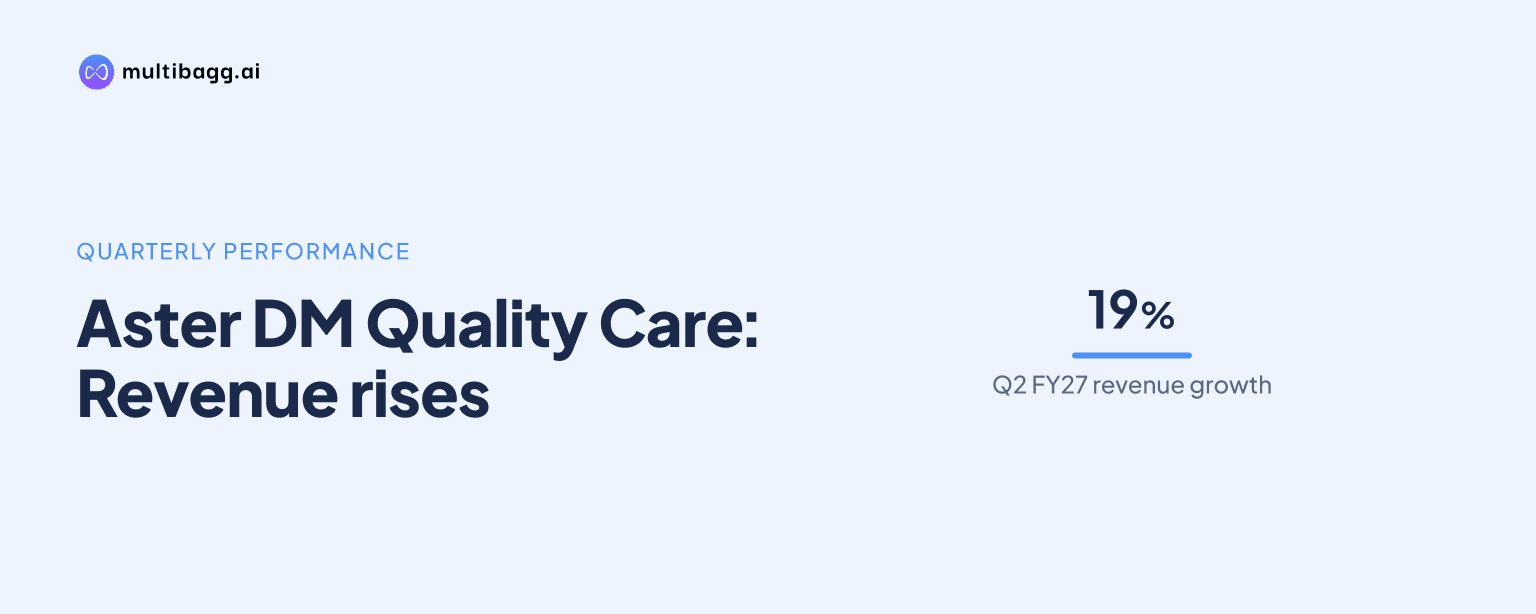
In Q2 FY27, Aster DM Quality Care reported revenue of Rs 2,829 crore, up 19% year on year, and normalised profit after tax of Rs 281 crore, up 34%, in its first full quarter as a combined company following the 1 July 2026 merger.
Know Aster DM Quality Care inside out
Results, valuation, peers and who's buying, in one view.
What were Aster DM Quality Care's key Q2 FY27 financial results?
Aster DM Quality Care reported Q2 FY27 revenue of Rs 2,829 crore and normalised profit after tax (PAT) of Rs 281 crore, increases of 19% and 34% year on year, respectively. Management attributed the revenue growth in the quarter ended 30 September 2026 to higher patient volumes, greater clinical complexity and a favourable payor mix.
Normalised PAT translated into a PAT margin of 10% in Q2 FY27. Return on capital employed (ROCE) was 23%, up 152 basis points (bps) year on year, while the company described the quarter as its first full reporting period after combining Aster DM Healthcare and Quality Care India.
The difference between revenue and profit growth was 15 percentage points in Q2 FY27, with normalised PAT rising faster than revenue. The announcement does not provide the prior-year revenue or normalised PAT amounts, but it identifies higher volumes, more complex procedures and the payor mix as the mechanisms behind the reported increase.
How did patient volumes and hospital occupancy change in Q2 FY27?
Aster DM Quality Care served 2.2 million patients in Q2 FY27, a 12% year-on-year increase, while occupancy rose 335 bps to 68% from 65%. The company said growth in key specialties and increased Medical Value Travel (MVT) patient flows lifted utilisation during the quarter ended 30 September 2026.
Neurosciences, oncology, orthopedics and gastroenterology led the total patient-volume increase of 12% in Q2 FY27. In the same period, robotic surgeries grew by approximately 39%, kidney transplants by approximately 31% and joint replacements by approximately 29%, indicating growth in complex clinical procedures alongside overall patient numbers.
MVT volume grew 31% year on year in Q2 FY27 and MVT revenue rose 36%, a faster rate than the company-wide revenue increase of 19%. Aster DM Quality Care said the Maldives and Gulf Cooperation Council markets led MVT revenue growth, while West Africa and other Middle East and North Africa markets made a rising contribution.
Which hospital segments drove Aster DM Quality Care's growth?
Aster DM Quality Care said mature hospitals contributed approximately 73% of hospital revenue in H1 FY27 and recorded 18% year-on-year growth. The company linked the segment's first-half performance to steady patient-volume expansion and an increasing share of complex clinical cases.
Emerging hospitals, including Kasargod and Nagarcoil, recorded 62% year-on-year growth in H1 FY27, supported by higher inpatient and outpatient volumes. That growth rate was more than three times the 18% growth reported for mature hospitals, although mature hospitals remained the larger contributor with about 73% of hospital revenue.
For Q2 FY27, Executive Chairman Dr. Azad Moopen said the emerging-hospital portfolio, including Kasargod and Nagarcoil, grew 61%. The source therefore reports 61% growth for the quarter and 62% for H1 FY27, rather than presenting the two figures as measures for the same period.
Got a follow-up? Ask IRIS
What changed after the Aster DM Quality Care merger?
Aster DM Quality Care began operating as one integrated platform on 1 July 2026, making Q2 FY27 its first full combined quarter. Managing Director and Group Chief Executive Officer Varun Khanna said teams were bringing together people, processes and systems while maintaining patient care and operational continuity.
The company rolled out its GO GREATER unified-culture initiative across nearly 40 locations during the integration. The combined platform has four brands, Aster DM, CARE Hospitals, Evercare and KIMSHEALTH, and comprises 38 hospitals across 27 cities with more than 10,840 beds.
The merged network provides primary, secondary, tertiary and quaternary care, with centres of excellence in specialties including oncology, cardiac sciences, neurosciences, gastro sciences, orthopaedics, nephrology, organ transplantation, mother and child-care, and critical care. In Q2 FY27, CARE Hospitals, HITEC City, Hyderabad, received Joint Commission International accreditation, while MIMS Kasargod achieved National Accreditation Board for Hospitals and Healthcare Providers accreditation within a year of starting operations.
What clinical and capacity plans did Aster DM Quality Care disclose?
Aster DM Quality Care reported three new Centres of Excellence in Q2 FY27: the ARISE Robotic Spine Institute at Aster CMI, Bengaluru; the CARE Cancer Institute at Ramkrishna CARE, Raipur; and the Fetal Medicine Centre of Excellence at Aster Medcity, Kochi. These additions followed a quarter in which robotic surgeries increased by approximately 39% year on year.
During Q2 FY27, CARE Banjara, Hyderabad, performed its first adaptive Deep Brain Stimulation procedure for Parkinson's disease management. Aster Medcity, Kochi, performed Kerala's first liquid nitrogen cryoablation for breast fibroadenomas, a minimally invasive treatment intended to preserve breast tissue.
Management said it was progressing the Aster Trivandrum project towards commissioning and planned to augment capacity across geographies. It also identified expansion of CONGO and other high-end specialties, clinical-talent investment, infrastructure, technology and improved healthcare access as priorities after Q2 FY27.
Conclusion
Aster DM Quality Care's first full combined quarter paired 19% revenue growth to Rs 2,829 crore with a 34% increase in normalised PAT to Rs 281 crore. Patient volumes rose 12% to 2.2 million, occupancy reached 68%, and MVT revenue grew 36%, while mature and emerging hospitals recorded 18% and 62% growth, respectively, in H1 FY27.
The next disclosed milestone is progress towards commissioning the Aster Trivandrum project and the planned capacity expansion across geographies. The company cautioned that forward-looking outcomes may differ materially, including because accounting policies and practices are being harmonised following the merger.