










Aster DM Quality Care logs Rs 16.6 crore Q2 synergies
Key highlights
- Aster DM Quality Care realised Rs 16.6 crore of synergies in Q2 FY27.
- Aster DM Quality Care reported a Rs 65 crore annualised synergy runway that includes the Q2 FY27 realised amount.
- Aster DM Quality Care identified Rs 200 crore of full synergy potential across its combined organisation.
- Aster DM Quality Care reported Q2 FY27 revenue of Rs 2,829 crore, up 19% year on year.
powered by IRIS
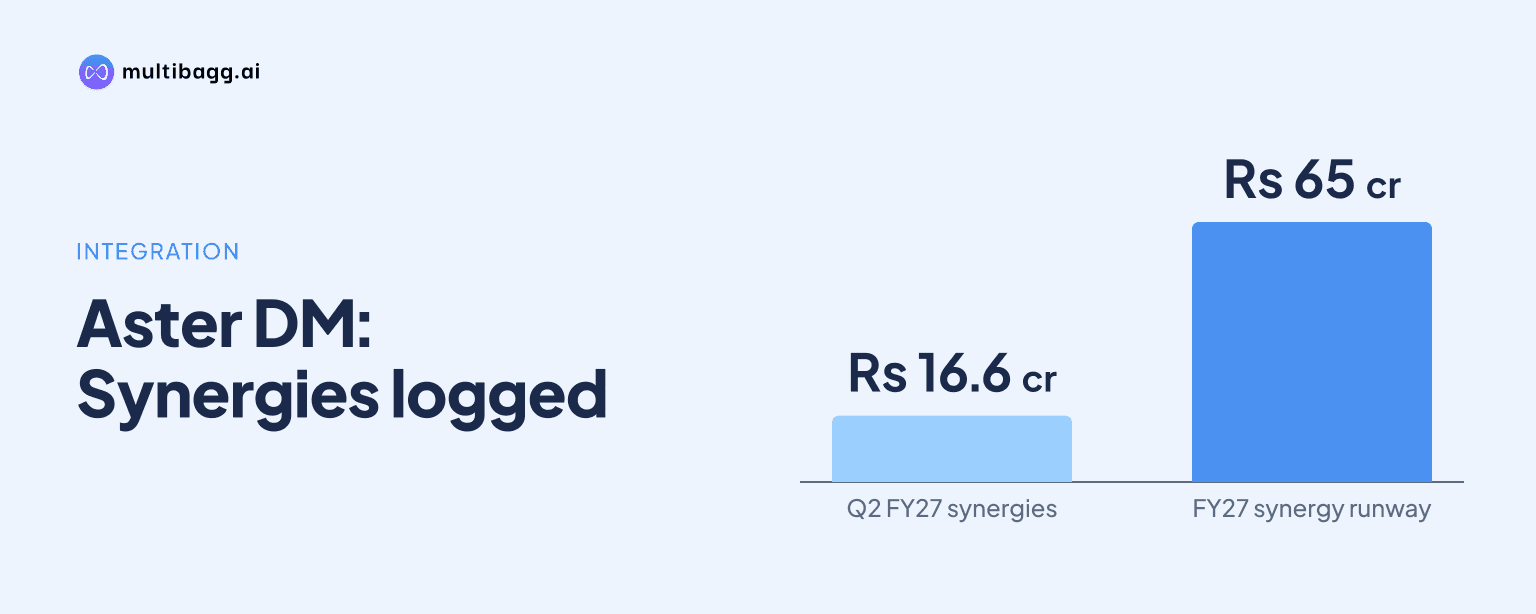
Aster DM Quality Care Limited realised Rs 16.6 crore of merger synergies in Q2 FY27 and reported a Rs 65 crore annualised synergy runway, including the amount achieved, against Rs 200 crore of full potential. The quarter ended 30 September 2026 and was the first quarter of the combined organisation’s integration programme from 1 July 2026.
Know Aster DM Quality Care inside out
Results, valuation, peers and who's buying, in one view.
How much merger synergy has Aster DM Quality Care realised?
Aster DM Quality Care realised Rs 16.6 crore of synergies in Q2 FY27, while identifying Rs 200 crore as the full synergy potential across the combined organisation. The realised amount represents the presentation’s first quantified measure of integration benefits following the 1 July 2026 start of the programme.
The company reported a Rs 65 crore annualised runway, which includes the Rs 16.6 crore achieved in Q2 FY27. It should therefore not be added to the quarterly realised amount. Based on the stated Rs 200 crore potential, Rs 135 crore remained outside the reported runway, although the presentation did not provide a timetable for realising it.
Aster DM Quality Care described the period as its first 100 days together across Aster, CARE Hospitals, Evercare and KIMSHEALTH. It reported zero disruption to patient care since the first day of integration and 2.2 million patients served during the quarter, indicating that the programme was implemented while hospital operations continued.
Which integration areas make up Aster DM Quality Care’s synergy plan?
Aster DM Quality Care listed 10 synergy areas but did not disclose the Q2 FY27 rupee contribution from each one. The areas include academics, nursing and talent sharing; renewable-energy savings; indirect-cost optimisation; capital-expenditure efficiencies; and information-technology integration covering call centres, customer relationship management and a digital app.
The remaining workstreams are business key-performance-indicator and reporting standardisation, material-cost optimisation, international medical tourism and third-party administrator activity, quality and accreditation, and food-and-beverage insourcing. Renewable energy, materials and food-and-beverage initiatives are cost mechanisms, while medical tourism, clinical sharing and digital integration can also affect patient access and service delivery.
Clinical sharing was one early example of integration in the first 100 days: Aster CMI expertise helped CARE Banjara perform adaptive deep brain stimulation. The company also said group leaders had been placed across finance, operations, people, clinical and digital functions, but it did not attach a financial value to either action.
Got a follow-up? Ask IRIS
Did financial performance improve alongside the Q2 FY27 synergies?
Aster DM Quality Care reported Q2 FY27 revenue of Rs 2,829 crore, operating earnings before interest, tax, depreciation and amortisation (operating EBITDA) of Rs 678 crore, and a 24.0% operating EBITDA margin. Revenue rose 19% year on year, operating EBITDA increased 25%, and margin expanded by 111 basis points from 22.9% in Q2 FY26.
The Q2 FY26 comparatives are presented on a pro forma basis, combining Aster’s limited-review financial information with QCIL’s pro forma information. Operating EBITDA for Q2 FY27 excludes employee stock option plan cost and variable operations and maintenance fee amounts within other expenses, while revenue and operating EBITDA exclude other income.
Management attributed the margin movement to operating leverage in material and other operating costs, higher patient footfall, complex procedures, a favourable payor mix and synergy realisation. The presentation did not quantify how much of the 111-basis-point margin improvement was attributable specifically to the Rs 16.6 crore of synergies.
Patient volumes increased 12% to 2.18 million in Q2 FY27, operational beds rose 4% to 10,611, and occupancy reached 68% from 65%. Average length of stay was unchanged at 3.3 days, so the disclosed data show higher utilisation alongside volume and bed growth without isolating the financial effect of merger actions.
What does the first 100 days indicate about integration progress?
Aster DM Quality Care said 98% of surveyed employees felt energised by the Go Greater programme during the first 100 days. It conducted 18 culture engagements and more than 50 town halls across units and offices, while eight shared tenets were cascaded across the four brands.
The 98% employee figure is an internal engagement measure rather than a financial result because the presentation does not disclose the survey sample size, methodology or a prior-period comparison. Its relevance to the Rs 65 crore annualised runway is that talent sharing, reporting standardisation and technology integration require common practices across the combined network.
Operational development continued alongside integration in Q2 FY27. Aster DM Quality Care commissioned a 32-bed CARE Cancer Institute in Raipur, added one linear accelerator, one digital positron-emission tomography-computed tomography system, three robots, two catheterisation laboratories and one magnetic resonance imaging system.
The company also reported a net addition of 66 doctors across the hospital network in H1 FY27, contributing about Rs 5 crore of monthly revenue. Mature units accounted for about 64% of operational beds and about 73% of revenue, while emerging units, including Kasargod and Nagercoil, grew revenue 62% year on year, according to management.
Conclusion
The Rs 16.6 crore realised in Q2 FY27 provides an initial quantified outcome from Aster DM Quality Care’s merger integration, while the Rs 65 crore annualised runway indicates initiatives already established or progressing. Revenue of Rs 2,829 crore, 24.0% operating EBITDA margin and 68% occupancy improved alongside the programme, but the company has not separated the contribution of synergies from volume, case-mix and operating-leverage effects.
What to watch next is whether Aster DM Quality Care converts the remaining potential outside its Rs 65 crore annualised runway into realised benefits and provides timing or workstream-level disclosure. The presentation identifies planned integration in call centres, customer relationship management, digital applications, reporting, procurement and clinical collaboration, but does not set a target date for the Rs 200 crore full potential.