










Aster DM Quality Care targets 15,070 beds by FY30 and beyond
Key highlights
- Aster DM Quality Care plans 4,230 additional beds, taking stated capacity from 10,840 to 15,070.
- Aster DM Quality Care allocates 53% of planned additions to new facilities and 47% to existing facilities.
- South-west and central India has the largest pipeline at 1,941 beds, including 1,471 greenfield beds.
- Aster DM Quality Care schedules 1,676 beds for FY30 and beyond, its largest expansion phase.
powered by IRIS
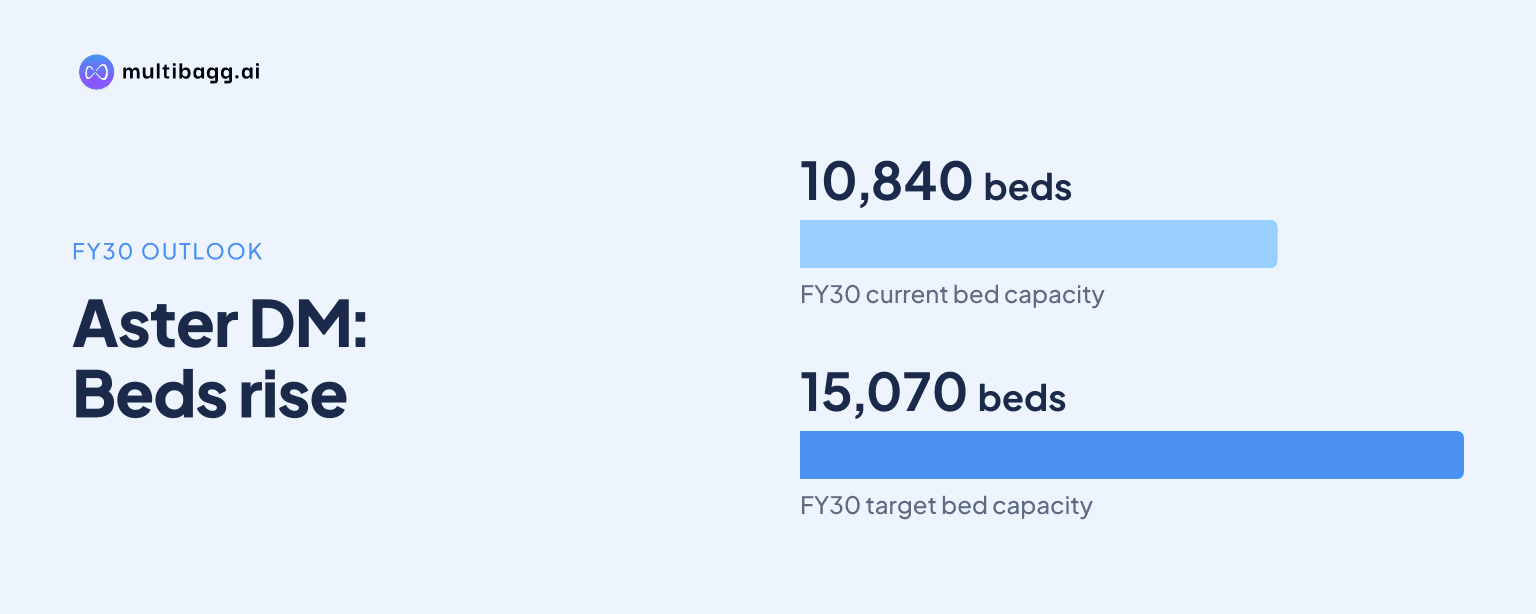
Aster DM Quality Care Limited plans to add 4,230 beds from FY27 through FY30 and beyond, increasing stated capacity from 10,840 to 15,070 beds. Aster DM Quality Care allocates 53% of the additions to new facilities, while south-west and central India has the largest regional pipeline at 1,941 beds.
Know Aster DM Quality Care inside out
Results, valuation, peers and who's buying, in one view.
What is Aster DM Quality Care’s bed-capacity target?
Aster DM Quality Care’s stated target is a 15,070-bed network after 4,230 additions across FY27, FY28, FY29 and FY30 and beyond. The plan starts from current capacity of 10,840 beds and sets out a projected total that is 4,230 beds higher.
The expansion mix is 47% beds in existing facilities and 53% beds in new facilities. The three regional pipelines identify 2,005 brownfield beds and 2,225 greenfield beds, which reconcile to the group’s planned 4,230-bed addition programme.
Aster DM Quality Care separately reported 10,611 operational beds in its hospital maturity analysis as of September 30, 2026. That operational-bed measure includes census and non-census beds, while the expansion schedule states current capacity at 10,840; the maturity analysis also excludes Wayanad Institute of Medical Sciences, or WIMS.
How is Aster DM Quality Care phasing the additions?
Aster DM Quality Care schedules 454 bed additions in FY27, 1,330 in FY28, 770 in FY29 and 1,676 in FY30 and beyond. FY30 and beyond is the largest scheduled phase, ahead of FY28, while FY27 is the smallest disclosed annual phase.
FY28 contains 760 greenfield beds and 570 brownfield beds, meaning new facilities account for the larger portion of that year’s 1,330 additions. FY30 and beyond follows the same pattern, with 1,011 greenfield beds and 665 brownfield beds among its 1,676 planned additions.
Aster DM Quality Care does not provide a greenfield and brownfield split for FY27 or FY29 on the capacity schedule. The disclosed FY28 and FY30-and-beyond splits cover 3,006 beds, leaving 1,224 additions across FY27 and FY29 without a facility-type allocation in the presentation.
Which Aster DM Quality Care region has the largest pipeline?
Aster DM Quality Care has its largest regional expansion pipeline in south-west and central India, at 1,941 beds across Karnataka, Maharashtra, Madhya Pradesh and Chhattisgarh. This plan includes 1,471 greenfield beds and 470 brownfield beds, making new facilities the principal source of capacity in that region.
Kerala and Tamil Nadu have a planned 1,179 beds, split between 725 brownfield beds and 454 greenfield beds. South-east, which covers Andhra Pradesh, Telangana, Odisha and Bangladesh, has 1,110 planned beds, including 810 brownfield and 300 greenfield beds; it has the largest brownfield share among the three regional plans.
The regional allocations add to Aster DM Quality Care’s 4,230-bed group programme: 1,179 beds in Kerala and Tamil Nadu, 1,941 in south-west and central India, and 1,110 in south-east. Current Q2 FY27 capacity is largest in Kerala and Tamil Nadu at 4,880 beds, compared with 3,419 in south-east and 2,541 in south-west and central India.
Got a follow-up? Ask IRIS
What operating trends support Aster DM Quality Care’s expansion?
Aster DM Quality Care reported revenue growth in all three geographies in Q2 FY27, led by Kerala and Tamil Nadu, where hospital revenue rose 23% year on year to Rs 1,216 crore from Rs 987 crore. Capacity in the region increased to 4,880 beds from 4,531, occupancy rose to 71% from 66%, and patient volume reached 1.30 million from 1.12 million.
South-west and central India recorded Q2 FY27 hospital revenue of Rs 689 crore, up 16% from Rs 596 crore in Q2 FY26. Occupancy increased to 69% from 66% and patient volume rose to 0.35 million from 0.32 million, while the reported hospital count changed to eight from nine.
South-east reported Q2 FY27 hospital revenue of Rs 830 crore, up 13% from Rs 736 crore a year earlier. Its capacity increased by 114 beds to 3,419, occupancy rose to 63% from 61%, and volume grew to 0.53 million from 0.51 million across 17 hospitals in both periods.
How do Aster DM Quality Care’s hospitals contribute to earnings?
Aster DM Quality Care’s mature hospitals generated 73% of hospital revenue and 83% of hospital operating earnings before interest, tax, depreciation and amortisation, or EBITDA, in the maturity analysis. These units recorded 18% revenue growth and 25% operating EBITDA growth, while operating EBITDA margin rose 186 basis points year on year to 30.2%.
Emerging hospitals contributed 6% of hospital revenue but recorded the fastest revenue growth, at 62%, and operating EBITDA growth, at 163%. Their operating EBITDA margin was 16.3%, up 624 basis points, with Aster DM Quality Care attributing the faster ramp-up to Kasaragod and Nagercoil.
At the consolidated level, Aster DM Quality Care reported Q2 FY27 revenue from operations of Rs 2,829 crore, up 19% year on year from Rs 2,382 crore. Operating EBITDA increased 25% to Rs 678 crore from Rs 545 crore, and its margin rose to 24.0% from 22.9%; property, plant and equipment including capital work in progress stood at Rs 7,252 crore on September 30, 2026.
Conclusion
Aster DM Quality Care’s 15,070-bed objective combines a 4,230-bed addition programme with rising Q2 FY27 revenue, occupancy and patient volumes across all three reported geographies. The plan is weighted toward new facilities at 53%, but its regional approach differs: south-west and central India is greenfield-led, while Kerala and Tamil Nadu and south-east have larger brownfield components.
The next disclosed delivery steps are 454 beds in FY27 and 1,330 beds in FY28, followed by 1,676 beds in FY30 and beyond. The presentation does not identify individual projects for every phase, so progress against the stated phasing, particularly the 1,471 greenfield beds planned in south-west and central India, is the key matter to watch.