










Aster DM Quality Care Q2 revenue hits Rs 2,829 crore
Key highlights
- Aster DM Quality Care reported Q2 FY27 revenue of Rs 2,829 crore, up 19% year on year.
- Operating EBITDA rose 25% to Rs 678 crore and margin increased 111 basis points to 24.0%.
- Normalised PAT increased 34% to Rs 281 crore in Q2 FY27.
- Aster DM Quality Care realised Rs 16.6 crore of Q2 FY27 synergies against Rs 200 crore of identified potential.
powered by IRIS
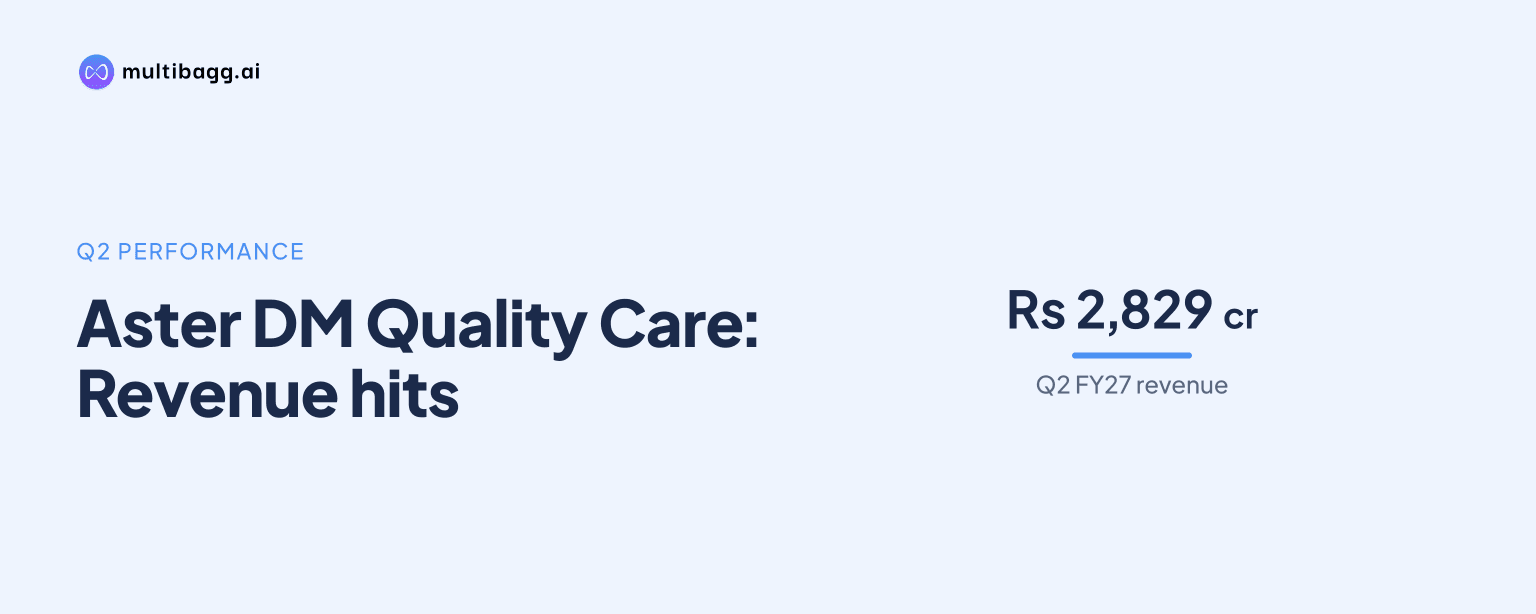
Aster DM Quality Care Limited reported record Q2 FY27 revenue of Rs 2,829 crore, up 19% year on year in its first quarter after the merger. Operating earnings before interest, tax, depreciation and amortisation (operating EBITDA) rose 25% to Rs 678 crore, lifting the operating EBITDA margin by 111 basis points to 24.0%.
Know Aster DM Quality Care inside out
Results, valuation, peers and who's buying, in one view.
How did Aster DM Quality Care perform in Q2 FY27?
Aster DM Quality Care recorded revenue from operations of Rs 2,829 crore in Q2 FY27, compared with Rs 2,382 crore in Q2 FY26, whose comparative result is presented on a pro forma basis. Operating EBITDA increased to Rs 678 crore from Rs 545 crore, outpacing revenue growth by 6 percentage points. Revenue, operating EBITDA and operating EBITDA margin exclude other income.
Normalised profit after tax (PAT), after non-controlling interests, rose 34% to Rs 281 crore from Rs 210 crore. Its margin increased to 9.9% from 8.8%. The Q2 FY27 normalised figure excludes exceptional merger-related expenses and the share of loss from equity-accounted investees.
The half-year result followed the same direction. H1 FY27 revenue grew 20% to Rs 5,429 crore, operating EBITDA increased 27% to Rs 1,255 crore and the margin rose 135 basis points to 23.1%. Normalised PAT for H1 FY27 was Rs 457 crore, up 27% from Rs 360 crore in H1 FY26.
What drove Aster DM Quality Care's revenue and margin expansion?
Aster DM Quality Care attributed Q2 FY27 revenue growth to a 12% increase in patient volumes, higher clinical complexity and a 4% increase in operational beds. Total patients reached 2.18 million from 1.95 million, while operational beds rose to 10,611 from 10,222 in Q2 FY26.
Occupancy increased by 335 basis points to 68% from 65%, while average length of stay remained unchanged at 3.3 days. The higher occupancy, alongside a stable average stay, coincided with growth in patient flows through key specialties and medical value travel.
Management said the 111-basis-point margin expansion reflected operating leverage in material and other operating costs, a favourable payor mix, complex procedures and realised synergies. Return on capital employed, calculated as EBITDA divided by average capital employed, rose 152 basis points to 23.0% in Q2 FY27.
Complex oncology, gastroenterology, neurology and orthopaedics, collectively termed CONGO by Aster DM Quality Care, accounted for 53% of revenue and grew 16% year on year. Robotic surgeries rose 39%, kidney transplants increased 31% and joint replacements grew 29%, while medical value travel revenue increased 36%, led by Maldives and Gulf Cooperation Council markets.
Which hospital segments contributed most to Aster DM Quality Care earnings?
Aster DM Quality Care's mature hospitals were the largest earnings contributor in H1 FY27, representing 64% of operational beds, 73% of hospital revenue and 83% of hospital operating EBITDA. Mature units, defined as more than three years old with operating EBITDA margin of at least 25%, grew revenue 18% and reported a 30.2% operating EBITDA margin.
Emerging hospitals, defined as units aged up to three years and including Kasaragod and Nagercoil, accounted for 10% of operational beds. Their revenue rose 62% year on year, operating EBITDA grew 163% and margin increased 624 basis points to 16.3%, which management attributed to faster volume ramp-up and efficiencies.
Focus hospitals accounted for 15% of beds and revenue, with revenue up 13% and operating EBITDA up 17% in H1 FY27. Under-performing hospitals represented 11% of beds and 5% of revenue, but delivered 24% revenue growth and 209% operating EBITDA growth; their margin was 12.1%, up 722 basis points. These segment data cover hospitals only and exclude corporate cost, other businesses and Wayanad Institute of Medical Sciences.
Kerala and Tamil Nadu produced the highest reported Q2 hospital revenue, at Rs 1,216 crore, up 23%, with occupancy rising to 71% from 66%. South-West and Central revenue increased 16% to Rs 689 crore, while South-East revenue grew 13% to Rs 830 crore. All three reported geographies expanded, although Kerala and Tamil Nadu recorded the fastest growth.
Got a follow-up? Ask IRIS
What merger synergies has Aster DM Quality Care realised?
Aster DM Quality Care reported Rs 16.6 crore of synergies realised in Q2 FY27 and an annualised runway of Rs 65 crore, which includes the realised amount. Management identified Rs 200 crore of full synergy potential across talent sharing, renewable energy, indirect-cost optimisation, capital-expenditure efficiencies, information technology and procurement-related initiatives.
The presentation does not disclose a date for achieving the full Rs 200 crore potential. Integration started on 1 July 2026, and the company reported zero disruption to patient care since day one. It also held 18 culture engagements and more than 50 townhalls during the first 100 days together.
Aster DM Quality Care added a net 66 doctors across the network in H1 FY27, whom it said were contributing about Rs 5 crore in monthly revenue. In Q2 FY27, it commissioned a 32-bed CARE Cancer Institute in Raipur and added one linear accelerator, one digital PET-CT system, three robots, two catheterisation laboratories and one MRI machine.
Over the preceding 18 months, Aster DM Quality Care said it invested more than Rs 600 crore in medical technology. As of 30 September 2026, the network had 44 catheterisation laboratories, 13 linear accelerators, 32 MRI machines, 33 robots and seven PET-CT systems.
What is Aster DM Quality Care's bed expansion plan?
Aster DM Quality Care plans to add 4,230 beds, increasing capacity from 10,840 beds to a projected 15,070 beds. The company had 38 hospitals across 27 cities as of 30 September 2026, with 76% of capacity beds in non-metro locations and 24% in metro locations.
The plan schedules 454 additional beds in FY27, 1,330 in FY28, 770 in FY29 and 1,676 in FY30 and beyond. Aster DM Quality Care classifies 47% of planned additions as expansion within existing facilities and 53% as new-facility capacity.
Kerala and Tamil Nadu have 1,179 planned beds, including 725 brownfield beds, while South-West and Central have 1,941 planned beds, including 1,471 greenfield beds. South-East has 1,110 planned beds, of which 810 are brownfield. These regional plans follow Q2 FY27 capacity of 4,880 beds, 2,541 beds and 3,419 beds, respectively.
Conclusion
Aster DM Quality Care's Q2 FY27 result showed profit growth ahead of revenue growth, with operating EBITDA up 25% against a 19% revenue increase and normalised PAT up 34%. Patient volumes, 68% occupancy, complex-care activity and early merger synergies coincided with the company's highest stated revenue, operating EBITDA and margin in the first quarter after the merger.
The next measures to watch are progress toward management's Rs 200 crore synergy potential and delivery of the 4,230-bed expansion plan. The disclosed schedule calls for 454 beds in FY27 and 1,330 in FY28, while the presentation does not give a completion date for the full synergy target.