










ROHL SAT Reserves Order in KSDPL Accounting Appeal Case
Key highlights
- SAT reserved its order in ROHL’s KSDPL accounting appeal on 15 October 2026.
- SEBI’s final order of 11 October 2024 sought disclosures covering FY 2021-22 to FY 2023-24.
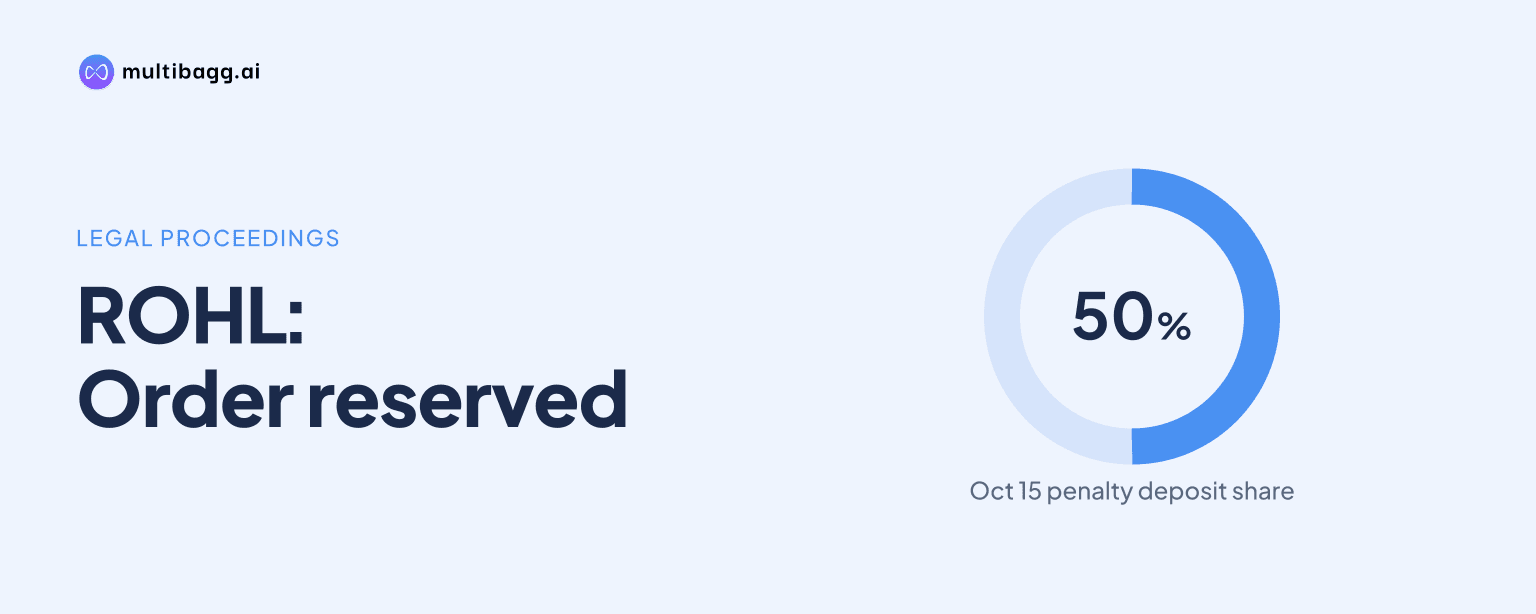
- ROHL says noticees deposited 50% of the penalties as a condition of the SAT stay.
- The separate NCLT KSDPL matter is scheduled for hearing on 26 November 2026.
powered by IRIS
On 15 October 2026, the Securities Appellate Tribunal reserved its order in Royal Orchid Hotels Limited’s appeal against SEBI directions on KSDPL’s accounting classification. ROHL’s 13 November 2026 filing says the outcome remains pending, while the separate National Company Law Tribunal dispute involving KSDPL is scheduled for hearing on 26 November 2026.
Know Royal Orchid Hotels inside out
Results, valuation, peers and who's buying, in one view.
What did SAT decide in ROHL’s KSDPL appeal?
SAT reserved its order after last hearing ROHL’s appeal on 15 October 2026, moving the challenge to SEBI’s KSDPL directions to the decision stage without disclosing a judgment date. The appeal concerns SEBI’s 11 October 2024 final order on the classification of Ksheer Sagar Developers Private Limited, or KSDPL, in ROHL’s consolidated financial statements.
SAT had earlier stayed parts of SEBI’s final order requiring the disclosure of financial statements and audit reports for FY 2021-22, FY 2022-23 and FY 2023-24, together with a report on the impact of treating KSDPL as a subsidiary. The filing says the monetary-penalty direction was stayed on condition that the noticees deposit 50% of the penalties, and that the noticees made those deposits on the date of the SAT stay order.
The regulatory process began with SEBI’s interim order-cum-show-cause notice of 31 March 2023. SAT initially stayed that order on 9 May 2023 until 30 June 2023, extended the stay until 17 August 2023, and then allowed ROHL an opportunity to respond to SEBI’s notice.
SEBI filed an affidavit in the appeal on 7 January 2025, after which ROHL was given two weeks to file a rejoinder. ROHL filed that rejoinder on 28 January 2025, before the matter was eventually heard on 15 October 2026 and the order was reserved.
What did SEBI require ROHL to do over KSDPL?
SEBI’s final order held that ROHL had incorrectly classified KSDPL as an associate rather than a subsidiary, although it did not conclude that the incorrect classification resulted in illegal gains for the noticees. The regulator required a public disclosure, the release of three financial years of financial statements and audit reports, and an analysis of the effect of subsidiary accounting on those consolidated accounts.
SEBI required the public disclosure within seven days of receiving its 11 October 2024 order, while the financial-statement disclosure and impact report covered FY 2021-22 through FY 2023-24. ROHL says it filed the public disclosure with stock exchanges, whereas SAT stayed the directions on the financial statements, audit reports and impact report.
The final order also imposed monetary penalties of Rs 5 lakh and Rs 1 lakh each under provisions of the SEBI Act cited in the filing. ROHL says it has made provisions for amounts considered necessary, but the filing does not quantify a possible effect on consolidated revenue, profit, assets or equity if the historical statements were restated.
SEBI’s March 2023 notice alleged that the associate classification had overstated the Royal Orchid Group’s consolidated net profit and misrepresented consolidated financial statements for the year ended 31 March 2022. It also proposed potential directions, prohibitions, inquiry and penalties under the SEBI Act, the Listing Obligations and Disclosure Requirements regulations, and the Prohibition of Fraudulent and Unfair Trade Practices regulations.
Got a follow-up? Ask IRIS
Why does ROHL dispute KSDPL’s subsidiary classification?
ROHL disputes SEBI’s conclusion because management says it lost control of KSDPL during the year ended 31 March 2022 after a change in the investee company’s board composition. Management says its assessment followed the control principles in Indian Accounting Standard 110, or Ind AS 110, which governs consolidated financial statements.
ROHL says its board and audit committee completed a detailed evaluation of the March 2023 order-cum-show-cause notice and filed the SAT appeal on legal advice. Management’s stated view is that SEBI’s contention in the final order is not tenable under its assessment of the loss of control.
Based on that management assessment and the SAT stay, ROHL says it made no adjustments directed by SEBI in consolidated financial results for the quarter ended 30 June 2026. The filing was issued with unaudited consolidated results for the quarter and half year ended 30 September 2026, approved by the board on 13 November 2026.
ROHL’s statutory auditors issued a qualified report on the 30 September 2026 consolidated results, although the note does not state whether the qualification relates to KSDPL. ROHL reports one operating segment, hospitality, and its half-year total income rose to Rs 230.71 crore from Rs 169.57 crore a year earlier, while consolidated profit rose to Rs 21.53 crore from Rs 15.49 crore.
What is happening in the separate NCLT KSDPL dispute?
The separate NCLT dispute remains pending, and the next hearing is scheduled for 26 November 2026. The Tambi Group’s petition under Sections 241 and 242 of the Companies Act, 2013 concerns alleged oppression and mismanagement in KSDPL’s affairs, including related-party transactions, independent-director appointments and the subsidiary-to-associate classification.
ROHL filed its response to the petition on 28 February 2024 and disputed the Tambi Group’s claims. On 29 February 2024, NCLT directed the parties to conduct KSDPL’s extraordinary general meeting as planned and comply with the Companies Act, 2013.
The extraordinary general meeting took place on 1 March 2024, with an ordinary resolution approving the appointment of a new independent director. From 2 March 2024, KSDPL’s board had one independent director, and ROHL’s administrative committee resolved that the director would chair KSDPL’s board and general meetings.
The Tambi Group filed an interlocutory application on 11 March 2024 challenging the independent-director appointment, while KSDPL filed a compliance affidavit on 16 April 2024. NCLT allowed a planned board meeting to proceed on 28 May 2024 after another application sought to halt approval of the independent director as KSDPL chairman.
ROHL says the Tambi Group submitted further interlocutory applications during the previous and current years, to which ROHL responded. In its NCLT submissions, ROHL has said provisions applying to a deemed public company do not apply to KSDPL and maintains that it should continue to account for KSDPL as an associate under Ind AS 110.
Conclusion
SAT reserving its order means ROHL’s challenge to SEBI’s KSDPL accounting directions has reached the decision stage, but the filing does not settle whether KSDPL should be treated as a subsidiary or whether historical consolidated accounts require restatement. SEBI’s order covered FY 2021-22 through FY 2023-24, while the reported 50% penalty deposits met the condition attached to the SAT stay on monetary penalties.
The next disclosed event is the NCLT hearing on 26 November 2026 in the separate KSDPL shareholder dispute. ROHL’s filing gives no date for SAT’s reserved order, so the next matters to watch are the tribunal’s decision and any resulting requirement to disclose prior accounts or quantify the effect of subsidiary accounting.