










Roopa Screen Limited H1 Profit Rises 36.7% Despite Revenue Decline
Key highlights
- Roopa Screen reported H1 FY27 profit after tax of ₹3.50 crore, up 36.7% year on year.
- H1 FY27 revenue from operations declined 5.3% to ₹25.05 crore.
- Cost of materials consumed fell 33.8% to ₹8.76 crore, while total expenses declined 11.7%.
- Cash and cash equivalents increased to ₹19.71 crore after the ₹19.20 crore fresh IPO issue.
powered by IRIS
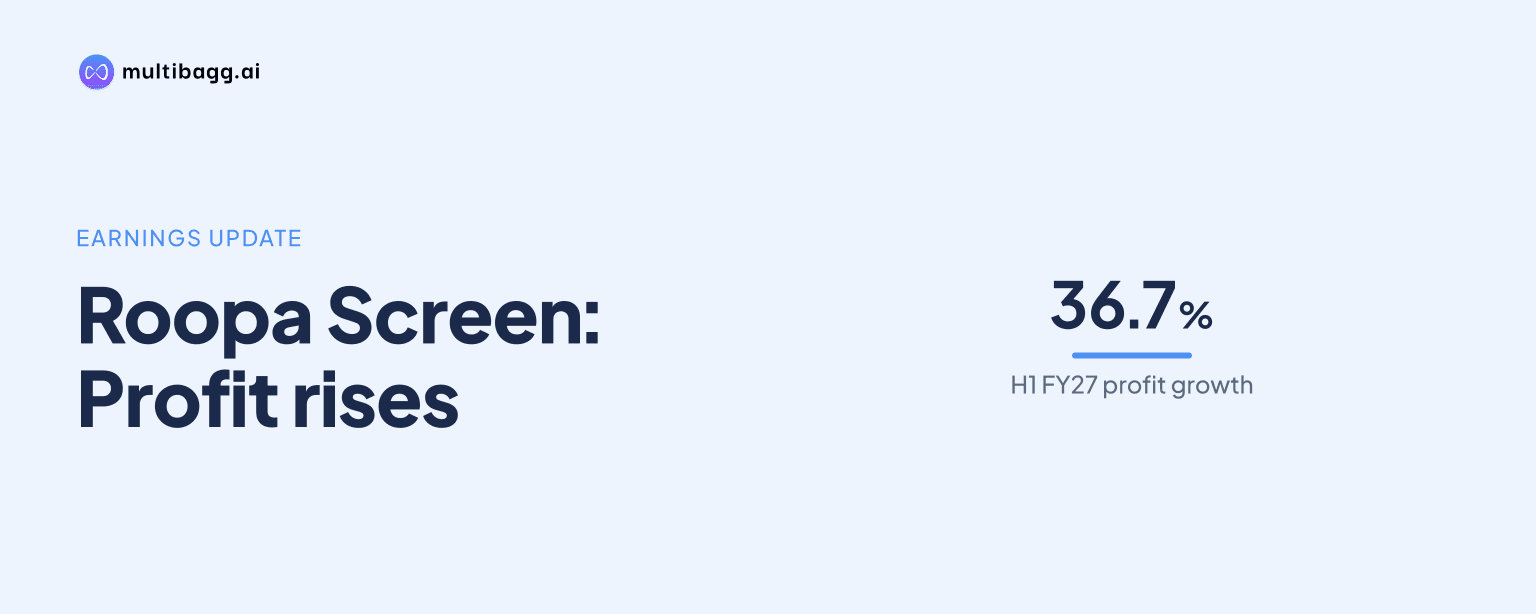
Roopa Screen Limited reported a 36.7% year-on-year rise in H1 FY27 profit to ₹3.50 crore for the half year ended September 30, 2026, despite a 5.3% fall in revenue to ₹25.05 crore. Lower materials costs and restrained total expenses supported the improvement, while the September 2026 IPO added substantial liquidity for planned uses.
Know Roopa Screen inside out
Results, valuation, peers and who's buying, in one view.
Why did Roopa Screen's H1 FY27 profit increase?
Roopa Screen's profit increased because its expenses declined faster than its revenue during the first half of FY27. Profit after tax rose to ₹3.50 crore from ₹2.56 crore in the corresponding half of the previous year, even as revenue from operations declined from ₹26.45 crore to ₹25.05 crore.
The company said the improvement reflected lower input costs and better margin management. Total expenses fell 11.7% year on year, exceeding the 5.3% decline in sales. This difference between the pace of revenue and cost changes enabled the manufacturer to report higher profitability despite weaker top-line performance.
Roopa Screen manufactures rotary nickel screens used in rotary screen-printing machines, primarily by textile manufacturers for continuous fabric printing. Its operating performance is therefore linked to production demand from textile printing customers as well as the cost of materials used in screen manufacturing.
Which costs changed during the half year?
The most significant reported cost movement was a 33.8% fall in the cost of materials consumed to ₹8.76 crore. This was the main stated driver of the reduction in total expenses and the resulting improvement in profitability.
Purchases of stock-in-trade, however, increased to ₹4.90 crore. Employee costs remained stable, according to the earnings review. The reported figures show that the fall in materials consumed was sufficiently large to offset the rise in stock-in-trade purchases and support the operating margin.
The available disclosure does not provide a detailed product-wise revenue split or the reasons for the revenue contraction. It does show that the company's H1 result depended more on cost control than on sales growth.
How did the September 2026 IPO change Roopa Screen's finances?
The September 2026 IPO materially increased Roopa Screen's liquidity and shareholders' funds. Cash and cash equivalents stood at ₹19.71 crore on September 30, 2026, compared with ₹0.30 crore at the end of FY26, following a fresh issue of equity shares aggregating ₹19.20 crore.
Shareholders' funds increased to ₹38.42 crore, reflecting the capital infusion and retained earnings. Long-term borrowings were ₹3.72 crore, while short-term borrowings stood at ₹8.16 crore as of September 30, 2026.
The company reported that ₹18.54 crore of IPO proceeds remained available for the planned capital expenditure and working-capital requirements. The board also approved a statement confirming that there had been no deviation from the objects stated in the IPO prospectus.
The IPO proposal had identified an expansion project estimated at ₹10.61 crore. Of this, ₹9.90 crore was proposed to be funded from IPO proceeds and ₹0.71 crore through internal accruals, with spending intended for plant and machinery, civil construction and electrical work.
Got a follow-up? Ask IRIS
What is the background to Roopa Screen's expansion plan?
Roopa Screen was incorporated in 2013 and produces rotary nickel screens, including Penta and Standard Screens, with the majority of its revenue derived from sales in India. These screens are consumables used by textile manufacturers in continuous fabric-printing operations.
The company had reported FY26 production of 71,800 screens, representing capacity utilisation of 96.51%. Its proposed expansion is intended to add 88,800 screens of annual capacity, taking installed capacity to 163,200 screens per annum.
High utilisation provides the context for the planned capacity addition. The IPO funding gives Roopa Screen a stated source for the project and working capital, though the disclosed H1 results do not specify a completion date for the expansion or production from the additional capacity.
For historical context, reported revenue rose from ₹35.71 crore in FY24 to ₹45.34 crore in FY25, while net income increased from ₹1.50 crore to ₹4.69 crore. These figures indicate that profitability had improved before the latest half-year result, although the H1 FY27 revenue decline shows that sales performance can vary between reporting periods.
What does the result mean for investors and operations?
The H1 result shows that Roopa Screen protected and improved profit despite lower revenue by reducing material-related costs and total expenses. For investors, the key reported financial change is the stronger balance sheet following the fresh equity issue, particularly the rise in cash and shareholders' funds.
At the same time, the revenue decline remains relevant because sales from textile-printing customers are central to the company's business. The source does not report a share-price reaction, customer-order trend, or revised revenue outlook. As a result, the disclosed information supports an assessment of the completed half-year performance but does not establish future sales growth.
On November 2, 2026, the board approved the unaudited H1 FY27 results and appointed G R Shah & Associates as Secretarial Auditor and M/s. Ashok K. Bhatt & Co. as Internal Auditor for FY27. The appointments, effective from November 2, form part of the company's compliance and financial-reporting oversight for the year.
Conclusion
Roopa Screen's H1 FY27 performance was defined by expanding profit margins rather than revenue growth. A 36.7% increase in profit after tax, alongside a 5.3% revenue decline, was supported by a sharp reduction in materials consumed and an 11.7% fall in total expenses. The IPO also substantially increased available cash and shareholders' funds.
The next items to watch are the use of the ₹18.54 crore in unutilised IPO proceeds, progress on the proposed capacity expansion, and whether revenue from textile-printing customers improves after the first-half decline. The company has also stated that IPO funds had been used without deviation from the prospectus objects as of the November 2 board meeting.