










Amtech Esters Starts Trials at 4,800 MTPA Haryana Plant
Key highlights
- Amtech Esters began trial production at its 4,800 MTPA Asoda UPR plant on 3 October 2026.
- Commercial operation at Asoda is set to raise total resin capacity from 2,960 MTPA to 7,760 MTPA.
- The Asoda plant was funded entirely through internal accruals.
- Unsaturated polyester resins contributed about 63% of consolidated revenue of about Rs 40.7 crore in the year ended March.
powered by IRIS
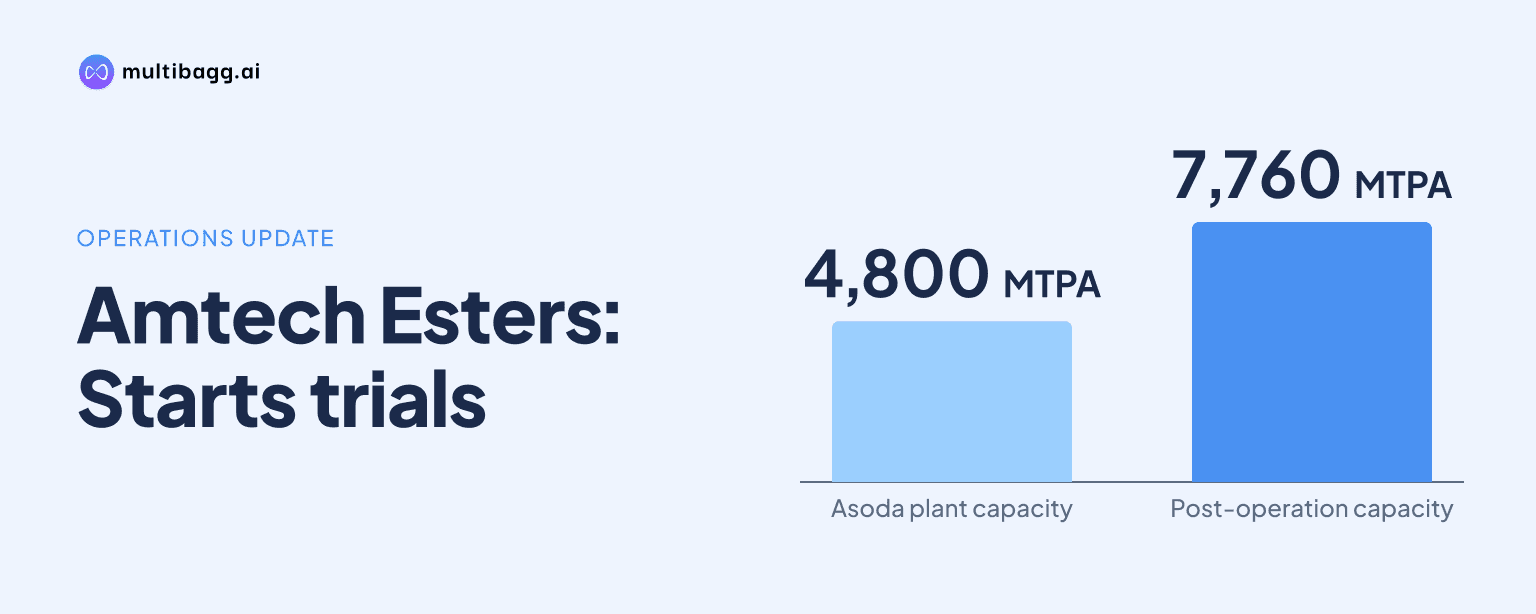
Amtech Esters Ltd began trial production on 3 October 2026 at its new 4,800 MTPA unsaturated polyester resin plant in Asoda, Haryana, a project that will raise total resin capacity to 7,760 MTPA from 2,960 MTPA when commercial operations begin. The expansion was funded through internal accruals.
Know Amtech Esters inside out
Results, valuation, peers and who's buying, in one view.
What has Amtech Esters announced at its Asoda plant?
Amtech Esters Ltd announced that trial production has commenced at its new manufacturing facility at Asoda in Jhajjar district, Haryana. The disclosure was made under Regulation 30 of the SEBI Listing Obligations and Disclosure Requirements Regulations, 2015, following the completion of installation and commissioning at the site.
The facility is located at Balaji Industrial Area, Asoda Todran, and is designed to manufacture unsaturated polyester resins, or UPR. The new unit has an installed capacity of 4,800 metric tonnes per annum, adding a second resin manufacturing location to the company's existing Bahadurgarh operations.
Trial production indicates that the installed equipment is being operated and evaluated before the unit moves to commercial production. Amtech Esters has said it will keep stock exchanges informed of material developments concerning the transition to commercial operations. The company did not specify a commercial production commencement date in the 3 October announcement.
The company secretary and compliance officer, Anjali Bansal, signed the exchange intimation dated 3 October 2026. The announcement followed an earlier indication in the company's offer document that the Asoda facility was expected to become operational by September 2026.
How much resin capacity will the new unit add?
The Asoda unit will add 4,800 MTPA of resin capacity, taking Amtech Esters' total installed resin capacity to 7,760 MTPA once commercial operations commence. The company previously had resin capacity of 2,960 MTPA at its Bahadurgarh manufacturing unit in Haryana.
The new plant's capacity is larger than the existing resin base. On the stated figures, the addition is about 1.6 times the previous 2,960 MTPA capacity, while the post-expansion capacity is more than 2.6 times the earlier level. These figures describe installed capacity, rather than actual production or sales.
Amtech Esters manufactures unsaturated polyester resins and pigment dispersions, while it also trades in products including fiberglass, hardeners, ancillaries and silicon. The resin operation is therefore a core part of its materials offering to composite fabricators.
Why is the Asoda expansion important for Amtech Esters?
The Asoda project is important because it materially expands the production base for Amtech Esters' main resin business. Unsaturated polyester resins accounted for about 63% of the company's consolidated revenue of about Rs 40.7 crore in the year ended March, according to the provided company information.
The existing resin operation had operated at 88% utilisation in that year. This reported utilisation level provides context for the capacity expansion, as the Bahadurgarh facility was already using a substantial part of its available capacity. However, the company has not disclosed expected utilisation, production volumes or revenue from the new Asoda plant.
The company has stated that the capital expenditure for the new manufacturing unit was funded entirely through internal accruals. This means the disclosed source of funding was internally generated funds rather than a separately identified borrowing or fresh equity issue for the project.
Amtech Esters also has pigment manufacturing through its wholly owned subsidiary. The supplied information states that pigments contributed about a quarter of consolidated revenue in the year ended March, while the offer document referred to a proposed rise in subsidiary pigment capacity to 973.2 tonnes per annum using IPO proceeds. That pigment plan is distinct from the internally funded Asoda resin project.
Got a follow-up? Ask IRIS
What does trial production mean for investors and customers?
Trial production means the Asoda plant has reached the testing stage after installation and commissioning, but it does not by itself confirm the start of regular commercial output. The company has specifically linked the increase in total resin capacity to the commencement of commercial operations.
For investors, the relevant disclosed operational milestone is therefore the future shift from trials to commercial production. The 3 October filing confirms that the plant has progressed beyond construction and installation, but it does not provide a production ramp-up schedule, sales outlook, project cost or expected profitability.
For customers and industry operations, the additional installed capacity creates the potential for Amtech Esters to supply a higher volume of UPR once the unit is commercially operational. The announcement does not identify customers, contract volumes, pricing arrangements or new markets linked to the facility.
The expansion also broadens the company's resin production footprint from its earlier Bahadurgarh base to Asoda in Jhajjar district. Both locations are in Haryana, and the company has not reported any closure or reduction of capacity at its existing Bahadurgarh unit.
How does this fit into the company’s earlier expansion plans?
The Asoda project was previously described as a greenfield facility, meaning a plant built from scratch at a new site. Its announced 4,800 MTPA capacity was part of the company's stated plan to expand total resin capability from 2,960 MTPA to 7,760 MTPA.
In its offer document, management had indicated that the plant was expected to become operational by September 2026. The 3 October disclosure confirmed the completion of installation and commissioning and the commencement of trial production, while leaving the commercial production date undisclosed.
Amtech Esters was founded in 2002 and operates in materials used by composite fabricators. Its earlier production footprint included two operational plants in Bahadurgarh with 2,960 MTPA resin capacity and 382.20 MTPA pigment capacity, based on the supplied company profile.
The capacity addition does not establish a change in financial performance by itself. Actual utilisation, customer demand, product mix, operating costs and the timing of commercial production will determine how the new plant affects production and financial results.
Conclusion
Amtech Esters has taken its Asoda expansion to the trial-production stage, adding a 4,800 MTPA UPR facility to its operating network. Once commercial production begins, the company’s installed resin capacity is set to increase from 2,960 MTPA to 7,760 MTPA, supporting a substantially larger production base for its principal business line.
The next disclosed milestone to watch is the start of commercial operations at Asoda. Investors will also look for company updates on the plant’s ramp-up, utilisation and contribution to resin sales, as these details were not included in the 3 October 2026 exchange announcement.