










Roto Pumps approves ₹10 crore facility for RESL refinancing
Key highlights
- Roto Pumps approved an up-to-₹10 crore loan facility for wholly owned RESL on November 11, 2026.
- RESL has a ₹5 crore DBS Bank working-capital facility that was constrained by inadequate drawing power.
- The facility is intended to repay higher-cost borrowing and fund RESL’s operational expenditure.
- Roto Pumps reported September-quarter standalone profit after tax of ₹14.7518 crore, compared with ₹3.6139 crore a year earlier.
powered by IRIS
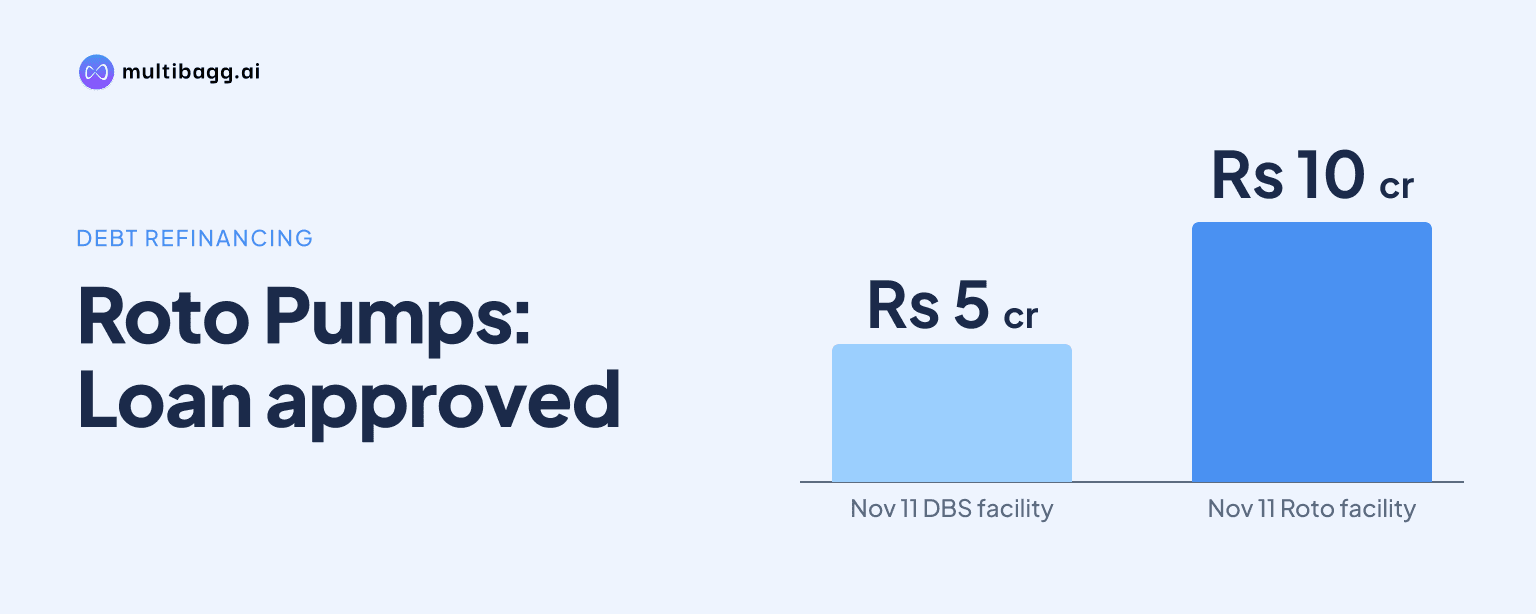
Roto Pumps Limited approved an up-to-₹10 crore loan facility for wholly owned Roto Energy Systems Limited on November 11, 2026, to repay higher-cost borrowing and meet operating expenditure after inadequate drawing power constrained the subsidiary’s ₹5 crore DBS Bank working-capital facility. The amount is proposed to be disbursed in tranches.
Know Roto Pumps inside out
Results, valuation, peers and who's buying, in one view.
Why is Roto Pumps lending up to ₹10 crore to RESL?
Roto Pumps is providing the facility because RESL has availed a ₹5 crore working-capital loan from DBS Bank, but inadequate drawing power has restricted the subsidiary’s available borrowing capacity. Roto Pumps said that a portion of its own working-capital limits had been earmarked to support RESL’s DBS Bank facility.
The board approved up to ₹10 crore for two specified purposes: repayment of RESL’s higher-cost borrowing and meeting its operational-expenditure requirements. The approved ceiling is twice the stated size of RESL’s ₹5 crore DBS Bank working-capital facility, although Roto Pumps did not disclose the amount outstanding under that facility on November 11, 2026.
Roto Pumps said the effective interest rate applicable to RESL’s DBS Bank facility is higher than the cost of funds available to the parent. This funding-cost difference is the disclosed basis for replacing higher-cost bank borrowing with an intercompany loan. The announcement does not disclose either interest rate or estimate an interest-cost saving.
How will Roto Pumps disburse the RESL loan facility?
Roto Pumps plans to disburse the up-to-₹10 crore loan in tranches rather than as a single payment. The November 11, 2026 board approval sets a maximum facility amount, and the filing does not say that RESL had received the full ₹10 crore, or any stated part of it, on the announcement date.
The filing does not provide a timetable, minimum tranche amount, interest rate, maturity, repayment schedule, security or conversion terms for the facility. It also does not identify the portion of the ₹10 crore that will be used to repay DBS Bank borrowing and the portion that will be used for RESL’s operating expenditure.
Roto Pumps linked the facility to RESL’s inadequate drawing power under the ₹5 crore DBS Bank arrangement. The company did not disclose the calculation of drawing power, the working-capital assets involved, or the specific bank conditions that resulted in part of the parent’s working-capital limits being earmarked for RESL.
What did the Roto Pumps board approve on November 11, 2026?
Roto Pumps’ board approved the up-to-₹10 crore loan to RESL at a meeting held on November 11, 2026, from 3:00 p.m. to 5:00 p.m. The disclosure identifies Roto Pumps as lender and RESL as borrower, and states that RESL is a wholly owned subsidiary.
The same board meeting approved and took on record Roto Pumps’ standalone and consolidated unaudited financial results for the second quarter and half year ended September 30, 2026. The company made the loan disclosure under Regulation 30 and Schedule III of the Securities and Exchange Board of India’s Listing Obligations and Disclosure Requirements Regulations, 2015.
The approval is for a loan facility, rather than an equity infusion, guarantee or expansion of the ₹5 crore DBS Bank facility. Roto Pumps did not state whether the intercompany funding would fully extinguish the DBS Bank borrowing, reduce it partly, or operate alongside it while RESL uses funds for operational requirements.
Got a follow-up? Ask IRIS
How did Roto Pumps perform in the September 2026 quarter?
Roto Pumps reported standalone revenue from operations of ₹75.8558 crore for the quarter ended September 30, 2026, compared with ₹48.753 crore in the quarter ended September 30, 2025. Standalone profit after tax increased to ₹14.7518 crore from ₹3.6139 crore, while basic and diluted earnings per share rose to ₹0.78 from ₹0.19.
Profit before tax for the September 2026 quarter was ₹18.89 crore, compared with ₹5.3051 crore a year earlier. Total expenses rose to ₹58.2079 crore from ₹44.5283 crore, while total income increased to ₹77.0979 crore from ₹49.8334 crore over the same periods.
The September 2026 quarter also improved from the preceding quarter ended June 30, 2026, when Roto Pumps reported revenue from operations of ₹57.4517 crore and profit after tax of ₹7.9091 crore. These are standalone parent-company results, while the announced facility concerns RESL; the filing does not provide separate revenue, profit, assets, cash or debt figures for RESL.
What did Roto Pumps report for the half year ended September 2026?
Roto Pumps reported standalone revenue from operations of ₹133.3075 crore for the half year ended September 30, 2026, up from ₹100.3809 crore in the corresponding half year of 2025. Profit after tax was ₹22.6609 crore, compared with ₹9.1816 crore in the prior-year half year.
Total income for the six-month period was ₹136.1292 crore, against ₹103.9097 crore a year earlier, while profit before tax increased to ₹29.5024 crore from ₹15.3703 crore. Finance costs were ₹1.2968 crore, compared with ₹1.282 crore in the corresponding 2025 period.
The half-year figures show that the parent reported higher revenue and profit before the November 11, 2026 funding approval. However, Roto Pumps did not say that the ₹10 crore RESL facility would be funded from the half-year profit, a specified cash balance or a new borrowing, so the filing does not quantify its effect on the parent’s cash flow or finance costs.
Conclusion
The ₹10 crore approval gives RESL access to parent-company funding for a stated combination of refinancing and operational expenditure. Roto Pumps disclosed that RESL’s ₹5 crore DBS Bank working-capital facility was constrained by inadequate drawing power and carried an effective interest rate higher than the parent’s cost of funds. Separately, Roto Pumps reported standalone September-quarter profit after tax of ₹14.7518 crore, against ₹3.6139 crore a year earlier.
The next matter to watch is the tranche-wise disbursement of the approved facility. Roto Pumps has not disclosed the amount drawn, loan terms, remaining DBS Bank exposure or the mechanism for resolving RESL’s drawing-power constraint, so later company disclosures may show how much is used for debt repayment and how much supports operating expenditure.