










Rustomjee Current Projects Lift H1 EBITDA Margin to 28% in H1FY27
Key highlights
- Rustomjee current projects generated 80% of H1FY27 revenue and a 28% EBITDA margin before corporate overheads.
- Rustomjee legacy projects generated 20% of H1FY27 revenue and a 9% EBITDA margin before corporate overheads.
- Rustomjee consolidated EBITDA margin rose to 17.8% in H1FY27 from 8.2% in H1FY26.
- Rustomjee disclosed a 30% blended embedded EBITDA margin on Rs 1,670 crore of sold and unsold revenue yet to be recognized.
powered by IRIS
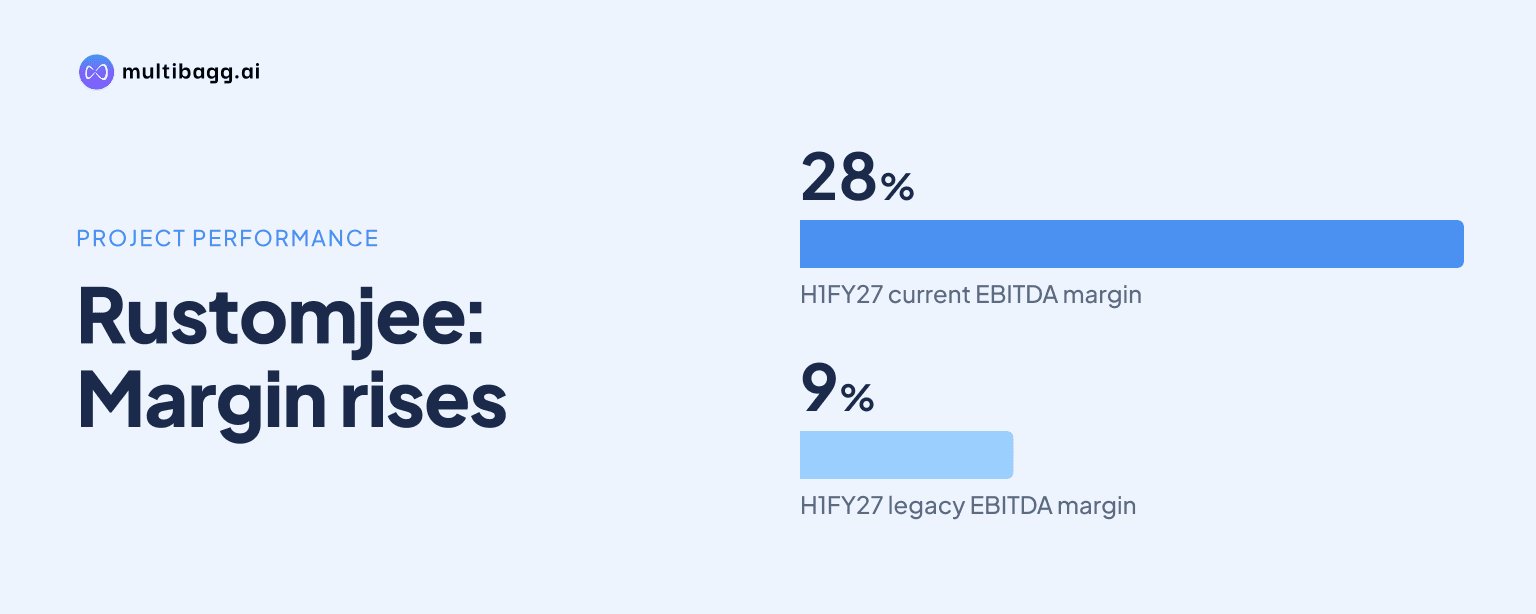
Rustomjee’s current projects recorded a 28% EBITDA margin in H1FY27, compared with 9% for legacy projects, while they generated 80% of revenue versus 20% from legacy projects. The disclosed mix shows that the higher consolidated EBITDA margin of 17.8%, up from 8.2% in H1FY26, coincided with a substantial shift toward current projects.
Know Keystone Realtors inside out
Results, valuation, peers and who's buying, in one view.
Why did Rustomjee’s H1FY27 EBITDA margin increase?
Rustomjee’s disclosed project mix indicates that current projects were the main contributor to H1FY27 margin expansion: they accounted for 80% of revenue and delivered a 28% EBITDA margin before corporate overheads, while legacy projects represented 20% of revenue at a 9% margin. This is a 19-percentage-point margin gap between the two project groups, rather than a uniform margin outcome across the portfolio.
The same split appears in gross margins. Current projects delivered a 41% gross margin in H1FY27, compared with 22% for legacy projects, against a disclosed overall gross margin of 37%. At the EBITDA level, the presentation shows a 24% overall project margin before corporate overheads, with the higher-margin current-project contribution carrying greater weight because of its 80% revenue share.
The period comparison reinforces the change in mix. In FY26, current projects supplied only 38% of revenue but reported a 21% EBITDA margin, while legacy projects supplied 62% at a 5% margin. By H1FY27, the current-project revenue share had increased by 42 percentage points and the legacy share had fallen by 42 percentage points; current-project EBITDA margin also increased by 7 percentage points and legacy-project margin by 4 percentage points.
How did Rustomjee’s consolidated H1FY27 results compare with H1FY26?
Rustomjee reported revenue from operations of Rs 967 crore in H1FY27, up from Rs 772.4 crore in H1FY26, while EBITDA rose to Rs 179.4 crore from Rs 66.3 crore. The consolidated EBITDA margin increased to 17.8% from 8.2%, a 9.6-percentage-point change, with the company’s results table stating that EBITDA includes other income.
Profit before tax was Rs 105.8 crore in H1FY27, versus Rs 35.2 crore a year earlier, and reported profit after tax was Rs 78.8 crore, compared with Rs 28.7 crore. Profit after tax after the share of profits from joint ventures and associates reached Rs 153.1 crore, versus Rs 26.2 crore in H1FY26, after a Rs 74.3 crore share of such profits compared with a Rs 2.5 crore loss a year earlier.
The project-level and consolidated margin measures are not presented on the same basis. Rustomjee labels the legacy-versus-current project EBITDA margins as before corporate overheads, whereas its consolidated table reports an EBITDA margin of 17.8% and says EBITDA includes other income. The 28% and 9% figures therefore identify relative project economics, while the 17.8% figure is the reported consolidated result for H1FY27.
Got a follow-up? Ask IRIS
What EBITDA margins are embedded in Rustomjee’s ongoing projects?
Rustomjee disclosed a 30% blended EBITDA margin on sold and unsold revenue yet to be recognized across ongoing projects, before corporate overheads and the share of joint venture, development management or other equity partners. The total ongoing-project gross development value, or GDV, was Rs 2,390 crore, including other receipts, according to the presentation.
Sold but unrecognized revenue was Rs 591 crore with embedded EBITDA of Rs 140 crore, or 24%. Unsold revenue yet to be recognized was Rs 1,079 crore with embedded EBITDA of Rs 358 crore, or 33%. The 9-percentage-point difference means the source identifies a higher embedded percentage on the unsold balance than on pre-sales already completed; these are project estimates disclosed by Rustomjee, not reported future consolidated earnings.
Luxury projects carried Rs 144 crore of sold but unrecognized revenue at a 45% embedded EBITDA margin and Rs 324 crore of unsold revenue at 46%. Emerging premium projects had Rs 180 crore of sold revenue at 11%, while their Rs 266 crore unsold revenue was shown at 28%, illustrating that disclosed margins vary by category as well as by whether revenue has been sold.
What do cash flow and debt show alongside Rustomjee’s margin change?
Rustomjee generated operating cash flow of Rs 192.7 crore in YTD FY27, down from Rs 227.2 crore in YTD FY26, despite the increase in H1FY27 EBITDA to Rs 179.4 crore. Net collections, including receipts from development management and joint-venture projects, rose to Rs 872.1 crore from Rs 716.1 crore, while project expenses increased to Rs 679.4 crore from Rs 488.9 crore.
Investment activity used Rs 425.4 crore in YTD FY27, compared with Rs 302.2 crore in YTD FY26, including land and approvals within project investment. Cash flow from financing activities was Rs 84.1 crore, down from Rs 285.2 crore, and cash flows for the period were negative Rs 148.7 crore, against positive Rs 210.2 crore a year earlier. These cash-flow movements show that reported profit expansion and cash movement followed different paths during the half year.
At September 30, 2026, gross debt was Rs 837.8 crore and cash and cash equivalents were Rs 705.4 crore, resulting in net debt of Rs 132.4 crore. At March 31, 2026, the company had gross debt of Rs 754.8 crore and cash of Rs 818.3 crore, producing net cash of Rs 63.5 crore. Rustomjee reported gross debt to equity of 0.28 at September 30, 2026, versus 0.26 at March 31, 2026, and said its current average borrowing cost was 9.2% per annum.
Conclusion
Rustomjee’s H1FY27 disclosure indicates that project composition was central to the period’s margin profile: current projects produced four-fifths of revenue and a 28% EBITDA margin before corporate overheads, compared with a 9% margin for the one-fifth supplied by legacy projects. The change from FY26, when current projects represented 38% of revenue, accompanied the rise in reported consolidated EBITDA margin to 17.8%.
The next item to watch is the realization of the disclosed Rs 1,670 crore of sold and unsold revenue yet to be recognized from ongoing projects, carrying a stated 30% blended embedded EBITDA margin before corporate overheads and partner shares. Cash conversion also remains relevant because YTD FY27 operating cash flow was Rs 192.7 crore and period cash flow was negative Rs 148.7 crore, while net debt moved from net cash at March 31, 2026 to Rs 132.4 crore at September 30, 2026.