










S.P. Apparels guides 17% EBITDA margin at 75% utilisation
Key highlights
- SPAL lists FY26 garment capacity utilisation of 75%, calculated on 4,950 machines.
- SPAL guides for adjusted EBITDA margin of about 17%, matching the FY25 and FY26 level shown in its presentation.
- Garment utilisation reached 85% in FY25 before falling 10 percentage points to 75% in FY26.
- YBAL reported revenue of Rs 321 crore in FY26 and Rs 181 crore in H1/FY27.
powered by IRIS
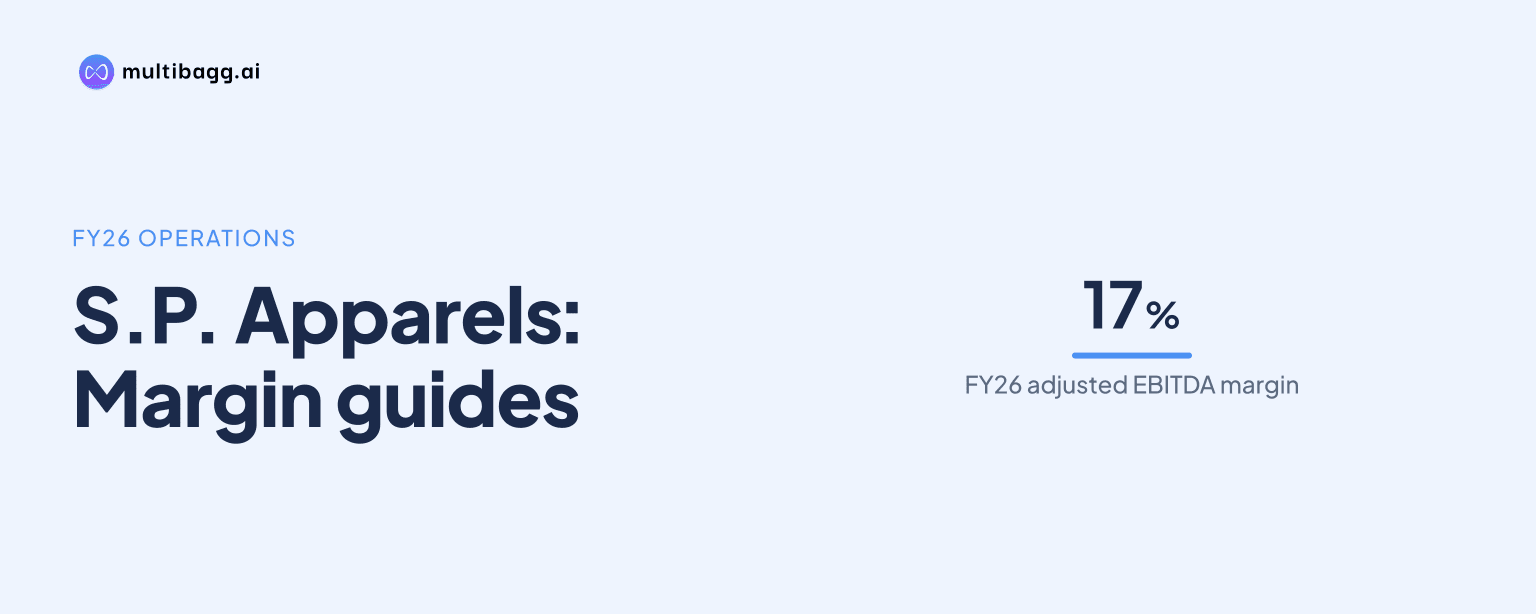
S.P. Apparels says its FY26 garment capacity utilisation is 75%, calculated on 4,950 machines, while it guides for an adjusted earnings before interest, tax, depreciation and amortisation (adjusted EBITDA) margin of about 17%. SPAL identifies room to raise utilisation and expand, but its presentation does not set a utilisation target above 90%.
Know S P Apparels inside out
Results, valuation, peers and who's buying, in one view.
What is SPAL's garment capacity and margin guidance?
SPAL guides for an adjusted EBITDA margin of about 17%, while its FY26 garment capacity utilisation is 75% based on 4,950 machines. The company states that the projected EBITDA margin range is guidance and says the approximately 17% level is sustainable.
SPAL says the current 75% utilisation level leaves headroom for further increases in utilisation and expansion. However, the presentation gives no numerical capacity-utilisation objective, including no target to exceed 90%. The disclosed operating case is therefore greater use of the existing 4,950-machine base alongside margin guidance of about 17%.
How has SPAL's garment utilisation changed since FY23?
SPAL's garment utilisation increased from 72% in FY23 to 85% in FY25, then declined by 10 percentage points to 75% in FY26. Adjusted EBITDA margin was 18% in FY23 and FY24 before moving to 17% in FY25 and FY26.
Utilisation rose by 4 percentage points between FY23 and FY24, followed by a further 9-percentage-point increase in FY25. The FY26 figure is lower than FY25's 85%, while the margin guidance of about 17% matches the level shown for FY25 and FY26. SPAL specifically notes that the FY26 utilisation calculation uses 4,950 machines.
What supports SPAL's operating-leverage plan?
SPAL's stated operating-leverage mechanism is higher utilisation of the 4,950-machine base used for the FY26 calculation, rather than a separately quantified capacity-addition plan. Its garment export business focuses on kids and infants, and the company says this segment requires a wide product variety and small-batch orders.
The company describes an integrated production chain covering spinning, knitting, dyeing, cutting, printing, automated embroidery, sewing, automated sewing assembly and semi-automated inventory management. Its process map also covers product development, customer order approval, garmenting, final acceptable quality level (AQL) inspection and export, with some yarn and fabric inputs partly outsourced.
SPAL identifies health, safety and manufacturing requirements as entry barriers in infants and children's garments. These include restrictions on hazardous chemicals, dyes and accessories in developed markets, as well as labour-intensive production, employee training, occupational health, welfare and ethical-factory standards. These processes are the operational conditions alongside which the company intends to increase factory utilisation.
Got a follow-up? Ask IRIS
Which businesses and capabilities support SPAL's garment strategy?
SPAL describes its garment division as a kids and infants export business that achieved more than 90% absolute growth and 18% compound annual growth from FY22 to FY26, including Young Brand Apparel Private Limited (YBAL) numbers. It also says the garment business delivered EBITDA margins of 17% to 18% over FY23 to FY26.
YBAL offers intimate wear, including innerwear and outerwear for men, women and children. The business has a 2,80,000-square-foot manufacturing facility on a 26-acre site on Chennai's outskirts, and SPAL says it works with 2,300 direct and 5,000 indirect partners. Its listed core export customers include Marks & Spencer, PINK, identified as Victoria's Secret, Jockey and American Eagle.
YBAL revenue was Rs 321 crore in FY26, down from Rs 324 crore in FY25 and below Rs 329 crore in FY23. Revenue was Rs 181 crore in H1/FY27, but SPAL does not provide a comparable H1/FY26 number or an FY27 revenue forecast. The presentation also cites design support through SPUK in the UK and in-house design and merchandising teams in SPUK and India.
How do quality controls affect SPAL's garment operations?
SPAL says quality checks operate across every stage from fabric to garmenting, including final AQL inspection before export. For its kids and infants segment, it says these controls are intended to prevent metal bits, needle tips and sharp edges in finished garments.
The company cites an ISO/IEC 17025 laboratory and accreditation from the National Accreditation Board for Testing and Calibration Laboratories. It also says it has customer self-certification for safety, clearance, shade and fit approvals, and lists a Tesco F&F Gold Rated Supplier Award from 2013 and a Marks and Spencer award from 2011. SPAL does not quantify the cost or margin effect of these controls.
Conclusion
SPAL's disclosed figures point to utilisation headroom rather than a stated above-90% capacity target. FY26 garment utilisation is 75% on 4,950 machines, below FY25's 85%, while adjusted EBITDA margin guidance is about 17%, consistent with the 17% margin shown in FY25 and FY26. The strategy combines kids and infants garment exports with YBAL's intimate-wear manufacturing capabilities.
The next disclosure to watch is whether SPAL increases utilisation from the FY26 75% level while maintaining its guidance of about 17% adjusted EBITDA margin. YBAL's Rs 181 crore revenue in H1/FY27 is another operating marker, although the presentation gives no FY27 revenue forecast, machine-addition schedule or quantified utilisation target.