










Samtex auditors qualify results over unmeasured asset losses
Key highlights
- Samtex’s September 30, 2026 standalone review was qualified over untested fixed-asset and receivable impairment and uncharged depreciation.
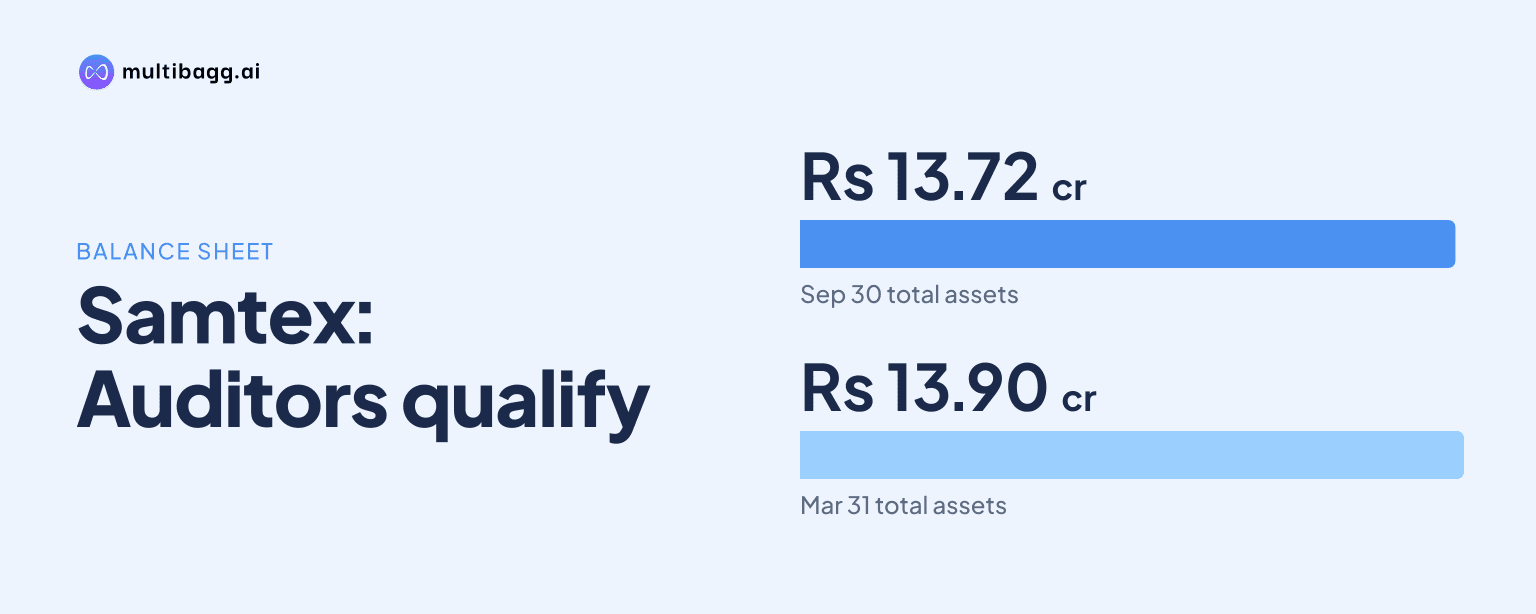
- Samtex reported total assets of Rs 13.72 crore at September 30, 2026, down from Rs 13.90 crore at March 31, 2026.
- Samtex’s total equity was negative Rs 47.60 lakh, while current liabilities of Rs 7.77 crore exceeded current assets of Rs 1.66 crore.
- Samtex disclosed a Rs 807.46 crore corporate guarantee for SSA International, which received a Rs 437.57 crore DRT demand notice on October 30, 2026.
powered by IRIS
Samtex Fashions Limited received a qualified conclusion on its unaudited standalone results for the quarter and half year ended September 30, 2026, because auditors could not quantify potential impairment of fixed assets and long-overdue receivables, while no depreciation was charged on property, plant and equipment during the quarter.
Know Samtex Fashions inside out
Results, valuation, peers and who's buying, in one view.
Why did Samtex receive a qualified review conclusion?
Samtex received the qualified conclusion because the possible financial-statement effects of several accounting matters could not be determined as at September 30, 2026. Kapil Kumar & Co. said the company had not conducted impairment testing of fixed assets under Indian Accounting Standard 36, or Ind AS 36, despite no manufacturing activity having been carried on since the business premises changed in March 2019.
Samtex also did not charge depreciation on property, plant and equipment during the September 2026 quarter. The auditors said the absence of impairment workings meant they could not ascertain the amount of any adjustment. Their report was a limited review under Standard on Review Engagements 2410, which relies primarily on inquiries and analytical procedures and provides less assurance than an audit.
The qualification also covered long-outstanding trade receivables. Samtex had neither obtained confirmation of debtor balances nor recognised an allowance for expected credit losses, and it had classified those long-outstanding receivables as non-current assets. The auditors said recoverability, reconciliation and any resulting adjustment could not be assessed without recovery evidence and counterparty confirmation.
What did Samtex’s September 2026 balance sheet show?
Samtex reported total standalone assets of Rs 13.72 crore at September 30, 2026, compared with Rs 13.90 crore at March 31, 2026. Non-current assets declined to Rs 12.05 crore from Rs 12.28 crore, while current assets increased to Rs 1.66 crore from Rs 1.62 crore. The September figures are unaudited, whereas the March figures are audited.
Samtex’s property, plant and equipment remained at Rs 2.67 crore at both balance-sheet dates, despite the absence of depreciation in the September quarter. Trade receivables fell to Rs 5.30 crore from Rs 5.53 crore, but the auditors said the long-overdue balances had not been confirmed or tested for impairment. Total equity was negative Rs 47.60 lakh at September 30, 2026, compared with negative Rs 29.95 lakh at March 31, 2026.
What other accounting matters did Samtex’s auditors identify?
Samtex had not followed the required recognition and remeasurement treatment for employee-benefit costs under Ind AS 19, according to the auditors. They also said they lacked sufficient appropriate evidence on the physical verification or availability of fixed assets and inventory as at September 30, 2026, leaving the possible accounting effect unresolved.
Inventory was Rs 25.32 lakh at September 30, 2026, unchanged from March 31, 2026. The auditors said the inventory had not been used for a long period because no business activity had been undertaken during the year or earlier years. They added that Samtex had not provided for any item that may have been damaged, obsolete or affected by a decline in selling price.
Samtex continued to carry deferred tax assets of Rs 1.32 crore at September 30, 2026. The auditors said they had not received probable certainty and convincing evidence of future taxable income needed to assess the extent to which those assets could be utilised. The company had also not recognised a fresh deferred tax asset or liability during the quarter ended September 30, 2026.
Got a follow-up? Ask IRIS
Why is Samtex facing a going-concern uncertainty?
Samtex faces a material uncertainty that may cast significant doubt on its ability to continue as a going concern, the auditors said. They cited accumulated losses, continuously eroding net worth, losses in the current and previous years, current liabilities exceeding current assets, and the absence of business activity in the current and earlier years. The financial statements nevertheless remain prepared on a going-concern basis.
Current liabilities of Rs 7.77 crore exceeded current assets of Rs 1.66 crore by Rs 6.11 crore at September 30, 2026. Trade payables other than dues to micro and small enterprises were Rs 7.56 crore, compared with Rs 7.56 crore at March 31, 2026, while non-current borrowings were unchanged at Rs 6.31 crore. The auditors said they could not determine adjustments that may be required if Samtex cannot realise assets and settle liabilities in the ordinary course.
The half-year loss was Rs 17.96 lakh for the period ended September 30, 2026, compared with a Rs 16.29 lakh loss in the half year ended September 30, 2025. Net cash generated from operating activities decreased to Rs 7,000 from Rs 64,000, while cash and cash equivalents ended the latest half year at Rs 1.36 lakh, versus Rs 2.39 lakh a year earlier.
What legal and guarantee matters remain unresolved for Samtex?
Samtex had given a corporate guarantee of Rs 807.46 crore for secured loans taken by wholly owned subsidiary SSA International Limited. The auditors said those loans had been classified as non-performing assets by banks. They also reported that IDBI Bank had declared SSA International, its directors and guarantors including Samtex as wilful defaulters under Reserve Bank of India guidelines.
The report said a consortium of banks had filed a petition against SSA International and its subsidiary before the Debt Restructuring Tribunal-II, Delhi, with an intimation to Samtex through Original Application 530/18 dated May 24, 2018. SSA International received a demand notice from Debt Recovery Tribunal-3, Delhi, on October 30, 2026, for Rs 437.57 crore. Updated details of the proceedings were not made available to the auditors.
Samtex’s bank accounts had been put under debit freeze by the Employees’ Provident Fund department, according to information provided to the auditors. The company had deposited Rs 1.19 crore under protest in income-tax litigation across different financial years, but the auditors said they had not received the litigation details or current status. They therefore could not comment on the possible financial-statement impact of those matters.
Conclusion
Samtex’s qualified September 2026 standalone review combines unmeasured fixed-asset and receivable impairment risk, uncharged depreciation, unverified balances and a material going-concern uncertainty. Total assets declined by Rs 18.21 lakh from March 2026, negative equity widened by Rs 17.65 lakh, and reported current liabilities remained substantially above current assets.
The next disclosed matters to watch are whether Samtex supplies impairment calculations, debtor confirmations and physical-verification evidence, as well as updated information on the Rs 807.46 crore guarantee and related proceedings. The Rs 437.57 crore demand notice issued to SSA International on October 30, 2026, alongside unresolved tax, Employees’ Provident Fund and banking matters, could require further assessment in future financial statements.