










Sanchay Finvest Limited reports Rs 34.46 lakh half-year loss
Key highlights
- Sanchay Finvest reported a Rs 34.46 lakh loss for the half year ended September 30, 2026, versus a Rs 60.44 lakh loss a year earlier.
- Inventory rose to Rs 4.2282 crore at September 30, 2026 from Rs 67.22 lakh at March 31, 2026.
- Operating activities used Rs 4.3316 crore of cash in the half year, including a Rs 3.5561 crore increase in inventories.
- Sanchay Finvest raised Rs 4.85 crore through the preferential allotment of 48.50 lakh equity shares.
powered by IRIS
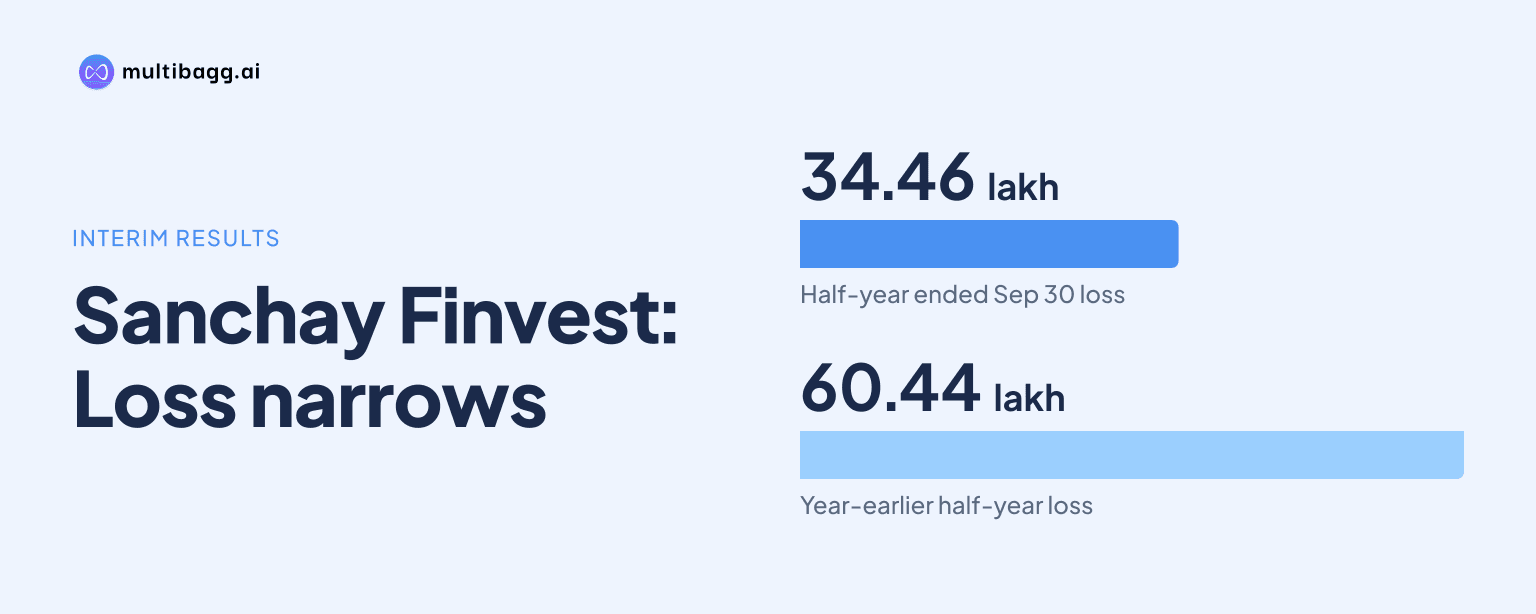
Sanchay Finvest Limited reported a Rs 34.46 lakh loss for the half year ended September 30, 2026, while inventory rose to Rs 4.2282 crore from Rs 67.22 lakh at March 31, 2026. The inventory build was reflected in Rs 4.3316 crore of cash used in operating activities, despite a Rs 4.85 crore preferential share issue during the period.
Know Sanchay Finvest inside out
Results, valuation, peers and who's buying, in one view.
How did Sanchay Finvest perform in the first half?
Sanchay Finvest reduced its half-year loss to Rs 34.46 lakh for the period ended September 30, 2026, from Rs 60.44 lakh in the corresponding period a year earlier. Loss before tax narrowed to Rs 34.95 lakh from Rs 62.52 lakh, while the financial statements were prepared under Indian Accounting Standard 34, or Ind AS 34, and subjected to a limited review.
Total revenue, comprising revenue from operations and other income, rose to Rs 20.13 lakh from Rs 6.06 lakh in the previous corresponding half year. Total expenses increased to Rs 58.31 lakh from Rs 39.91 lakh, as other expenses rose to Rs 48.58 lakh from Rs 35.25 lakh and employee-benefit expense increased to Rs 9.37 lakh from Rs 3.84 lakh.
Sanchay Finvest recorded a Rs 1.70 lakh profit in the quarter ended September 30, 2026, after a Rs 35.63 lakh loss in the quarter ended June 30, 2026. Revenue from operations was Rs 37.61 lakh in the September quarter, compared with negative Rs 17.33 lakh in the preceding quarter, but the June-quarter loss left the six-month result negative.
Why did Sanchay Finvest's inventory increase?
Sanchay Finvest's inventory increased by Rs 3.556 crore, from Rs 67.22 lakh at March 31, 2026 to Rs 4.2282 crore at September 30, 2026. The company reports one segment, share broking and trading in shares and securities, and its balance sheet gives no product-level composition or stated reason for the inventory increase.
The cash-flow statement recorded a Rs 3.5561 crore increase in inventories in the half year ended September 30, 2026. This was the largest working-capital movement and contributed to net cash used in operating activities of Rs 4.3316 crore, compared with cash generated from operating activities of Rs 61.13 lakh in the half year ended September 30, 2025.
Current assets rose to Rs 4.8244 crore at September 30, 2026 from Rs 1.0389 crore at March 31, 2026, largely alongside the inventory change. Trade receivables rose from nil to Rs 8.60 lakh, other current tax assets increased to Rs 29.37 lakh from Rs 23.60 lakh, and cash and cash equivalents rose to Rs 4.84 lakh from Rs 30,000.
Got a follow-up? Ask IRIS
How did the share issue and redemption affect the balance sheet?
Sanchay Finvest received Rs 4.85 crore through a preferential allotment of 48.50 lakh equity shares with a face value of Rs 10 each to non-promoter investors. It received Rs 1.50 crore on April 18, 2026 and Rs 3.35 crore on April 20, 2026, increasing paid-up equity share capital to Rs 8 crore at September 30, 2026 from Rs 3.15 crore at March 31, 2026.
Sanchay Finvest also redeemed 12% redeemable non-cumulative preference shares issued to promoters during the quarter ended September 30, 2026. The company paid Rs 47 lakh to settle the liability component of the shares, which had been due for redemption in October 2024, and transferred their Rs 4.29 lakh equity component to retained earnings.
Financing activities generated Rs 4.38 crore of cash in the half year, comprising the Rs 4.85 crore share issue offset by the Rs 47 lakh preference-share redemption. That inflow offset the Rs 4.3316 crore operating outflow and Rs 31,000 investing outflow, leaving cash and cash equivalents at Rs 4.84 lakh at September 30, 2026, compared with Rs 30,000 at the start of the period.
Total equity increased to Rs 5.991 crore from Rs 1.4855 crore between March 31 and September 30, 2026. Other equity remained negative at Rs 2.009 crore at September 30, compared with negative Rs 1.6645 crore at March 31, reflecting the reported half-year loss and the transfer connected with the preference-share redemption.
What matters did the limited-review auditor identify?
The limited-review auditor said Sanchay Finvest did not have an appropriate system for obtaining confirmations and reconciling balances of deposits, advances, and other receivables and payables. In its report dated November 14, 2026, the auditor said the absence of sufficient appropriate audit evidence meant it could not determine the possible impact on the financial results.
The auditor also said trade payables had been split between micro, small and medium enterprises and other creditors, and further classified as disputed or undisputed, solely on management's assessment. It said no audit evidence was provided for that classification and it could not comment on the accuracy, completeness or potential impact on liabilities and related disclosures; its conclusion was not modified in respect of these matters.
Sanchay Finvest said National Stock Exchange of India dues were Rs 28.39 lakh at March 31, 2026. Following a Rs 3.69 lakh reversal or adjustment, it paid Rs 22.50 lakh on May 6, 2026 in relation to dues covered by a May 4, 2026 notice, and adjusted the balances using the latest exchange financial-status report.
Jain Jagawat Kamdar & Co. resigned as Sanchay Finvest's statutory auditor with effect from the close of business on November 14, 2026. The firm cited professional commitments and resource-allocation requirements, and stated that its resignation was not due to disagreements with management or the board, or concerns about financial statements, accounting practices, internal controls or financial reporting.
Conclusion
Sanchay Finvest narrowed its first-half loss by Rs 25.98 lakh from the prior-year period, but the improvement in the income statement did not convert into operating cash generation. The Rs 3.5561 crore inventory increase was the principal working-capital use, while the Rs 4.85 crore equity issue provided funding that increased total equity to Rs 5.991 crore.
The next disclosures to watch are Sanchay Finvest's progress in compiling supplier information under the Micro, Small and Medium Enterprises Development Act, 2006, and any action addressing the auditor's reconciliation and confirmation observations. Changes in the Rs 4.2282 crore inventory balance and the appointment of a successor statutory auditor would also clarify the company's balance-sheet and reporting position.